War
The SecretWar appears in The Secret less as an isolated military event than as a social condition sustained by the attention directed against it. Lisa Nichols argues that campaigns against war, like campaigns against cancer, poverty, drugs, terrorism, or violence, can inadvertently keep the unwanted subject emotionally and mentally active. In this account, the language of resistance does not merely describe conflict; it helps reproduce the field of conflict by concentrating energy on the very thing people hope to eliminate.
Definition and Mechanism
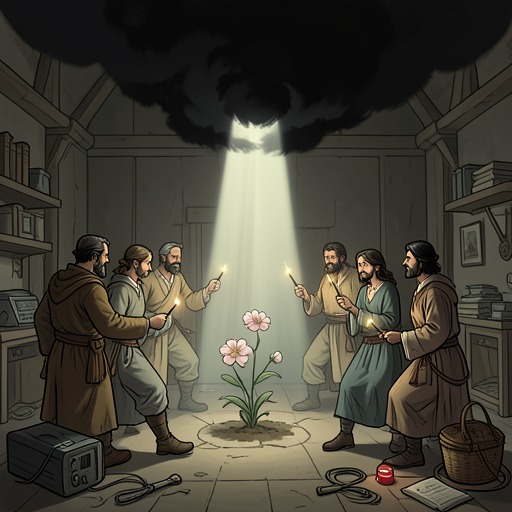
The book explains war through its broader account of thought and attention. When people focus on an unwanted condition in order to stamp it out, obliterate it, or fight against it, they give that condition continued imaginative and emotional force. The resulting paradox is that opposition can become a form of participation: the anti-war position remains organized around war, so the conflict continues to occupy the center of collective consciousness.
Hale Dwoskin describes resistance as adding “more energy and more power” to the unwanted pictures already present, making the event or circumstance grow larger. The book extends this logic from individual experience to public life. Once an event has appeared, many people’s thoughts and emotions can keep it in existence and enlarge it; if attention is withdrawn and redirected toward love, the text claims, the unwanted condition would eventually evaporate.
Public Movements and Reversal
Jack Canfield states that the anti-war movement creates more war, just as the anti-drug movement has created more drugs, because each movement concentrates attention on what it rejects. The claim is not that the movements desire the outcomes they oppose, but that their organizing language remains attached to the unwanted object. Their moral purpose is therefore separated from the effect that The Secret attributes to their focus.
The book offers Mother Teresa as the model for reversing that pattern. Rather than attending an anti-war rally, she is presented as preferring a peace rally, summarized in her statement, “I will never attend an anti-war rally. If you have a peace rally, invite me.” Her example turns political attention from negation toward affirmation: peace becomes the named, imagined, and emotionally supported condition instead of war remaining the movement’s central reference point.
Proposed Alternative
Hale Dwoskin reformulates the same principle through a series of positive substitutions. A person opposed to war should become pro-peace; opposition to hunger should become support for people having more than enough to eat; and opposition to a particular politician should become support for that politician’s opponent. In each case, the proposed change is linguistic, emotional, and strategic at once. The desired condition is meant to receive the energy that resistance had previously supplied to the unwanted one.
Lisa Nichols asks why people would give a problem all their energy instead of focusing on trust, love, abundance, education, or peace. This contrast places war inside a larger moral vocabulary. The alternative is not merely quietism or withdrawal from public concern; it is a deliberate redirection of concern toward the conditions the book says people actually want to create.
Relation to Healing and Thought
War is connected to The Secret’s treatment of health because both are governed by the same proposed law of attention. Dr. John Demartini says that healing through the mind can work harmoniously with medicine and that a person can think of perfect health privately even in difficult circumstances. He also describes bodily symptoms as feedback about an imbalanced perspective or a failure to be loving and grateful. Bob Proctor similarly advises a person with disease to see a perfectly healthy body rather than continually focus on the illness, while leaving the disease to the doctor.
These health claims establish the book’s general pattern: attention is treated as formative, and the preferred remedy is to concentrate on the desired state rather than the feared or rejected one. The same structure is applied to war. Peace is not simply the absence of military conflict; within the book’s vocabulary, it is a condition strengthened by sustained thought, love, and deliberate collective focus.
Thematic Significance
War therefore functions as the clearest public test of the book’s doctrine that like attracts like and that energy follows attention. The argument shifts responsibility away from opposing an external condition and toward managing one’s own mental participation in it. The book closes this line of reasoning with the assertion that a person has “no patient but yourself” and must convince himself of the truth he wants to see manifested.
The resulting vision is both empowering and troubling. It gives individuals a simple method for imagining peace and insists that constructive attention matters. At the same time, it treats war primarily as an effect of thought and focus, leaving little room in this passage for political institutions, material interests, historical causes, or the unequal power relations that shape armed conflict. War’s significance in The Secret lies precisely in that reduction: it becomes the largest example of a problem the book believes can be transformed by changing what people collectively choose to contemplate and affirm.