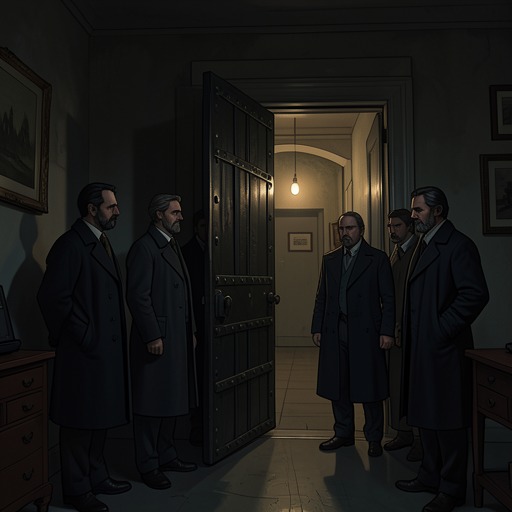
Attempted theft of the Eberhard formula at Wyvern Abbey
The Seven Dials MysteryThe attempted theft of Eberhard’s formula at Wyvern Abbey turns an apparent attack into an elaborate staged robbery: the papers vanish, only to be recovered, while the supposed assailant’s wounds and the scene itself conceal how the scheme worked.
Causes and Background
The formula was valuable because it embodied Eberhard’s steel-strengthening invention, a secret sought by a criminal operating in the same world as Gerald Wade. As Superintendent Battle later explained, two valuable secret inventions had already been stolen by someone with inside knowledge. Professional investigators had failed to catch the thief, so Wade proposed an amateur group to undertake secret-service work. Battle warned him that the work could be dangerous, but Wade and his friends went ahead. The investigation at Wyvern Abbey thus unfolded against the larger effort to discover a highly capable criminal and prevent another theft.
The danger was not abstract. At a secret meeting, Mr. Mosgorovsky warned that too much was becoming known about the organization and its location, and said that people who suspected them would have to be silenced. The meeting also discussed the newly discovered letter from Gerald Wade, which named the organization, and the coming inquest into Ronald Devereux’s death. These concerns show how the formula operation sat within a wider contest involving secrecy, murder, and efforts to control what investigators and witnesses might learn.
The Staged Robbery
The plan depended on making a genuine transfer look like the aftermath of a struggle. Jimmy Thesiger and Loraine Wade had arranged to meet at an exact time. Loraine drove to the Abbey, climbed through a fence, and reached the terrace just after two. Her later account of how she arrived was, as Superintendent Battle recognized, true; what it concealed was that the meeting had been planned. Battle’s men saw her enter but had been ordered not to stop anyone coming in, because he wanted to observe what happened and learn as much as possible.
At the appointed moment, a parcel fell at Loraine’s feet, and she picked it up. A man came down the ivy; she began to run. The apparent attack and ensuing commotion were meant to draw everyone toward the struggle while Loraine escaped with the formula. But she ran directly into Battle. That unexpected interception changed the operation from an attack into a defence: Loraine gave an account that was both sensible and substantially true, but her presence at precisely the right moment remained a clue to Battle.
There had been no second attacker. Battle eventually reconstructed the scene as a solo performance by Thesiger, who first went out through a window and climbed the ivy to Terence O’Rourke’s room. O’Rourke’s whisky and soda had been drugged the night before, allowing Thesiger to obtain the papers without waking him. Thesiger then threw the parcel down to Loraine, climbed back down, and began the staged fight. He overturned tables, staggered about, and alternated between his ordinary voice and a hoarse whisper to make the struggle sound as though another man were present.
The gunfire supplied the scene with its most persuasive false evidence. Thesiger fired his Colt automatic at an imaginary assailant, then, using his left gloved hand, took out a small Mauser pistol and shot himself through the fleshy part of his right arm. He threw the Mauser through the window, pulled off the glove with his teeth, and cast it into the fire. By the time Battle arrived, Thesiger was lying on the floor as though he had fainted. The real injury, the discarded pistol, and the destroyed glove were not incidental traces of an attack: each had been arranged to support the fiction of one.
The performance also exploited what witnesses could reasonably infer in the darkness. Babe St. Maur’s account agreed with Thesiger’s, but she recalled that after the lights went out and he moved toward the window, he became so still that she thought he had left the room. Battle later treated that stillness as a significant opening in the story: if Thesiger had gone outside, the route up the ivy to O’Rourke’s room supplied a way to reach the papers and return without a second man. The apparent assailant was therefore not merely an invented accomplice; the whole sequence of movement, noise, and gunfire had been arranged to make a single actor look like two.
Recovery and Forensic Reconstruction
The apparent loss of the papers was reversed when Sir Stanley Digby rushed back with the news that Terence O’Rourke was deeply asleep and that the documents had vanished. Battle, however, announced that the formula had not been lost and pointed instead to Loraine, who was still mechanically clutching a brown-paper parcel. He took it from her and showed it to George Lomax; Digby tore it open, and Eberhard clasped the recovered work to his heart. The parcel’s return exposed the central misdirection: the supposed escape with the formula had been staged, but its transfer had in fact succeeded before Battle stopped Loraine.
Battle’s reconstruction rested on physical traces that did not fit the story of an unknown attacker. He identified two bullets: the larger, a .455 fired from Thesiger’s Colt automatic, had grazed the window sash and lodged in a cedar tree; the smaller Mauser .25 bullet had passed through Thesiger’s arm and embedded itself in an armchair. The different weapons and trajectories matched the contrived account of shots exchanged with an assailant, yet Battle treated them as parts of one performance rather than proof of a second gunman.
The Mauser’s position outside also contradicted the claim that a fleeing attacker had dropped it. Battle had reconstructed Sir Oswald’s route from footprints leading up from the bottom of the garden, a place where he had stopped and stooped, and a dent in the grass. Crucially, there was only one set of footprints crossing the lawn at the spot where the pistol was found: Sir Oswald’s. Battle had asked him to throw the weapon through the window and observed that it landed farther away than it should have; a right-handed man, he reasoned, could not throw as far with his left hand. The test did not by itself settle the matter, and Battle described his suspicion at that stage as faint, but it helped turn the pistol from apparent evidence of flight into a clue about how the scene had been arranged.
The decisive question was not simply who had thrown down the papers, but who had been meant to collect them. For observers unaware of the arrangement, the Countess seemed the obvious intended recipient. Battle knew she was uninvolved, so the papers’ planned handoff pointed back to Loraine—and her arrival at the exact moment of the supposed attack ceased to look accidental. Her truthful account of reaching the terrace did not disclose the rendezvous behind it. Together, the recovered parcel, the bullet paths, the footprints, and the timed arrival revealed the attempted theft as a coordinated operation that failed only when Loraine ran into Battle.
Clues and Significance
The later reconstruction depended on evidence that had initially seemed to confirm the attack. Thesiger had bought the Colt automatic openly the day before, making its presence easy to explain away, while the small Mauser and the wound in his arm helped supply the appearance of an exchange of fire. The burnt glove, found in the fireplace with teeth marks on it, gave Battle a different kind of clue: it connected the discarded evidence to the staged scene and prompted him to reconsider what had happened. He did not understand the whole deception at once; the glove began a reconstruction that remained, at first, only a faint suspicion.
The attempted theft therefore turns on a gap between what the witnesses saw and what the physical traces could establish. The apparent struggle was convincing enough to mislead Battle at first, but the planted shots, the concealed handoff, and the traces left by the Mauser could be assembled into a single explanation. Once that explanation emerged, the formula’s recovery also exposed the operation as more than a failed robbery: it revealed how Thesiger used his apparent victimhood to hide his own role in the theft.