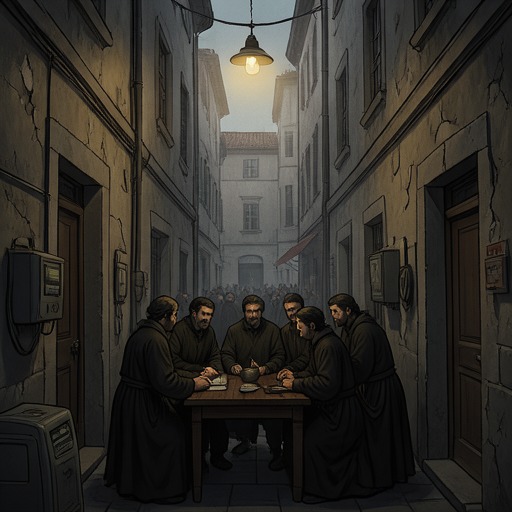
Bundle's infiltration of Seven Dials Club and witnessing of a secret meeting
The Seven Dials MysteryBundle Brent’s infiltration of the Seven Dials Club gives her first direct view of the secret meeting behind the name that has become a clue in the investigation. She enters hoping to question Alfred, the former footman from Chimneys, but a search of the premises leads her to a concealed room and then to hours of cramped concealment. From there she hears masked members discuss Wyvern Abbey, Eberhard’s invention, and the danger of their activities becoming known. The scene presents the organization as a real threat while leaving its full place in the larger investigation to be clarified later.
The Approach and Alfred
After ending a telephone call, Bundle dresses in nondescript clothes belonging to her maid and sets out on foot for the Seven Dials Club. She reaches 14 Hunstanton Street at about six in the evening, when she judges the premises to be quiet. Her immediate objective is not to attend a meeting but to get hold of Alfred. She believes that speaking to him will make the rest of her inquiry easy, and intends to keep her presence from as many people at the club as possible.
The opportunity arrives without an elaborate plan: the door opens and Alfred himself comes out. Bundle greets him, startling him, and begins questioning him about why he left Chimneys. She presses him directly on how much he was paid. Alfred admits that Mr. Mosgorovsky visited Chimneys with a party on a day when the house was being shown to visitors. Because Mr. Tredwell was indisposed, Alfred conducted the tour; afterward, Mosgorovsky stayed behind, gave him a substantial payment, and began a conversation. Alfred’s account gives Bundle a concrete connection between the club’s organizer and the household she is investigating.
Alfred also admits that the club has been raided twice, but says that nothing compromising was found because of the neatness of Mosgorovsky’s arrangements. Bundle makes clear that gambling is not the only matter she suspects. She tells Alfred that she has heard curious things at Scotland Yard and asks for his help, offering to put in a good word for him if trouble follows. Her manner is both reassuring and authoritative: rather than wait for Alfred to volunteer information, she asks to inspect the whole building from top to bottom.
The Hidden Room
Alfred accompanies Bundle on a thorough tour. Most of the premises yields nothing that catches her attention until she reaches the gaming room and notices an inconspicuous locked door in a corner. She determines that its ordinary lock may yield to a key from another door. Alfred fetches likely keys; the fourth fits. Beyond it, Bundle finds a small, dingy room with a long table in the centre, chairs around it, no other furniture, and two cupboards built into either side of the fireplace.
Alfred indicates one cupboard, but its lock is not an ordinary one: it is a patent lock that will open only with its own key. The distinction makes this door a more deliberate obstacle than the one Bundle has just opened. Her attention shifts from the visible club rooms to what the hidden chamber is for. She eventually remains concealed in the cupboard, though she has no certainty that anyone will come to use the room. The wait is physically punishing. She has guessed that a meeting, if one is planned, will happen while the club is busy, probably between midnight and two in the morning. As the hours pass, she worries that her interpretation of the room’s cleaning that morning may be wrong and that she will have endured the cramped hiding place for nothing.
The Masked Meeting
The chapter allows the four hours of waiting to pass quickly in narration, then makes the arrival of the meeting audible: Bundle hears a door being unlocked. One man checks his watch and moves briefly out of her line of sight. When he reappears, his face is covered not by a fitted disguise but by a round piece of material hanging like a curtain, with slits for the eyes and a clock face whose hands point to six. Bundle recognizes the sign of the Seven Dials. Seven muffled taps follow, and Mosgorovsky crosses toward the other cupboard door. A sharp click and greetings in a foreign language mark the beginning of the gathering.
Mosgorovsky presides over the meeting. The members first turn toward an empty chair for their absent comrade, No. 2, whom he says he wishes were present because difficulties have arisen. The ritual gives absence a formal place in the room: the group acknowledges the vacant chair together before moving to business. Mosgorovsky then says that too much is becoming known about the organization and its premises, that several people suspect them, and that those people must be silenced. Hidden nearby, Bundle understands that discovery could put her in danger.
The conversation turns to Chimneys and then to plans for Wyvern Abbey. No. 3 has brought plans, and Mosgorovsky reads out a list of names, including Sir Stanley Digby, Terence O’Rourke, Sir Oswald Coote and Lady Coote, Rupert Bateman, Countess Anna Radzky, and Jimmy Thesiger. When Mosgorovsky asks who Jimmy Thesiger is, the exchange shows that the names are being assessed rather than simply recited. The meeting also considers whether Eberhard’s invention is valuable: one member answers that there is no doubt, while No. 5, speaking as an aviator, says the device is feasible and that Eberhard’s genius has brought a long-discussed possibility to fruition.
Intelligence, Exposure, and Aftermath
Mosgorovsky says that the original scheme cannot be improved and raises a letter by Gerald Wade that mentions the organization. He learns that Lady Eileen Brent found it and that it was written to Gerald’s sister. He calls the discovery unfortunate, then turns to the impending inquest on Ronald Devereux. The American member reports that stories about local boys practising with rifles have been spread; Mosgorovsky accepts this as sufficient preparation for the inquest. The discussion links the meeting’s plans not only to the invention but also to the management of suspicion and the shaping of what others may believe.
Before the group disperses, Mosgorovsky wishes their one o’clock luck in the part she is to play. She acknowledges the toast with a foreign gesture, rises, and the others follow. Bundle catches a glimpse of No. 3 as he puts Anna’s cloak around her: he is tall and heavily built. The party leaves through the secret door, which Mosgorovsky secures. After extinguishing the electric light, he passes through the other door as well. Alfred does not release Bundle until two hours later. She is so stiff that she nearly falls into his arms, and he has to hold her up.
The event’s revelations are deliberately partial. Bundle hears enough to connect the club with the plans for Wyvern Abbey, Eberhard’s invention, the Gerald Wade letter, and the arrangements surrounding Ronald Devereux’s inquest; she also learns that the members fear exposure and are willing to threaten those who may uncover them. Later, Superintendent Battle supplies a wider account of the amateur secret-service effort: Gerald Wade first approached him about forming a band of amateur workers, despite Battle’s warning that such work could be dangerous. Battle explains that they wanted to catch a particularly dangerous thief operating in the world of secret inventions, after professional investigators had failed. That later explanation reframes the investigative story around the amateurs’ purpose, without erasing the menace Bundle heard in the hidden room.