Countess Anna Radzky
The Seven Dials MysteryCountess Anna Radzky is presented through two contrasting scenes: as a striking, partly concealed participant in a secret meeting and as a conspicuous society guest introduced by George Lomax. The novel gives her few explicit biographical details, but her designation as One o'clock, her questions about No. 7, and the group's formal toast mark her as a figure with an assigned place in the meeting's plans. Bundle's observations make her appearance vivid while leaving the full extent of her role uncertain.
Identity and Introduction
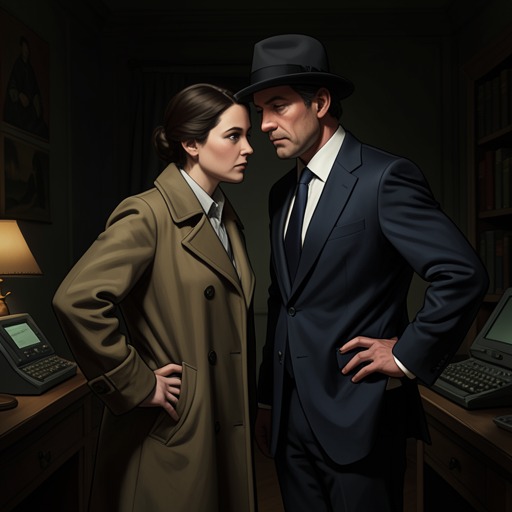
At a social gathering, George Lomax introduces Countess Radzky after introducing Rupert Bateman. She has been talking with Bateman and is seated on a sofa. The name used in this introduction connects her to the woman called Anna and One o'clock at the secret meeting: the text's shift between title, personal name, and clock designation gives the character several identities without supplying a fuller account of her background.
Bundle's attention fixes on the Countess's appearance. She is leaning far back on the sofa, her legs crossed in what Bundle considers a daring manner, and smoking through an exceptionally long holder studded with turquoise. Bundle regards her as one of the most beautiful women she has ever seen. The portrait is specific: very large blue eyes, coal-black hair, matte skin, a slightly flattened nose described as Slav, and a slender, sinuous body. Her reddened lips seem particularly out of place to Bundle at Wyvern Abbey. This description establishes the impression she makes on an observer, not an independent account of her character or intentions.
The Secret Meeting
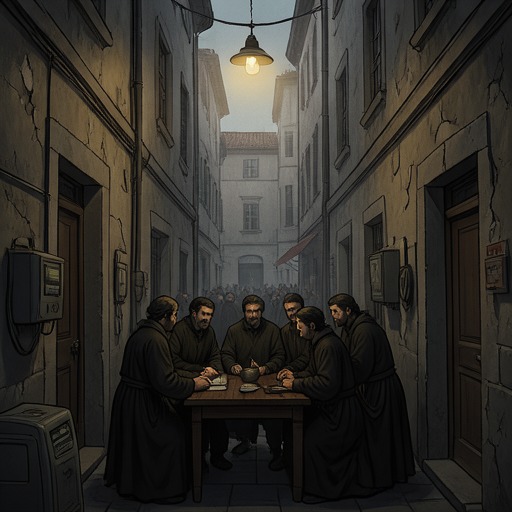
Bundle first sees Anna from inside a cupboard, where her view of the meeting is restricted by the room's furniture and the concealment of her own position. Anna takes a chair opposite Mr. Mosgorovsky, with her back initially toward Bundle. The narration therefore introduces her through partial visibility before she speaks: Bundle can notice her striking, low-cut appearance, but the meeting's hidden arrangement keeps the woman and the gathering at a distance.
Anna is the first to speak in the exchange about the empty chair at the head of the table. She asks whether they are not to see No. 7 that night and whether they will ever see him. Her questions make his absence an immediate subject of concern within the group, while the vacant chair gives that absence a visible place in the scene. The American responds that he is beginning to believe no such person exists; Mr. Mosgorovsky cautions him against that conclusion. Anna thus helps establish the meeting's central uncertainty without resolving it.
One o'clock and the Part Assigned to Her
Later, the meeting turns to the inquest on Ronald Devereux, scheduled for the following day. The American reports that stories about local lads practising with rifles have been spread. Mr. Mosgorovsky then says that nothing further needs to be discussed and proposes that they congratulate their “dear one o'clock” and wish her luck in the part she has to play. The group cries, “To Anna!” These details link Anna's clock designation to a specific task and to the discussion surrounding the inquest, though the available account does not explain the task itself.
The toast becomes a small ceremony. Everyone extends a hand in the same gesture Bundle has noticed earlier; Anna acknowledges the salute with what the narration calls a typically foreign gesture. She then stands, and the others follow. A tall, heavily built man puts her cloak around her before the party files out through the secret door. Mr. Mosgorovsky secures the door after them. Anna's departure is therefore presented not as an isolated exit but as part of the group's coordinated conclusion to a concealed meeting.
Public Appearance and Narrative Significance
The later introduction of Countess Radzky places the same striking figure in a social setting, beside Rupert Bateman and within George Lomax's introductions. In the meeting, Bundle has seen her from concealment and heard her speak about No. 7; at the gathering, Bundle receives a fuller visual portrait and a formal name. The difference is consequential for how the reader encounters her: secrecy first makes her a voice and a glimpse, while public presentation makes her appearance legible without explaining her private purpose.
Anna's characterization depends on this gap between visibility and knowledge. Her beauty and carefully noticed clothing occupy Bundle's gaze, but the more consequential facts are structural: she is called One o'clock, singled out for luck in a role, and toasted by the assembled group as Anna. The narration confirms that she belongs to the meeting's circle and has some part to play in the events under discussion; it does not disclose enough here to define that part. Her presence consequently binds the group's cryptic clock-based language to a person whose public title and conspicuous appearance offer no simple explanation of her allegiance.