Eberhard’s steel-strengthening invention
The Seven Dials MysteryEberhard’s steel-strengthening invention is a patent process that makes steel so toughened that a wire can equal the strength of a steel bar. Its promise is not merely a technical improvement: by reducing the weight of aircraft, it could transform the economics of flying, and its formula becomes the object of an international contest involving industrial expertise, state interest, and murder. The invention gives the concealed struggle around Wyvern Abbey a concrete prize, while its uncertain history makes it difficult to distinguish scientific breakthrough from speculation until the plot reveals what is at stake.
The Process and Its Aeronautical Promise
As Jimmy Thesiger recalls it, Eberhard developed a process applied to steel, although Jimmy cannot explain its scientific details. The result, as he understands it, is a striking change in the relation between strength and weight: a wire treated by the process would be as strong as an untreated steel bar had been. The evidence establishes the effect, not the chemistry; the invention’s importance rests on what the process can do rather than on any disclosed technical formula.
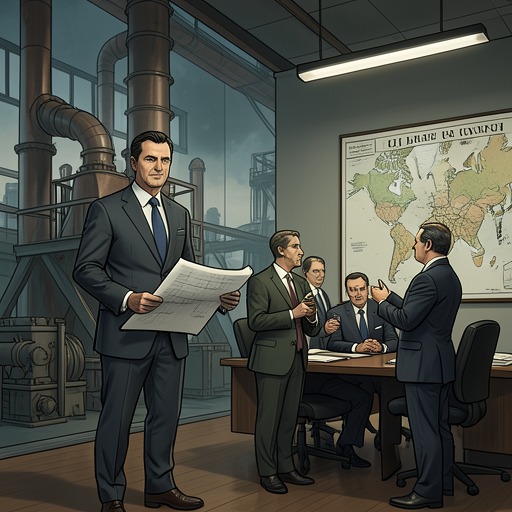
Eberhard’s intended application is aviation. Lighter aircraft, Bundle Brent reasons, would make flying far less costly and could revolutionize it. At the secret meeting, a member identified as No. 5, who says he is an aviator, supports the invention’s feasibility and says the problem had been discussed for years before Eberhard brought it to fruition. The distinction between a long-recognized engineering ambition and Eberhard’s successful solution helps explain why the invention attracts attention beyond its immediate commercial value.
A Contested History and a High Price
Before the events at Wyvern Abbey, Eberhard had offered his invention to the German Government. It rejected the proposal on the grounds that the process had a flaw, and Jimmy recalls that the rejection was delivered in a way that offended Eberhard. Eberhard then worked around the difficulty and vowed that the invention would not belong to the government that had dismissed it. Jimmy had regarded the story as probably baseless; the disclosures about the formula give it a new significance without supplying the technical details needed to judge the earlier objection.
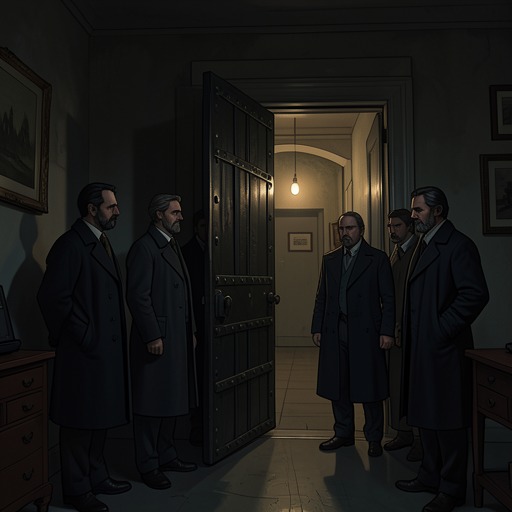
At the meeting of the Seven Dials Society, the invention is treated as both sound and exceptionally valuable. Mr. Mosgorovsky asserts that Sir Oswald Coote, an expert, would not have made a mistake about it. The Russian estimates its commercial worth at millions and also stresses the consequences of competition between nations. A member cynically accepts that the formula could be worth a few lives. The exchange makes explicit the human cost implicit in the invention’s international value: it is not simply a promising device, but a strategic asset whose possession could provoke violence.
The Formula as the Object of the Plot
Bundle connects the meeting’s discussion to an unofficial conference planned at Wyvern Abbey, where Eberhard is expected to bring the formula. The gathering is to include Sir Oswald Coote, George Lomax, the British Air Minister, and Eberhard. Bundle concludes that the Seven Dials Society intends to steal the formula; the meeting’s members have seen the plans, and Mr. Mosgorovsky says their original scheme cannot be improved. What is being targeted is therefore not an abstract scientific reputation but the specific information that would allow the process to be used.
The plan also sits within a wider pattern of theft. Superintendent Battle later explains that two valuable secret inventions had already been stolen by someone with inside knowledge, while professional investigators had failed to identify the culprit. The amateurs’ secret-service effort grew out of the search for this dangerous criminal. Eberhard’s formula extends that investigation from past losses to a fresh, concrete target: its anticipated presence at Wyvern Abbey makes the conference a point where technical knowledge, access, and covert action converge.
Documents, Deception, and Consequence
The invention’s formula acquires plot significance through its papers. In explaining the events at Wyvern Abbey, Superintendent Battle reconstructs how Jimmy Thesiger went outside, climbed the ivy to Mr. O’Rourke’s room, obtained papers, and passed them down to a woman. Battle sets this account against the staged gunfight: Jimmy fired his Colt automatic at an imaginary attacker, then shot himself through the fleshy part of his right arm with a Mauser .25 pistol. He threw the small pistol through the window and destroyed his glove in the fire. The reconstruction shows how a theft of papers could be hidden inside an apparently violent encounter, even as the evidence does not disclose the formula’s technical contents or establish its final disposition.
The physical evidence reinforces Battle’s broader method of separating a convincing story from the actions that could actually have produced the traces. He identifies two bullets: a .455 fired from Jimmy’s Colt, which grazed the window sash and lodged in a cedar tree, and a Mauser .25 bullet that passed through Jimmy’s arm before embedding itself in an armchair. Sir Oswald’s footprints, a place where he had stopped and stooped, and a dent in the grass help Battle challenge the suggestion that the small pistol had simply been dropped by a fleeing man. These details concern the staged scene rather than the invention’s workings, but they clarify the dangerous circumstances surrounding the papers and the effort to conceal their movement.
Narrative Significance
The invention remains technically described only in outline, yet that very gap gives the formula its force as an object of pursuit. Characters can assess its weight-saving promise, argue over its feasibility, and estimate its commercial and international value without the reader being given the process itself. The difference between the invention and its formula is crucial: Eberhard’s achievement is the underlying method, while the formula is the portable, stealable means by which others might gain access to it.
The object also binds together seemingly separate strands of the mystery. Eberhard’s earlier rejection and resentment explain the history attached to the invention; the planned conference provides an opportunity to acquire it; and the papers sought during Jimmy’s staged shooting connect the criminal plot to the secret-service investigation. Its importance is measured not by a complete account of how it works, but by the actions and risks that gather around the possibility of possessing it.