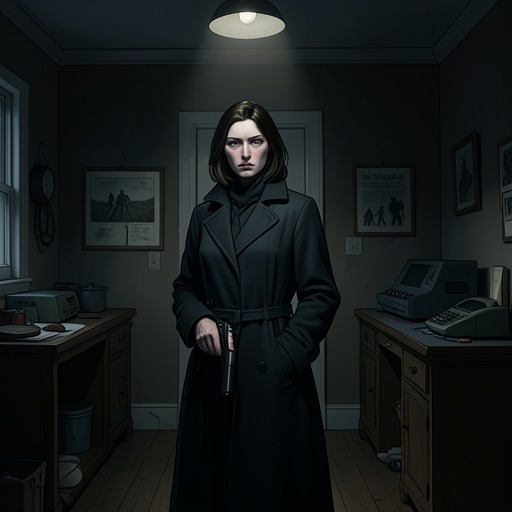
Gerald Wade and Loraine Wade’s protective family bond
The Seven Dials MysteryGerald Wade and Loraine Wade’s protective family bond joins an intimate sibling attachment to a conflict over protection and agency. Gerald tries to spare his half-sister the danger surrounding the Seven Dials business, while Loraine’s grief makes withdrawal impossible: she insists on facing the affair because the brother she loved has been killed.
Family Life and Affection
Loraine Wade is Gerald Wade’s half-sister and lives at Deane Priory, about twenty miles from where the news of his death is being discussed. When Gerald was not in town, he lived with her. That detail gives their relationship a practical, domestic closeness: Deane Priory is not merely the address to which his relatives can be notified, but the home they shared during his absences from town. Ronny Devereux recognizes the obligation to tell her and volunteers to go, calling it an unpleasant task that someone must undertake. His concern establishes the immediate human consequence of Gerald’s death: the news must reach the person closest to him.
Jimmy Thesiger’s recollection adds a view of their attachment from outside the family. Asked about Gerald’s sister, Jimmy pauses before describing her warmly, then says Gerald had been devoted to her and often spoke of her. He also says that she was devoted to Gerald and that the loss would strike her hard. The exchange makes the bond reciprocal rather than merely protective: Gerald’s affection is not a private sentiment inferred only from his later letter, and Loraine’s grief is anticipated by someone who knows how much she cared for him. The group reaches Deane Priory in silence, a quiet transition that gives the approaching encounter with his sister weight without turning it into a public display.
The Unfinished Letter
The clearest evidence of Gerald’s tenderness survives in an unfinished letter addressed to Loraine. Bundle Brent identifies it as a letter he must have been writing on the evening of the tragedy, after establishing that the 22nd was the day Gerald was found dead. Its opening addresses Loraine as his darling; he says he will be down on Wednesday, feels unusually fit and pleased with himself, and looks forward to seeing her. The ordinary warmth of these plans makes the abrupt interruption more affecting: he is writing toward a familiar reunion, not composing a farewell.
The letter then turns from affection to warning. Gerald asks Loraine to forget what he had said about Seven Dials. He had thought the matter would be something like a joke, he now says, but it is nothing of the kind; he regrets ever raising it and believes that young people like her should not be mixed up in it. His concern is specific: he wants to withdraw her from an affair whose seriousness he has come to understand. The wording presents protection as an effort to revise an earlier disclosure. Gerald cannot undo having mentioned the business, but he can ask her not to pursue it.
The letter breaks off before Gerald finishes what he was trying to tell her. He says he is so sleepy that he cannot keep his eyes open, then begins another thought concerning Lurcher and leaves it incomplete. The surviving page therefore preserves both what he explicitly wanted Loraine to know and the limit of what she, and the reader, can recover from him. Its interrupted domestic tone stands beside the warning: the same brother who longs to see her is trying to keep her clear of danger, but the document cannot tell her everything he meant to say.
Grief and Resistance
After Gerald’s death, the protective arrangement he sought to maintain becomes impossible. Jimmy urges Bundle Brent and Loraine to keep out of the investigation, distinguishing his position as Ronny Devereux’s friend from their involvement and telling them that Bundle has already delivered Ronny’s message. Bundle has made up her own mind but does not press Loraine, unwilling to draw her into a dangerous undertaking. Loraine, however, immediately rejects the prospect of standing aside. Her indignation is directed at the suggestion that she could remain uninvolved after Gerald has been killed.
Loraine describes him as the dearest and kindest brother a girl could have and says he was the only person belonging to her in the whole world. The declaration explains why Gerald’s warning cannot simply govern her choices after his death. What he meant as care—to keep her away from the Seven Dials business—meets a grief that turns attachment into a demand for action. Her response is not evidence that she has ceased to value his protection; rather, it shows that his death has changed what protection can mean to her. Remaining outside the danger would also mean refusing the claim she feels her brother’s murder makes upon her.
Significance of the Bond
The relationship is shaped by a sharp contrast between Gerald’s incomplete attempt to shield Loraine and Loraine’s insistence on confronting the danger that took him. His letter moves from anticipation of seeing her to a request that she forget the Seven Dials matter; her later words move from love of her brother to refusal to keep out of the inquiry. Both turns arise from the same attachment, but they lead in opposite directions. Gerald tries to reduce her exposure, while Loraine treats action as inseparable from loyalty to him.
The unfinished state of the letter gives that contrast a particular force. Gerald’s concern reaches Loraine only through a page he did not complete, while his death leaves her to act without the further explanation he may have intended to give. The bond is consequently shown through several distinct traces: the home they shared when he was away from town, the affection Jimmy remembers, Gerald’s hopeful plans to visit, his warning about Seven Dials, and Loraine’s refusal to let his murder be someone else’s concern. Together, these details make their closeness both the motive for Gerald’s caution and the reason Loraine cannot accept it as a final instruction.