Loraine Wade
The Seven Dials MysteryLoraine Wade first appears in mourning for Gerald Wade, whom she calls her brother and remembers as the dearest person in her life. Her conviction that his death was murder is genuine, but it does not make her an ally of the investigation: she is secretly devoted to Jimmy Thesiger and passes him information. By the final reconstruction, she is implicated not only in the conspiracy surrounding the Eberhard formula but also in the assault and deception used against Bundle Brent.
Identity and First Impressions
When Jimmy Thesiger and Ronald Devereux arrive at Deane Priory, Loraine is in the garden. As Jimmy tells her that they have bad news, fear flashes across her face; she immediately asks whether it concerns Gerald. The reaction establishes the strength of her attachment before the circumstances of the death are known. Later, Bundle Brent identifies her at a London gathering by her deep mourning, recognizing the young woman she has never met from that visible sign of grief.
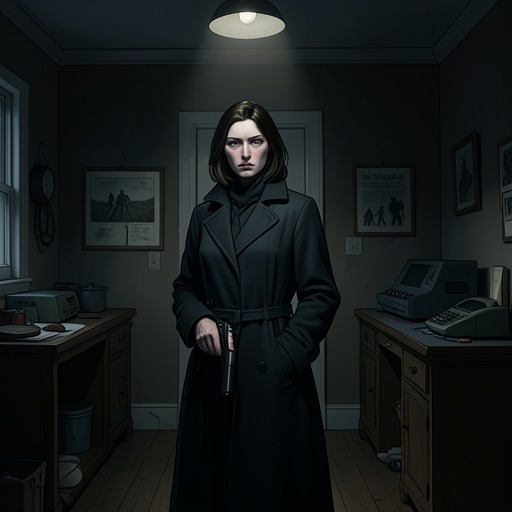
Loraine’s outward presentation repeatedly encourages others to read her as gentle and vulnerable. She has a small face, and Bundle thinks of her as a quiet, gentle person. That impression is not wholly false: her sorrow for Gerald is sincere. But it is incomplete. The contrast between the softness others see and the choices she makes is crucial to her role, because her apparent meekness helps her avoid suspicion even as she makes up her mind to take part in dangerous events.
Grief for Gerald and the Hidden Family History
For weeks, Loraine has believed Gerald did not die a natural death. She argues that he slept too well to need medicine, and that he himself thought it strange to take something to induce sleep. This directly challenges the initial explanation offered after his death: an apparent overdose of Chloral found by his bedside, with a bottle and glass. Her suspicion is therefore grounded in what she knows of Gerald’s habits, not merely in grief. When she learns that Bundle has also come to suspect murder, she confirms the belief she has been carrying privately.
Her grief is expressed with an intensity that makes her attachment seem absolute. When Jimmy urges Bundle and Loraine to stay away from the investigation, Loraine indignantly refuses. Gerald, she says, was the best and kindest person she knew and the only person she had in the world. She will not accept safety as a reason to leave his killing unanswered. This declaration is emotionally sincere, but the later account complicates its meaning: Gerald was not actually her brother. He was devoted to her and, according to Battle, hoped to marry her; he had told her more about his work than he should have done.
That revelation changes the apparent family bond without erasing its emotional force. Gerald’s protective confidence in Loraine gave her access to information about his investigation, while his love for her left him exposed to the person closest to him. The relationship that seemed to explain her grief also becomes part of the mechanism through which Jimmy obtained information.
Loyalty to Jimmy and Betrayal
Loraine’s decisive allegiance is to Jimmy Thesiger. Battle explains that she was devoted to him and would do anything he asked. She passed on information Gerald had shared with her, enabling Jimmy to learn what Gerald knew. The account makes her betrayal more than a single disclosure: her intimacy with Gerald supplied access, and her loyalty to Jimmy determined how that access was used.
Ronald Devereux was also attracted to Loraine and may have warned her about Jimmy. Battle’s reconstruction connects Devereux’s later murder to his effort to send word that Jimmy was the killer. The evidence does not establish that Loraine arranged Devereux’s death, but it places her in the chain of personal attachments and warnings surrounding the men Jimmy silences. Gerald’s confidence and Devereux’s interest in her both intersect with the secret Jimmy is trying to protect.
Loraine’s decision to enter the investigation is itself concealed. She later admits that, from the first day Bundle and Jimmy advised her to remain at home and out of danger, she had already resolved not to be kept out. She says nothing at the time, allowing them to mistake her silence for agreement. Bundle recognizes in retrospect that Loraine had seemed surprisingly meek. What looks like acquiescence is a deliberate performance: she quietly chooses her own course while letting her companions believe they have persuaded her to withdraw.
The Abbey Plot and the Attack on Bundle
Battle’s reconstruction identifies Loraine as Jimmy’s partner in the operation at the Abbey. She drives there, climbs through a fence, and reaches the terrace just after the clock strikes two. A parcel falls at her feet and she picks it up; a man comes down the ivy, and she runs as the struggle and gunshots draw attention. The confusion is meant to give her the opportunity to leave with the formula. The plan fails when she runs directly into Battle, whose men have been ordered to prevent people leaving, not entering. Loraine then gives an account that is true in its details and plausible on its face, while concealing the part she has played in the scheme.
Her complicity continues in the later deception involving Bill Eversleigh and Bundle. Bill recalls hearing Loraine tell Jimmy that everything had gone splendidly, then hearing them discuss moving him upstairs as a surprise for No. 7. She asks Jimmy whether Bundle will wake; he assures her that he struck with all his might. Loraine helps Jimmy carry Bill upstairs and locks the door with him after they leave. These actions show her participating in the staged scene and in the confinement of the people she had appeared to be investigating alongside. The contrast with her earlier protest against being excluded is stark: she has not simply joined the search for Gerald’s killer but is helping that killer control what others see and do.
Exposure and Narrative Significance
Loraine’s part in the conspiracy is revealed through the gap between her genuine emotions and her concealed loyalties. She can mourn Gerald, remember his kindness, and believe that he was murdered, while still having helped Jimmy exploit the information Gerald entrusted to her. Her tenderness does not function as proof of innocence; nor does her deception make the grief itself false. The character’s force lies in that disturbing coexistence.
The mystery also revises the meaning of familiar appearances. Loraine’s mourning first identifies her as a bereaved woman; her quietness is taken for compliance; her account at the Abbey is accurate enough to sound exculpatory. Each appearance contains truth, but none tells the whole story. By the final confrontation, Bundle can no longer reconcile the gentle person she thought she knew with the woman who helped Jimmy. Her question to Battle about whether he has caught Loraine too underscores the personal shock of the exposure, while the account of Loraine’s actions establishes why she is implicated.