Seven-o’clock masks
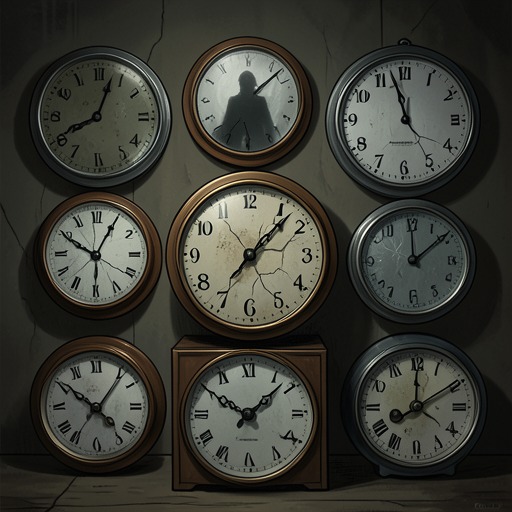
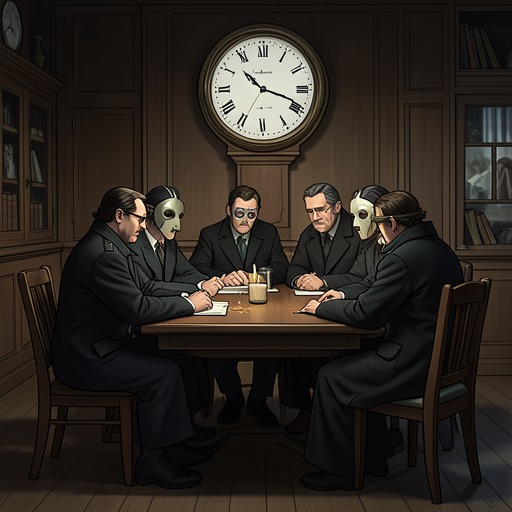
The Seven Dials MysteryThe Seven-o’clock masks are the distinctive disguises Bundle sees at a concealed meeting associated with the Seven Dials Society. Made not as fitted face coverings but as round pieces of material hanging before the wearers’ features, they show clock faces with different hand positions. Their effect is double: they conceal individual faces while turning the meeting into a deliberately dramatic display of clocks, numbers, and secrecy. The scene initially makes the masks look like the insignia of a dangerous criminal organization; the later explanation of the Society’s real work gives their theatrical appearance a different meaning.
Appearance and First Recognition
The first mask Bundle sees belongs to Mr. Mosgorovsky. After checking his watch, he takes something from his pocket and moves out of her line of sight. When he reappears, his features are hidden behind a round piece of material that hangs like a curtain, with two slits for his eyes. The clock face printed on it has hands pointing to six o’clock. Its awkward, conspicuous design is unlike a conventional close-fitting mask: it hides the wearer without making the disguise naturalistic.
Bundle immediately connects the image to the Seven Dials. At that moment, seven muffled taps sound, joining the visual clock face to an audible signal. Mr. Mosgorovsky then crosses to another cupboard door; after a sharp click, greetings in a foreign tongue announce the arrival of others. The sequence makes the clock imagery feel like part of a coordinated entrance, although the scene does not explain the precise function of the taps or the relation between the different clock positions.
The Masked Gathering
The newcomers also wear clock masks, but their hands point to four and five o’clock rather than six. The variation is visible, but its code is not decoded in the scene. Bundle can distinguish the men only by the contrasting glimpses the masks leave available and by their clothing and manner: one is a slender, elegantly dressed young man who moves with a grace Bundle considers foreign rather than English; the other is wiry and lean, with clothes that fit adequately but no more. The disguise conceals their faces while leaving other clues for an observer to interpret.
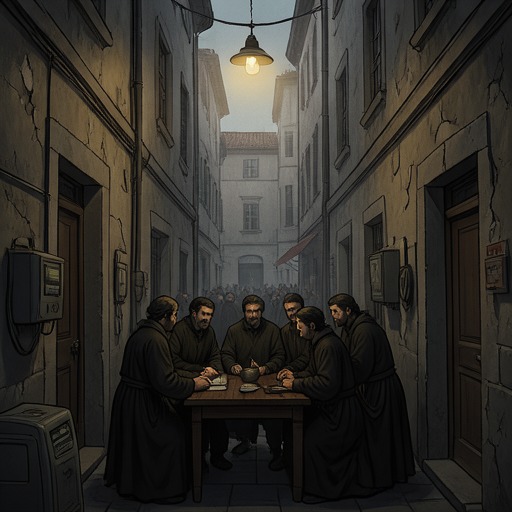
The meeting’s language makes the concealment more than pageantry. One speaker warns that too much is becoming known about the group and its location, says that several people are suspicious, and concludes that they must be silenced. Bundle, hidden nearby, understands that discovery could place her in danger. The masks therefore belong to a scene in which secrecy has real stakes: behind the stylized clock faces, the participants discuss exposure, a possible threat to witnesses, and what has or has not been discovered about Chimneys.
Later in the meeting, Mr. Mosgorovsky brings up the letter Gerald Wade wrote to his sister, which Lady Eileen Brent found. He also discusses the forthcoming inquest into Ronald Devereux’s death and the effort to make rifle practice by local boys account for it. These details tie the masked gathering to the murders and to the concealment of the group’s activities. They also show why the masks matter at the moment of discovery: they mark a meeting whose participants are coordinating information and managing the risk that their real purposes will be exposed.
What the Masks Conceal—and What They Do Not
The disguises withhold faces, but not every sign of identity. Bundle observes the cut of the newcomers’ clothes, their build, and the way one of them moves. The masked men are also assigned different clock positions, so concealment is paired with visible distinctions rather than uniform anonymity. The book does not establish that the positions identify rank, names, or duties; their significance in this scene is that they vary while preserving the shared clock-face design.
That distinction matters to the mystery’s method. The masks encourage Bundle—and the reader—to treat the gathering as the work of a sinister, tightly organized criminal society. The clock motif appears to offer a key, but initially supplies only partial recognition: Bundle identifies the Seven Dials connection without yet knowing who the members are or what they seek. The disguise thus both signals a group and delays understanding of it. What looks like a complete emblem is only one piece of evidence among the sounds, movements, conversation, and concealed identities surrounding the meeting.
Retrospective Meaning
Superintendent Battle’s later account overturns the assumption that the masks prove the existence of a criminal organization headed by an unseen mastermind. He explains that the group began when Gerald Wade proposed that young people form an amateur band to do secret-service work. Battle warned that the work could be dangerous, but Wade and his friends accepted that risk. The group sought a highly dangerous criminal operating in the world of secret inventions, after professional investigators had failed to identify him.
Battle describes the agents as amateurs willing to face danger for excitement and from an honest desire to serve their country. He acknowledges that they chose melodramatic trappings, while emphasizing that their work had been valuable to his department. In this light, the masks are not proof of criminal purpose: they are part of a theatrical style adopted by people conducting real clandestine work. The contrast is central to their significance. Their concealment is genuine, and the danger Bundle senses is not imaginary, but the melodrama of the clock faces disguises the opposite of what she first suspects: not a secret criminal society, but an informal intelligence effort operating alongside professional policing.