Sir Oswald Coote
The Seven Dials MysterySir Oswald Coote is a powerful industrialist and the custodian of the closely guarded formula for Eberhard’s invention. His insistence on discipline, his confidence in practical judgment, and his conspicuous authority make him a natural object of suspicion when the invention becomes a target. Yet the investigation does not establish him as a member of the Seven Dials Society: Bundle Brent suspects him, while Superintendent Battle says his own suspicions fell instead on Sir Oswald’s secretary.
Identity and habits
Sir Oswald’s success is associated with a creed of early rising, frugal living, and methodical habits. That creed shapes more than his public image. For the first ten years of their married life, he insisted that breakfast be served by eight o’clock, and a delay of even half a minute brought an angry response. Lady Coote consequently learned to regard unpunctuality as a grave fault; even after his demands had eased, the habit of anxiety remained. His domestic discipline is therefore visible indirectly, in his wife’s unease when younger people are late and her concern that they do not rise early enough to be useful.
The narrative also presents him as a man accustomed to deference. At dinner, he proposes bridge in a manner that is less a casual suggestion than an expression of preference, and the people around him promptly accommodate themselves to it. He plays exceptionally well and expects a partner of comparable ability. His secretary, Rupert Bateman, proves an efficient partner, while Lady Coote and Gerald Wade play together against them. Sir Oswald’s authority thus appears not only in his business position but in the social arrangements that form around his wishes.
Business and Eberhard’s invention
Bundle asks her father, Lord Caterham, what Sir Oswald is and how he made his money, describing him by way of comparison as a steamroller. The question registers the force of his presence, but the available account does not identify the source of his fortune. Elsewhere, he is identified with the public category of industrial leaders: he has been designated No. 7 in the first series of Our Captains of Industry. That label reinforces his stature without making him the secret society’s No. 7, an identity Bundle later wonders about.
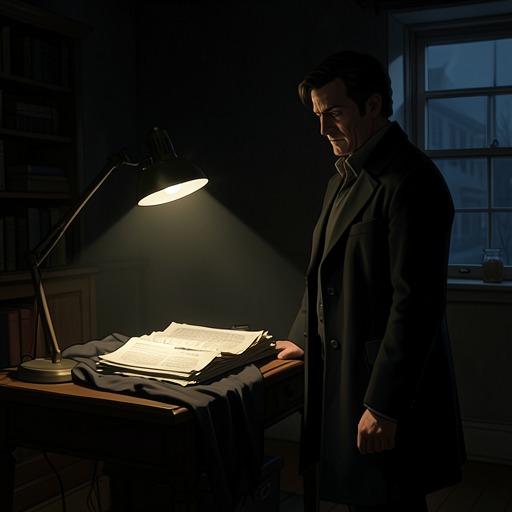
His practical judgment becomes important when the discussion turns to Eberhard’s invention. Mosgorovsky argues that a man like Sir Oswald would not have made a mistake; an aviator among the conspirators likewise says the invention is feasible and credits Eberhard’s genius with bringing it to fruition. The formula has been tested secretly at Sir Oswald’s works, where Eberhard has been present, and it is kept with Sir Oswald. By the time Bill Eversleigh explains this to Jimmy Thesiger, Sir Oswald and the others are in the study discussing the matter in earnest. The details make Sir Oswald more than a wealthy observer: his works and custody of the formula place him at the center of the invention’s protection.
Authority under scrutiny
The threat to the formula makes Sir Oswald’s property and movements part of the inquiry. When footsteps approach along the terrace during an attempted robbery, he appears at the window and takes in the scene: Jimmy’s roughly bandaged arm, Bundle’s unusual attire, Loraine Wade, whom he does not know, and Superintendent Battle. He then asks crisply what has happened. Battle identifies it as an attempted robbery. Sir Oswald’s arrival is direct and observant, not bewildered; his attention moves across the people and the physical circumstances before he speaks.
His practical knowledge also enters the examination of a pistol found outside. Battle notes that the person who handled it wore gloves, and Sir Oswald agrees that this would be expected of someone who knew what he was doing. Battle then asks whether Sir Oswald found the weapon about twenty yards from the bottom of the steps leading to the terrace; Sir Oswald confirms that it was almost exactly there. The exchange establishes a concrete point in the reconstruction of the attempted robbery, while showing Sir Oswald cooperating with the questioning. It does not, by itself, identify the person who handled the pistol.
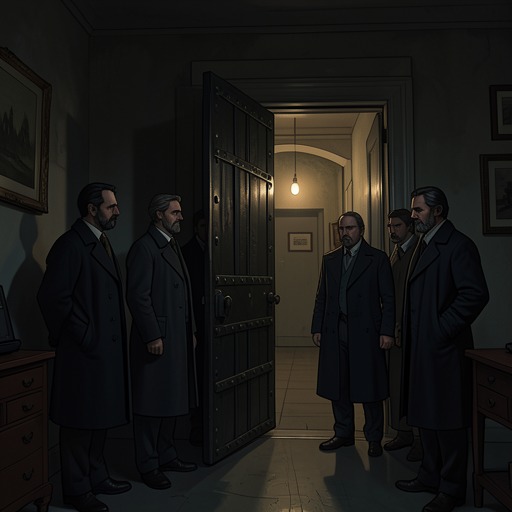
Sir Oswald also recognizes how a long-prepared infiltration could exploit the difference between his household and nearby Chimneys. When told the missing man had been at Chimneys for just under a month, he recalls him as a tall, well-drilled man who had arrived about a fortnight before the party left. New servants at his own residence would have attracted close scrutiny, he observes, whereas someone placed at Chimneys, five miles away, could avoid that attention. His unfinished conclusion conveys the force of the tactic: the distance between the two houses was a vulnerability someone had used deliberately.
Suspicion and character contrast
Bundle suspects Sir Oswald, especially after seeing him come in from the garden on the night in question. Battle says he never suspected him, although he did suspect the young secretary. These differing judgments preserve Sir Oswald as a plausible focus of suspicion without turning suspicion into proof. His standing, command of the household, and connection to the formula make him conspicuous; Battle’s account instead directs attention toward the secretary, while Bundle’s suspicion records how easily authority itself can look incriminating.
A later conversation with Lord Caterham supplies a smaller but pointed measure of Sir Oswald’s temperament. On the golf course, he plays a fair game, though his style is stiff and he does not indulge an opponent by conceding a six-inch putt. He makes the other player putt it. Lord Caterham objects to this as contrary to the spirit of the game, while Bundle suggests that Sir Oswald likes to be sure. The contrast is revealing without resolving into a simple verdict: Sir Oswald is straight in play, but exacting about the terms, and uninterested in stylistic theory. Bateman, by comparison, is interested in theory and offers Lord Caterham a technical account of the role of the left arm in golf. Sir Oswald’s practical, results-oriented manner therefore distinguishes him both in business and in leisure.
Narrative significance
Sir Oswald helps connect the mystery’s social world to its material stakes. His habits explain the discipline expected within his household; his works and possession of the formula explain why the conspirators’ plans matter to him; and his recognition of the Chimneys infiltration clarifies how the threat could have been organized in advance. At the same time, the contrast between Bundle’s suspicion and Battle’s different assessment keeps his apparent importance from functioning as proof of guilt. He embodies the authority and practical certainty that make him a convincing suspect, while the investigation’s attention to the secretary unsettles that first impression.