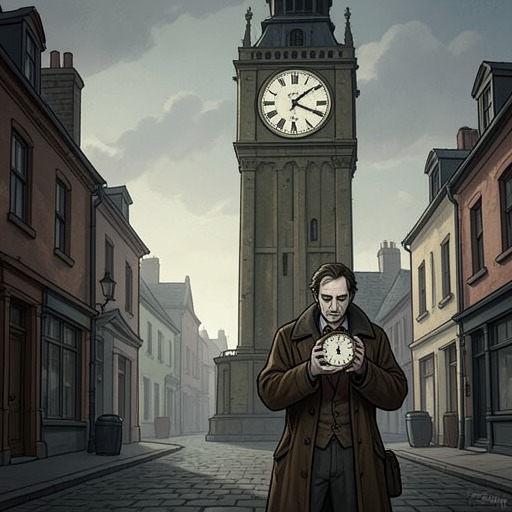
The alarm clocks
The Seven Dials MysteryThe alarm clocks are first assembled for a noisy practical joke on Gerald Wade, then become the conspicuous objects through which Bundle Brent notices that the apparent prank conceals a mystery. Their changing number and unexplained placement make them more than comic props: the clocks carry a clue from the bedroom where Gerald dies toward Bundle’s deduction about Seven Dials.
Purchase and Purpose
The clocks are acquired at Mr. Murgatroyd’s shop, where the shopkeeper tries to steer the group toward a more reliable model priced at 10/6. Reliability is beside the point: Nancy wants a clock that need only work for one day, Helen insists on a loud ring, and Socks rejects subtlety. Jimmy Thesiger, mechanically minded, finally gets the alarm mechanism going, and the shop fills with the raucous sound of ringing clocks. Six are selected as starters. Ronny Devereux adds one for Pongo, whose idea has earned him a place in the joke, and Bill Eversleigh takes another for Lady Coote, who is helping with the plan. What began as a purchase therefore becomes a set of eight.
The joke is organized around Gerald’s reputation as a champion sleeper. While the other guests are supposedly dancing to the wireless in the ballroom, they gather outside his bedroom amid subdued giggles and the clocks’ ticking. They debate whether all eight alarms should ring together or whether a prolonged, staggered assault would be more effective. The latter plan wins: the clocks are set to sound one after another, beginning at 6:30 a.m. Bill presents the prank as a lesson for Gerald, giving the episode its cheerful, self-congratulatory surface.
The Bedroom Arrangement
Pongo carries the clocks into Gerald’s dark bedroom in successive pairs, returning to the threshold each time for more. The group waits outside, listening. Gerald’s rhythmic breathing continues beneath the clocks’ emphatic ticking, which seems to bury it. The scene turns an ordinary domestic object into a collective performance: the conspirators’ attention is fixed on the sleeping man, while the steadily accumulating clocks transform the room into a mechanism designed to interrupt his rest.
After Gerald’s death, the clocks appear in a different arrangement. Jimmy sees them ranged neatly along the mantelpiece in the tidied room, beside Gerald’s still figure and the white flowers on the coverlet. The ordered display unsettles the earlier memory of clocks placed beneath the bed for a prank. Jimmy counts seven, not eight, and asks Ronny who arranged them; Ronny can only suggest that a servant did so. The missing clock is initially treated as a small irregularity, but the count makes the objects newly difficult to dismiss as background decoration.
The Missing Clock
Bundle later learns a detail that sharpens the discrepancy: seven clocks were on the mantelpiece, while the remaining clock had been found on the lawn outside, apparently thrown from the window. She cannot see a sensible reason for a maid to have thrown it away, and she doubts Gerald could have done so after waking; by then, she understands, he would have been comatose for some time. The distinction between an object merely put in order and one deliberately cast out changes the clocks’ significance. The arrangement on the mantelpiece accounts for seven, but the clock on the lawn demands a separate explanation.
When Bundle raises the thrown clock with Loraine Wade and Jimmy, Jimmy is startled: he has not heard of it before. He admits that the clocks have given him the shivers and that he sometimes dreams of them in a row. His unease contrasts with Bundle’s practical response. In darkness, she observes, the clocks would not be visible unless their dials were luminous. That thought makes the number and the image of the clocks click into place for her: seven clocks, luminous dials, Seven Dials. She insists that the resemblance cannot be coincidence, converting an odd household detail into a lead in the wider investigation.
From Prank to Clue
The clocks’ narrative function depends on repetition with alteration. First they are selected, counted, and set to ring as a joke; later they are found silent, rearranged, and incomplete. Their initial comic purpose encourages the household to regard them as harmless, while the neat row and the missing eighth clock make that assumption unstable. The episode does not make the clocks themselves explain Gerald’s death; instead, their physical disposition gives Bundle a question to pursue and a verbal association that links the bedroom mystery to Seven Dials.
That shift also makes the objects a measure of how appearances can mislead. The joke’s participants intend noise and inconvenience, but the aftermath supplies silence, a body, and a count that does not agree. Jimmy notices the seven on the mantelpiece, yet the discarded clock’s significance reaches him only when Bundle reports it. Bundle, in turn, moves from puzzling over an apparently purposeless act to recognizing a possible clue. The clocks thus bind the prank to the investigation: their number, location, and luminous-dial possibility carry the story from comic mischief toward concealed danger.