The burnt glove
The Seven Dials MysteryThe burnt glove is a small but decisive piece of physical evidence in Superintendent Battle’s reconstruction of Jimmy Thesiger’s staged shooting. Nearly destroyed in a fireplace, it carries a trace that links the apparent attack to the wound on Thesiger’s right arm and redirects suspicion away from another man.
Discovery and Physical Evidence
During Battle’s examination of the evidence, Jimmy Thesiger drew attention to a blackened object on the table. Battle identified it as the final exhibit in his collection: a glove recovered from the grate, nearly burnt through but still recognizable. Its damaged condition made it conspicuous, while marks on it suggested that it had been chewed. The object was not merely debris left by a fire; its survival preserved evidence of how it had been removed and discarded.
Battle rejected the suggestion that it belonged to Loraine Wade, despite the fact that she kept several dogs. It was not a woman’s glove, he explained, and even on Thesiger’s hand it appeared unusually large. The fit therefore narrowed the question of who had worn it, while its tooth marks made the manner of its removal relevant to the investigation. Together, these physical details turned a nearly destroyed glove into a clue whose significance depended on reading damage, size, and use alongside the other traces at the scene.
Use in the Reconstruction
Battle interpreted the glove alongside the two bullets and the scene’s other traces, rather than treating the apparent shooting as proof of an outside attacker. The larger bullet, fired from Jimmy Thesiger’s Colt automatic, had grazed the window sash and lodged in a cedar tree; the smaller one, from the Mauser .25 pistol, had passed through Thesiger’s right arm and embedded itself in an armchair. In Battle’s reconstruction, Thesiger fired the Colt at an imaginary assailant, then used his left, gloved hand to shoot himself through the fleshy part of his right arm. He threw the Mauser through the window, removed the glove with his teeth, and discarded it in the fire before lying on the floor as though unconscious.
The glove’s tooth marks helped distinguish this performance from an alternative explanation. Rupert Bateman, known as Pongo, had initially seemed a plausible suspect: he was left-handed, had carried the clocks into Gerald Wade’s room on the night of Wade’s death, and could have placed the chloral bottle and glass beside the bed. But a left-handed man with an unimpaired right hand would not have needed to pull off a glove with his teeth. Battle concluded that the marks pointed instead to someone whose right hand had just been made unusable. The injury was therefore not simply part of Thesiger’s story about an attack; it explained the distinctive damage to the glove and helped clear Bateman.
The object also helped Battle recover the deception behind the supposed second gunman. Thesiger’s account was convincing in part because it contained genuine details, and the staged struggle had briefly unsettled Battle’s suspicions. The charred glove, read together with the bullets and the wound, exposed the apparent attacker as a construction: Thesiger had staged the shots, inflicted his own injury, and supplied physical traces that could be mistaken for evidence of someone else. Nearly burned away, the glove survived just long enough to make that false account untenable.
From Relic to Testimony
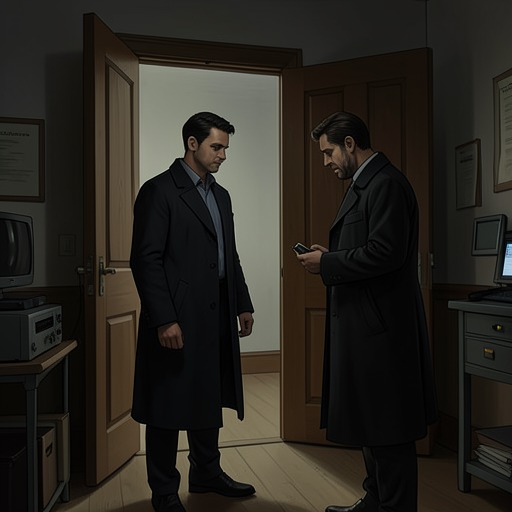
The glove’s status changes through the examination: Battle handles the charred remnant with evident pride, then fits it over Jimmy Thesiger’s hand so its size can be judged directly. This movement from table exhibit to something tested against a person makes the clue legible through contact, not appearance alone. Its nearly erased surface cannot identify its wearer by itself; its fit and the marks left by its removal acquire meaning only when Battle compares them with the wound and the staged account of the shooting.
The Clue That Reverses Suspicion
Battle’s account gives the glove a delayed force: it does not explain the apparent attack when first noticed, but later resolves the doubts raised by Thesiger’s convincing performance. The struggle and gunfire had momentarily shaken Battle’s confidence in his theory; the glove’s tooth marks restored it. Its evidentiary value lies not in naming a wearer outright, but in making the physical circumstances of its removal incompatible with the theory that another man had staged the scene.
That reversal also makes the glove a test of how suspicion is formed. Its size and apparent damage initially invite guesses about its owner, while its marks acquire decisive meaning only when set against the wounded right arm and the competing account of events. The nearly destroyed object therefore does more than expose Thesiger’s deception: it turns an apparently incriminating trace into the means of clearing Bateman, showing how the same clue can redirect blame when read in context.