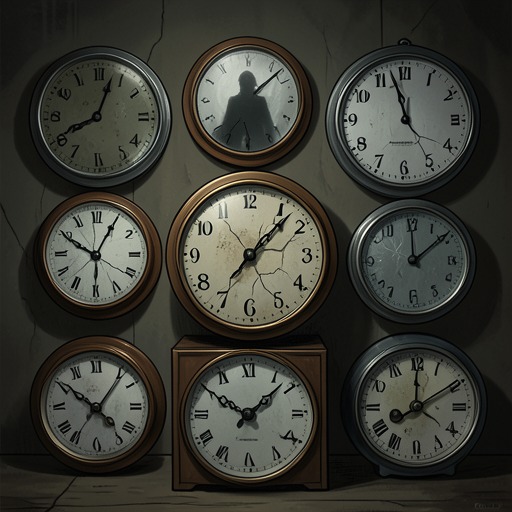
The imagery of seven clocks and clock faces
The Seven Dials MysteryThe imagery of seven clocks and clock faces turns an ordinary measure of time into a recurring sign of death, suspicion, and concealed identity. Its force develops through changes in what the characters—and the reader—can make of it: first a disturbing sound associated with Gerald Wade, then a deliberate signal arranged by Ronald Devereux, and finally a scene of recognition in which the voice of No. 7 precedes the removal of a mask.
Sound, Memory, and Dread
While Jimmy Thesiger waits in the gloom, Leopold lies ready across his knee. It is twenty minutes to one, an hour after the household has gone to bed, and the only sound is a clock ticking somewhere in the distance. The clock is not identified, but its sound draws Jimmy back to the seven clocks on the mantelpiece and to the unresolved questions surrounding them: who put them there, and why? The association gives an otherwise commonplace tick a menacing charge. Time seems to continue in the quiet room, but Jimmy’s attention is caught by what that sound recalls.
The passage makes the clocks part of a chain of memories rather than a self-contained puzzle. Jimmy thinks of Gerald Wade, then of Ronald Devereux and Gerald Wade together: two young men, both remembered as lively and healthy, now bound in his mind to death. The clocks’ significance is therefore emotional before it is fully explained. Their ticking unsettles Jimmy because it summons the earlier deaths and the possibility that those deaths were connected. The wait in the dark also slows the scene: with no new sound except the distant tick, recollection crowds into the present and makes stillness itself feel threatening.
The Seven Clocks as a Deliberate Sign
The final explanation supplies a purpose for the mantelpiece arrangement. After Gerald Wade died at Chimneys, apparently from an overdose of sleeping draught, Ronald Devereux did not accept the explanation as straightforward. He believed Wade had been deliberately put out of the way and suspected that the criminal might be someone in the house. Devereux came close to confiding in Jimmy Thesiger, whom he did not then suspect, but held back. Instead, he arranged seven clocks on the mantelpiece and discarded an eighth.
The arrangement was intended as a symbol that the Seven Dials would avenge the death of one of its members. Devereux watched to see whether anyone would betray themselves or show perturbation. The clocks thus function as a test as well as a sign: their visible number communicates a threat, while the reactions of those who see them might expose knowledge or fear. Their meaning is not inherent in the objects; it depends on the circumstances of the death, Devereux’s suspicions, and his knowledge of the organization. What had seemed to Jimmy an unexplained placement becomes a purposeful act of observation, devised because he could not yet say openly whom he suspected.
That meaning also sharpens the contrast between the apparent and the concealed. The household could read the clocks as a strange arrangement, while Devereux meant them to carry a specific message about the death of a member. The discarded eighth clock makes the count selective rather than incidental: seven is the number that gives the display its connection to the Seven Dials. At the same time, the signal does not name the killer. It creates pressure and watches for a response, leaving the underlying identity unresolved until other evidence can expose it.
Numbered Voices and the Unmasking
The imagery of counting and concealment reaches a different kind of recognition when Bundle hears the voice of 7 o’clock. The voice awakens a memory, but Bundle’s certainty is not immediate: she wonders whether she knows it, and waits as No. 7 slowly feels for the fastening of his mask. When the mask falls, she finds herself looking at Superintendent Battle. The sequence makes recognition a process staged across sound, number, and sight. The voice supplies the first clue; the removal of the mask supplies the visible answer.
The unmasking does not simply identify one participant. It overturns Bundle’s assumptions about what the society is. Battle tells her that the familiar picture of a criminal organization governed by an unseen super-criminal is a literary convention, not an account of this group. He describes instead a band of amateurs who have done dangerous work for his department and wished to serve their country. The episode therefore gives concealment a double edge: masks and numbers make identities difficult to read, but they also belong to an organization whose purposes Bundle has misjudged. The scene’s revelation changes what the signs mean without making the earlier mystery unreal.
From Omen to Clue
Across these moments, the clocks move from atmosphere to evidence. Their distant ticking first revives Jimmy’s anxiety about two deaths; the seven-clock display is later explained as Devereux’s purposeful response to Gerald Wade’s death; and the numbered voice at the meeting becomes the cue that lets Bundle recognize Battle when the mask comes off. These are related forms of delayed understanding, but they are not the same clue: the mantelpiece arrangement is a coded test, while the voice and mask create a separate recognition scene.
The motif’s effect depends on that distinction between what can be seen or heard and what those signs disclose. A clock can be only a sound in the dark until memory gives it a history; seven clocks can look inexplicable until Devereux’s intention is revealed; a numbered speaker can remain anonymous until a familiar voice triggers recognition. The recurring imagery makes the reader experience the same gap between sign and explanation that troubles the characters. Its eventual clarifications do not erase its earlier unease: instead, they show how a sound, a count, and a concealed face can carry meanings that become legible only when the story supplies their context.