The staged theft of the formula at Wyvern Abbey
The Seven Dials MysteryThe staged theft of the formula at Wyvern Abbey is a manufactured crime scene: the apparent struggle and gunfire disguise the planned removal of Eberhard’s papers and misdirect those investigating it. Its force lies in the reversal between what witnesses seem to see and what the physical evidence eventually establishes.
Causes and Background
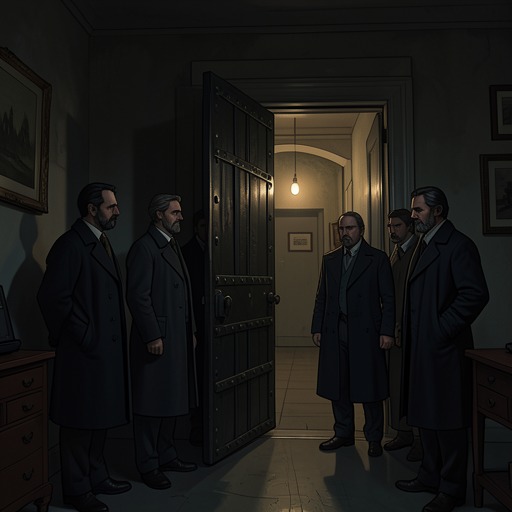
The operation takes place against the Seven Dials Society’s secret efforts to obtain Eberhard’s invention. At a meeting, the members discuss plans for an aviation-related application of the invention and agree that their original scheme remains sound. Their concern is not merely the formula itself: Gerald Wade’s discovered letter names the organization, and its leader, Mr. Mosgorovsky, worries that too much has become known about the group and its premises. He identifies Lady Eileen Brent as the person who found the letter and notes that Bauer should have prevented it from coming to light.
The approaching inquest into Ronald Devereux’s death adds another risk. The conspirators discuss reports that local young men have been practising with rifles, accepting this as a way to make the inquest’s outcome appear plausible. In this atmosphere of surveillance, exposure, and deliberate misdirection, the attempted acquisition of the formula at Wyvern Abbey is not an isolated burglary: it is part of a wider covert contest in which information and appearances are both weapons.
The deeper history of that contest is later explained by Superintendent Battle. Gerald Wade had proposed forming a group of amateur secret-service workers, despite Battle’s warning that such work could be dangerous. Their purpose was to catch a criminal operating in Wade’s world, a figure with inside knowledge who had already been responsible for the theft of valuable secret inventions. The professionals had failed; the amateurs took up the pursuit. The Wyvern Abbey incident brings that pursuit to its decisive test, as Battle must distinguish a genuine attack from a performance designed to look like one.
The Apparent Attack and Its Reconstruction
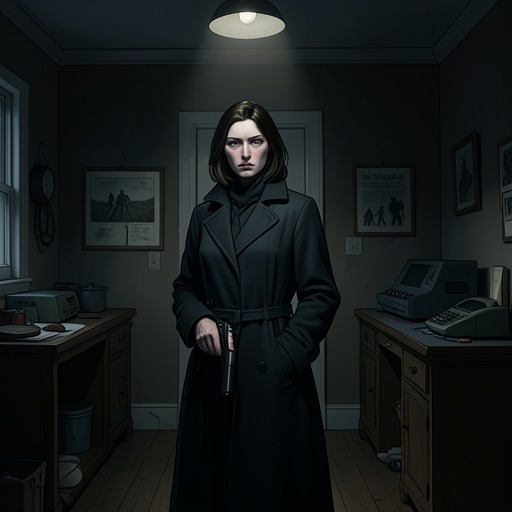
Just after the clock struck two, Loraine Wade reached the terrace at Wyvern Abbey. She had entered the grounds by climbing through the fence, while Superintendent Battle’s men, under orders to stop people leaving rather than arriving, let her pass. A brown-paper parcel fell from an open window at her feet. As she picked it up, a man began climbing down the ivy; Loraine ran, still holding the parcel. Behind her came the noise of a struggle, then two revolver shots. She rounded the terrace and ran directly into Superintendent Battle, urging him to hurry because the men were killing each other. The scene seemed to offer a straightforward account: an intruder had descended from the house, a fight had followed, and Loraine had stumbled upon the attack.
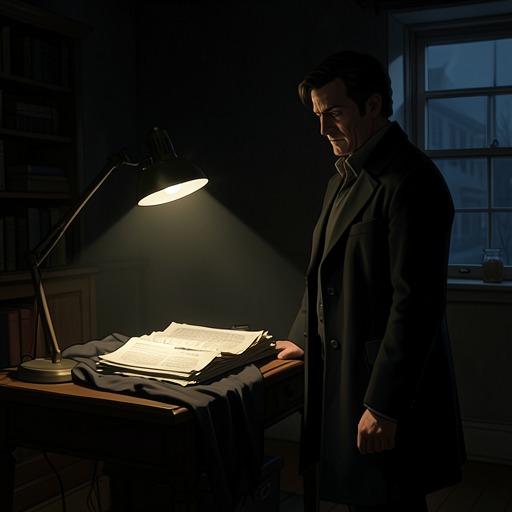
Battle’s later reconstruction overturned that account. There was no second man. Loraine and Jimmy Thesiger were working together, and her arrival at the exact moment the papers were dropped was part of their plan. Thesiger had left the room by the window, climbed the ivy to Mr. O’Rourke’s room, and taken the papers. He threw them down for Loraine to collect, then staged the struggle below. He knocked over tables, staggered about, and used his own voice and a hoarse whisper to make the confrontation sound like an exchange between two men.
The gunfire supplied the performance’s final proof of violence. Thesiger fired his Colt automatic at an imaginary attacker, grazing the window sash; with his left, gloved hand, he then used the small Mauser pistol to shoot through the fleshy part of his own right arm. He threw the Mauser through the window, tore off the glove with his teeth, and cast it into the fire before lying on the floor as if unconscious. Loraine, meanwhile, could have left the grounds with the papers while everyone rushed toward the apparent fight. When she ran into Battle, the plan changed from escape to defence: she gave an account that was true in its visible details, but concealed her part in arranging them.
The objects left behind made the performance vulnerable to reconstruction. The Colt’s larger bullet had grazed the sash and lodged in a cedar tree; the smaller Mauser bullet had passed through Thesiger’s arm and embedded itself in an armchair. Battle also examined the footprints and a dent in the grass. Only one set of footprints crossed the lawn where the pistol was supposed to have been dropped by a fleeing attacker: Sir Oswald Coote’s. The pistol’s position and the evidence of how it had been thrown did not fit the simple story of an assailant losing it while running away. The parcel, the two bullets, the glove, and the marks outdoors thus exposed a single staged sequence beneath the apparent attack.
Evidence, Reversal, and Consequences
The parcel changed the apparent outcome of the scene. After George Lomax assumed the document had been lost, Superintendent Battle pointed out that it was safe and took the brown-paper parcel from Loraine Wade, who had continued to clutch it mechanically. What had looked like an escape with stolen papers had instead placed the evidence directly in the hands of the investigators, even as Loraine’s presence at the terrace initially concealed her role in the plan.
Battle did not understand the performance at once. He later traced the shift in his thinking to the burnt glove, which he found in the fireplace with teeth marks on it. To test how the pistol had reached the lawn, he had Sir Oswald Coote throw it through the window. It landed farther away than Battle expected: a right-handed person could not have thrown it that distance with the left hand. The experiment did not prove the whole reconstruction, but it gave physical meaning to a detail that the staged account had left unexplained.
The intended recipient of the papers supplied another turn in the investigation. Battle reasoned that they had plainly been dropped for someone to collect. For those unaware of the plan, Babe St. Maur seemed an easy answer; Battle, however, knew she was not involved. That left the person who had actually arrived at the precise moment the parcel fell: Loraine. Her apparently accidental discovery of the papers became, in retrospect, the strongest indication that the timing had been arranged. When Bundle suspected the countess, Battle deliberately said enough to divert her, protecting the investigation while he worked through his own still-tentative theory.
The staged attack therefore failed not because its visible details were wholly false, but because its traces could not all support the same account. Battle had initially been deceived along with the others; the glove, the pistol’s trajectory, and the suspicious timing gradually made the supposed second attacker unnecessary. The recovered parcel and the reconstruction together recast the incident as an attempted theft by Jimmy Thesiger and Loraine Wade, not a struggle that had interrupted an ordinary burglary. The formula had not disappeared, and the apparent violence had served as cover for the transfer rather than as evidence of a genuine fight.
Aftermath and Narrative Significance
The episode turns on a calculated gap between watching and intervening. Battle’s men had been told to stop people leaving, not entering, so Loraine could reach the terrace; that restraint gave the planned handoff room to begin, but also kept the investigators in position to observe what followed. The brown-paper parcel ultimately remained with the authorities, while its passage through the scene exposed the intended coordination between Loraine and Thesiger. In this sense, the operation’s concealment becomes its weakness: the conspirators rely on witnesses to interpret the apparent fight as an interruption, yet the exact timing and surviving traces permit Battle to read it as a diversion. The staged attack is therefore both a failed theft and a revelation of how the criminal plot uses the language of violence to disguise the movement of secret papers.