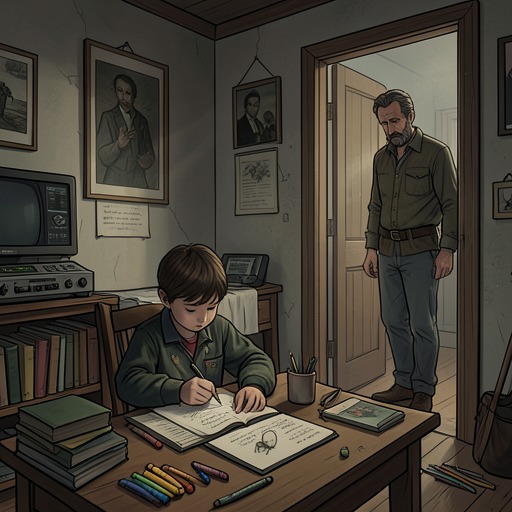
Anthony Fortuni
The Shadow of the WindAntoni Fortuny, known as the hatter, is a prosperous Barcelona tradesman whose household is shaped by the gap between the respectable life he seeks and the violence he inflicts at home. He marries Sophie Carax, raises her son Julian as his own, and later employs Julian in the hat shop; his family’s concealed history becomes entangled with the powerful Aldaya family when Don Ricardo places a major order.
Identity and Background
Fortuny is already over thirty and a confirmed bachelor when he meets Sophie in 1899 by the steps of Barcelona Cathedral. He has recently inherited his father’s well-regarded hat shop on Ronda de San Antonio and hopes one day to teach the trade to a son of his own. Sophie, a young French woman without family or money in Barcelona, earns her living giving music and piano lessons. Fortuny considers her beautiful, docile, and suited to the family he wants.
After four months of persistent courtship, Sophie accepts his proposal. A friend of Fortuny’s late father warns him that the marriage may be too convenient for Sophie and urges him to wait, but Fortuny says he already knows all he needs to know about his future wife. They marry at the Basilica del Pino. The marriage soon exposes how little he understands the woman he has chosen: their honeymoon is cut short, and Sophie returns home in distress.
Marriage, Violence, and Julian’s Childhood
Six months after the wedding, Sophie tells Fortuny that she is pregnant by another man. He refuses to accept that the child could have an ordinary human father, deciding instead that the child is the son of sin and that the Evil One must be responsible. He covers the home with crucifixes and confines Sophie to a room. When she questions his behavior, he attacks her and leaves her on the landing. The next day she is still there, injured and cold; her right hand never fully recovers, and she can no longer play the piano.
Sophie gives birth to a boy and names him Julian, after her own father. She pleads with Fortuny to punish her rather than an innocent child and asks him to give the boy a home and a father. Fortuny considers turning her away, but fears that the scandal would damage his business and make customers see him as a cuckold. Sophie and Julian therefore remain in the apartment, though he assigns her a dark room at the back and stays away for the first three days after the birth.
Fortuny’s violence does not end with that first crisis. He tells himself he loves Sophie and the child, and that he will be a better man than his own father, who had beaten Fortuny’s mother. Yet he repeats the pattern he hoped to escape. In time, he thinks of possession through tyranny when he cannot possess Sophie as a husband. Sophie’s disappointment and isolation deepen; she eventually answers him with insults and reproaches, and their conflict often falls on Julian, who grows up amid their hostility.
Work and the Aldaya Connection
In October 1914, Don Ricardo Aldaya arrives at the Fortuny shop in a grand carriage. One of the richest men in Barcelona and Spain, he commands a textile empire and holds influence across banking, land, local government, ministries, and the Church. He orders six top hats, a dozen bowler hats, hunting caps, and a hat for the Cortes in Madrid.
The order gives Fortuny’s business a chance to rise from a respectable but modest enterprise into more prestigious circles. Fortuny is delighted, and Julian, then working as his assistant, understands the importance of the commission. He skips school and works alongside his stepfather to complete it. The shop thus becomes the point where Julian’s family life meets the social world of the Aldayas, a connection that will prove consequential in his later story.
Later Connections and Narrative Significance
Years afterward, Fortuny’s name remains linked to the consequences of that childhood. When Daniel Sempere and his father take in the destitute Fermín Romero de Torres, they bring him upstairs, wash him, and find him clean clothes; Daniel later sees his father shaving Fermín in the bath. This scene belongs to the book’s wider pattern of care offered to people in need, a sharp contrast with the failure of care within the Fortuny household.
The novel also returns to the costs of family silence through the care given to others. At the hospital, Nuria Monfort visits the severely burned Julian every day and learns from the nurses how to tend his wounds and change his bandages. At the hospice, Daniel and Fermín visit Jacinta Coronado, and Rociito gives her fee to the staff to provide patients with food. These episodes do not erase Fortuny’s actions; instead, they place his household’s coercion and emotional estrangement beside acts of practical tenderness. His family’s long silence, in which its members become strangers under one roof, forms one of the book’s clearest examples of harm carried forward through private life.