Cemetery of Forgotten Books secrecy rule
The Shadow of the WindThe Cemetery of Forgotten Books secrecy rule is the demand that Daniel Sempere keep his first visit to the hidden library private. Spoken by his father before Daniel is allowed to see the place, it binds access to discretion and makes safeguarding forgotten books part of a family inheritance. As the novel unfolds, the rule’s protective secrecy contrasts with the concealment imposed by political power: Daniel’s search for the past requires bringing suppressed evidence into view.
The Rule and the First Visit
In the early summer of 1945, Daniel’s father warns him not to tell anyone what he is about to see—not even his friend Tomás. When Daniel asks whether the prohibition includes his mother, his father answers with a sigh rather than a direct explanation. The restriction is thus established before the place itself is revealed, preparing Daniel to understand that entry carries an obligation as well as a privilege.
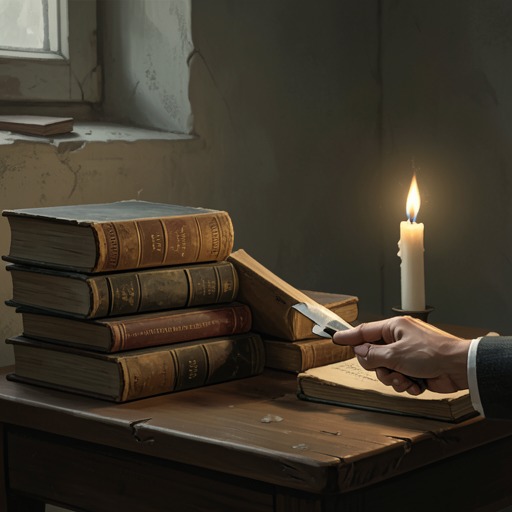
At the entrance, Daniel’s father introduces him to Isaac and says that Daniel will one day inherit the bookshop. He presents the visit as something for which the boy is now old enough, then explains the Cemetery as a sanctuary where books survive when libraries disappear, bookshops close, or volumes are consigned to oblivion. Its guardians bring forgotten books there so that they may wait for new readers. Because each book carries the lives of its writers and readers, keeping the place secret protects a refuge for works that have lost their public home.
The rule is not simply a ban on speaking. Daniel’s father asks whether he can keep the secret after describing the books as having no true owner and as having once been somebody’s best friend. The request turns silence into a pledge of care: Daniel is being trusted to help preserve a place whose purpose is to resist oblivion. Daniel nods, accepting the responsibility along with his introduction to the hidden library.
Secrecy, Inheritance, and Books
The visit links the secrecy rule to the future of the family bookshop. Daniel’s father tells him that the shop will one day be his, while the Cemetery’s guardianship extends beyond the shop’s buying and selling. The books may change hands, but the father insists that their deeper value is not ownership; they are preserved for the reader who may find them again. The child’s promise therefore joins family continuity to a broader duty toward books and their histories.
That inheritance is also associated with Daniel’s early hopes of becoming a writer. He asks his father whether everything would be different if he had Victor Hugo’s fountain pen, and his father promises to buy him one after he finishes his first work. Daniel’s literary ambitions soon fade as he turns to mechanical toys, and he stops asking about the pen. The episode gives the father’s promise a quieter counterpart to the Cemetery pledge: both express a willingness to foster Daniel’s relationship with books, even when his interests change.
The Rule in a Wider Web of Hidden Evidence
The novel’s later investigations complicate the distinction between protective secrecy and harmful concealment. Daniel discovers an old envelope addressed to Julian Carax, postmarked 18 October 1919, with a return address for Penelope Aldaya in Barcelona. This private letter becomes one piece of evidence through which the past can be approached. The act of reading it does not abolish the Cemetery’s rule; instead, it shows how the novel’s histories survive through documents that have been kept, misplaced, or recovered.
Other records reveal how secrecy can be manipulated by authority. A morgue account describes a body identified through a passport as Julian Fortuny Carax, with a book among its few belongings. A third policeman later overrides the ordinary identification process, signs the registration form, and orders the body buried in a common grave at Montjuïc. The episode exposes a grave disparity: the Cemetery’s guardians preserve books from oblivion, while officials can suppress a person’s identity through a false record and an unmarked burial.
The false identification is eventually explained through Miquel Moliner’s death. His body is left in the Raval with Julian Carax’s passport and a copy of The Shadow of the Wind; the police conclude that the dead man is Carax. Javier Fumero recognizes Miquel but signs the report confirming the false identity and orders the body’s removal to a common grave. The concealed truth is therefore not just a private secret but an official fabrication, maintained through documents and enforced silence.
Disclosure and the Rule’s Significance
Daniel’s role changes as he follows such clues. Isaac tells him that he believes him and produces an envelope after Nuria’s death, recalling her visits and their conversations about books. The scene places another private account in Daniel’s hands, joining personal memory to the documentary trail. What began as a child’s promise to guard a hidden sanctuary becomes part of a larger effort to recover voices and identities that others have tried to erase.
The rule’s meaning is sharpened by the later fate of the Aldaya mansion. Daniel returns to the house where he and Bea conceived Julian; it has been restored, the former garden made into a car park, and the room where Daniel nearly lost his life turned into a boardroom. The building’s new use overlays rather than preserves its history. Soon afterward, a parcel from Paris brings The Angel of Mist by Boris Laurent, bearing a dedication to Daniel and Bea. The book’s return and its dedication make preservation newly personal: a silenced writer has regained his voice and pen, while Daniel’s first lesson in secrecy has matured into a bond between memory, books, and the work of telling what was hidden.