Clara Barceló
The Shadow of the WindClara Barceló, the blind niece of Gustavo Barceló, is both Daniel Sempere’s first great infatuation and an independent reader whose discovery of a novel by Julián Carax changes how she understands literature. Her story moves from a meeting mediated by touch and Daniel’s idealization of her, through the painful asymmetry of their attachment, to a later reconciliation in which Clara asks to be friends and tells him she is to marry another man.
Identity and Introduction
Gustavo introduces Clara to Daniel as his niece and as the expert on Julián Carax. The description of her white eyes establishes that she is blind, but her first meeting with Daniel is not only an occasion for him to notice her disability. Clara actively reaches for him and invites him closer; by taking his hand and guiding it, she asks to explore his face through touch. Daniel understands the request and lets her read his features with her hands. The scene establishes a mode of contact in which Clara initiates, interprets, and directs the encounter, even as Daniel experiences it through the intensity of his adolescent attraction.
Clara’s blindness is a concrete condition of her life, but it does not make her a passive emblem of mystery. She has expertise in Carax, a history of reading, and the ability to articulate what that experience means to her. The contrast between Daniel’s initial fixation on her appearance and Clara’s later account of her intellectual and emotional life helps distinguish his fantasy of her from the person who speaks and acts in the story.
Reading and Julián Carax
Clara’s attachment to Carax begins when she is a teenager. Her tutor, Monsieur Roquefort, gives her and her sister Claudette The Red House, presenting it as a love story in the hope that the book might engage pupils who had shown little interest in reading. Clara describes the novel as the first book to draw her fully into a story. Until then, reading had seemed like an obligation imposed by teachers and tutors; Carax’s work introduces her to the pleasure of imagination, beauty, fiction, language, and what she calls the recesses of the soul.
For Clara, reading also changes her relation to blindness. She says that the book could give her back the sight she had lost—not by restoring physical vision, but by allowing her to live more intensely through imagination. She describes that first encounter with a compelling book as a spark one never forgets. This account gives her a perspective distinct from Daniel’s: where he first encounters Carax through the mystery surrounding the surviving copy, Clara speaks of the novel as a lasting personal discovery. Her role as the expert on Carax is therefore grounded not simply in her uncle’s introduction but in a reader’s long-standing engagement with his work.
Daniel’s Infatuation and Its Limits
Daniel’s attachment to Clara develops into an idealized love that he cannot easily separate from his hopes about what she might feel for him. As time passes, hints from his father, Bernarda, and Gustavo help him recognize the obstacle: he is a boy ten years younger, and Clara does not see him as he wishes to be seen. Proximity becomes difficult for him, including the ordinary acts of being near her or taking her arm on walks. Clara is aware of his distress and tries to tell him that they need to talk and that she has not behaved well toward him. Daniel repeatedly leaves before she can finish, unable to face the possibility that the imagined relationship is coming apart.
The account makes the mismatch between them consequential rather than incidental. Daniel’s silence prevents an honest conversation, while Clara’s efforts to begin one show that she recognizes the hurt and wants to address it. Later, when Daniel is asked whether he has gone out with other women, he names Clara as the person against whom he compares them. The persistence of that comparison shows how strongly his youthful fantasy has shaped him, but it does not establish that Clara shares his romantic attachment.
Reunion and Reconciliation
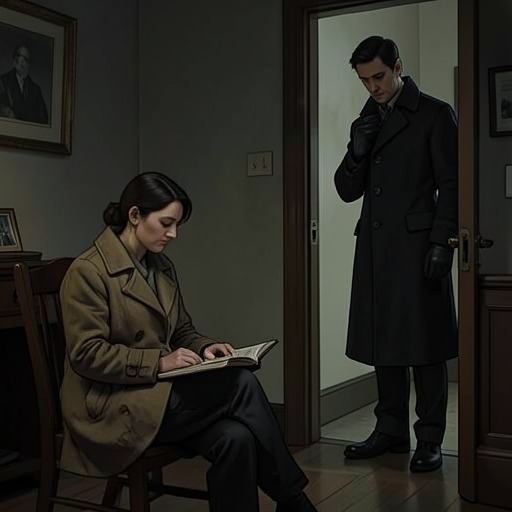
Years later, after Daniel has been beaten and is staying at Gustavo’s home, Clara finds him there. She tells him that she can come in because she still cannot see him, acknowledging the circumstances of her blindness with familiarity rather than ceremony. When Daniel emerges, she comments that his voice has changed and asks whether he has changed too. As in their first meeting, she reaches out and he guides her hand to his face. The repeated gesture links the reunion to their earlier intimacy, but now it belongs to a conversation between adults who can name the hurt that remained unresolved.
Clara apologizes for having hurt him and asks his forgiveness; Daniel answers by asking her to forgive him as well. Their exchange does not revive his earlier romantic hope. Instead, it allows each to acknowledge responsibility and meet again without pretending that the past did not matter. Clara’s uncle has supplied Daniel with an old suit to wear, another practical sign of the welcome he receives in the household. The reunion is interrupted when Bernarda enters and sees them holding hands, but Clara then gives Daniel the clothes and leaves him to dress.
Friendship, Marriage, and Narrative Significance
When Daniel later phones Gustavo’s home while looking for Fermín Romero de Torres, Clara answers. She asks whether they might be friends again and how long it will take him to forgive her. Daniel says they are already friends and that he has nothing to forgive. She invites him to visit for tea and tell her about his investigation into Carax, adding that she has things to tell him. Their conversation shows that a relationship once dominated by Daniel’s unspoken expectations can continue on different terms: shared friendship, conversation, and interest in the same writer.
Clara then tells Daniel she is getting married. Her fiancé, Jacobo, is a friend of Gustavo’s and a director of the Bank of Spain; she says they met at an opera recital organized by her uncle, that Jacobo is older, and that they are very good friends. Daniel is hurt by the news but congratulates her. Clara asks whether he will ever forgive her, expecting that he may continue to regard her as the faithless figure of his old disappointment. Daniel replies that she will always be Clara to him, without the accusation. The conversation gives their reconciliation a clear limit as well as a future: Clara’s marriage is her own choice, and Daniel’s care for her no longer needs to take the form of a claim on her.
Clara’s character also appears in the book’s broader account of how disability is seen and narrated. Daniel initially describes her through the striking fact of her blindness and his own response to it; the story later gives her direct speech about reading, friendship, and marriage. In that movement, she becomes more than the object of another character’s gaze or romantic imagination. Her blindness remains part of her identity, while her choices, knowledge, and understanding of the relationship establish her as a person with a perspective and a life beyond Daniel’s longing.