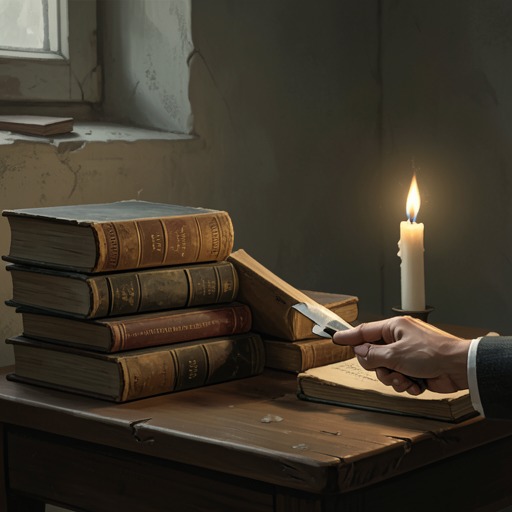
Daniel hides The Shadow of the Wind
The Shadow of the WindDaniel’s decision to hide The Shadow of the Wind in the Cemetery of Forgotten Books transforms an urgent act of protection into a ritual of preservation. Returning before dawn to the place where his father first brought him, he entrusts the novel to a labyrinth whose obscurity can shield it from an arsonist. He does not abandon the book: with the keeper Isaac’s advice, Daniel marks the route to its hiding place and vows to come back for it.
Background and Return
The night begins with Daniel leaving the Barcelos apartment in anger and jealousy, then finding himself unable to hate Clara. He has sworn not to see her again, but before going home he feels there is one more thing he must do to clear his conscience. In the rain, he makes for Calle Arco del Teatro, recognizing the wooden door and baroque facade from his first visit with his father six years earlier.
The entrance evokes that earlier encounter with an unsettling change of emphasis. Black water runs down the narrow street toward the Raval quarter, and the doorway reeks of urine and rotten wood. The Cemetery of Forgotten Books seems more than ever to smell of death. Daniel knocks first at the demon-faced knocker’s horns, then again with six louder blows, until his fist hurts. When no one appears, he crouches against the door and takes the novel from inside his jacket, reopening the first sentence that had enthralled him years before.
That remembered opening carries a private burden beyond the book itself. It recalls Daniel’s mother’s deathbed confession: she had loved another man, whom she had been told was killed in the war, and asked Daniel to find him because he was his real father. Daniel connects the rainy summer of that memory with his own learned capacity for lying. The novel he has come to protect is thus bound to a family secret and to the first reading experience that shaped his life.
Isaac and the Choice to Hide the Book
When the door finally opens, Isaac appears with an oil lamp. His sharp eyes notice the volume beneath Daniel’s jacket, and he identifies it as a Carax novel, remarking that at most ten people in town may know of the author or have read the book. Daniel explains that one of those people intends to set it on fire and that he can think of no better hiding place than the Cemetery. Isaac objects that it is a cemetery, not a safe; Daniel answers that the book needs to be buried where nobody can find it.
The exchange defines the refuge’s paradox. The place is not secure because it resembles a conventional strongbox but because its immense, disorienting archive makes discovery difficult. Isaac lets Daniel slip inside, where the vestibule is dark and damp. He gives Daniel the lamp, then produces a ring of keys and works an elaborate lock concealed beneath a glass case of relays and cogwheels. The mechanism’s levers and fulcrums move in sequence until steel bars clamp the great door into the stone wall, closing the outside world behind them.
Shortly before dawn, Daniel enters the labyrinth alone with the lamp. He thinks he remembers the route from his first visit, but its spiraling passages defeat his memory: three attempts to follow a remembered path return him to the same point. Isaac waits there with a wry smile. Daniel asks whether there is a way to cheat the maze, and Isaac invokes the Minotaur, offering him an old penknife and a practical answer: make a notch at each corner, in a pattern only he will recognize. The archive’s maze can be negotiated, Isaac suggests, not by mastering it all at once but by leaving marks along the way.
The Hidden Shelf
Following Isaac’s advice, Daniel begins again, marking the shelves with a C and an X whenever he changes direction. Twenty minutes later, deep inside the tower, he finds a suitable hiding place. A row of books on the disentailment of church property by Jovellanos forms an unremarkable outer layer. Behind it, Daniel discovers another row, concealed by what he sees as a wall of marble prose: plays by Moratín, a new copy of Curial e Guelfa, and Spinoza’s Tractatus Theologico Politicus.
Daniel places the Carax novel between a 1901 yearbook of civil-court minutiae from Gerona and a collection of novels by Juan Valera. To make room, he removes a book of Golden Age poetry and takes it with him; The Shadow of the Wind occupies its place. He then restores the Jovellanos volume, sealing the hidden row behind the visible one. The concealment is carefully composed rather than haphazard: the novel disappears within a shelf already crowded with works whose scholarly and literary presence makes an effective screen.
The act of hiding is not an act of relinquishment. Before the journey into the maze, Daniel has already insisted that he will return for the book. The marks made with Isaac’s penknife preserve a private route through the otherwise unreadable structure, while the disguised shelf preserves the novel from the person who wants to destroy it. Together, these choices make the hiding place both a grave and a deposit: the book is buried from its enemy, but kept accessible to its guardian.
Preservation, Memory, and Return
Daniel leaves by following the marks he placed on the way in. As he walks through the dark tunnels of books, he is overcome by sadness at the scale of what remains undiscovered. His own chance encounter with a single unknown book has opened a universe to him; he imagines tens of thousands more books still unexplored and forgotten. The abandoned pages become, in his perception, worlds and souls without owners, sinking in darkness while the world outside the library seems to lose its memory and mistake forgetting for wisdom.
This reflection enlarges the meaning of his immediate task. Daniel has come to save one volume from deliberate destruction, but the journey exposes a broader vulnerability: books may survive physically yet remain lost to readers, just as a community may carry a past while forgetting it. The Cemetery gathers those possibilities into one image. It is at once a shelter for endangered writing and a necropolis of works whose stories may never again be heard.
At dawn, Daniel returns to the apartment on Calle Santa Ana. He slips inside without turning on the light and sees the party table still laid out, the cake untouched and the crockery waiting. His father remains awake in his best suit, watching from an armchair by the window and smoking a cigarette, something Daniel has not seen him do for years. The scene does not undo the secrecy or the trouble of the night; it places Daniel’s return to his family beside his act of safeguarding a book whose first sentence has accompanied him since childhood.
The episode closes its immediate danger without closing the novel’s future. Daniel has hidden The Shadow of the Wind where its would-be destroyer is unlikely to find it, but his promise to return keeps the story open. The route marked through the maze gives that promise a material form: amid countless forgotten books, this one remains deliberately recoverable.