Gustavo Barceló
The Shadow of the WindGustavo Barceló is a prosperous Barcelona bookseller whose love of rare and neglected books draws him into Daniel Sempere’s search for Julián Carax. A flamboyant figure in the city’s literary circles, he is more than a collector: his knowledge of the book trade, money, connections, and willingness to act help Daniel and Fermín move from suspicion toward evidence about Carax’s reported death and Inspector Fumero’s involvement.
Identity and Background
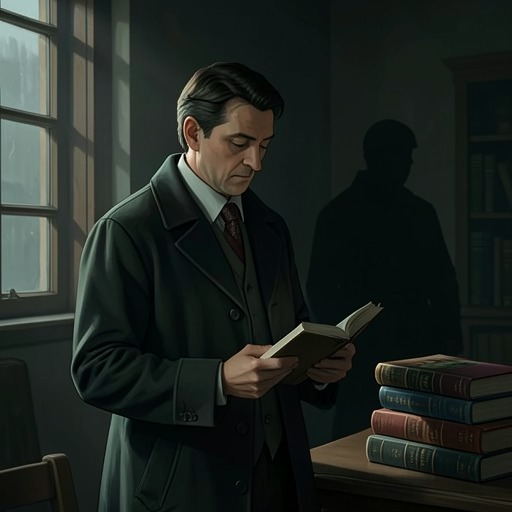
An old colleague of Daniel’s father, Barceló owns a large bookshop on Calle Fernando and occupies a commanding place in Barcelona’s secondhand-book trade. His family fortune came from an industrialist ancestor whose wealth had been acquired by questionable means, leaving the shop more a passion than a financial necessity. Barceló describes himself as the last romantic and claims a distant descent from Lord Byron. His chosen costume makes the claim visible: a cravat, white patent-leather shoes, and a plain glass monocle, which gossip says he keeps on even in private.
The pipe he habitually carries is unlit, but its distinctive aroma accompanies the performance. Barceló is verbose, pedantic, and fond of elaborate gestures; he also has an elephantine memory and a serious command of books. At the Café Els Quatre Gats, he joins a circle of bibliophiles to discuss decadent poets, dead languages, and neglected works. Beneath the dandy’s pose, his attention is sharply practical: he can recognize a promising book and a reader’s genuine interest.
A Bookseller’s Judgment and Generosity
Barceló’s interest in Carax begins when Daniel’s father suggests that he might know something about an unusual Spanish-language book first published in France. When Daniel presents the volume, Barceló examines it with practiced care, feeling the paper and binding and checking its publication and printer’s notices. He identifies the name Carax, but returns the book when Daniel reaches for it. His brief, controlled response leaves Daniel with the impression that the book has caught his attention without giving away what he knows.
His expertise is not simply acquisitive. Although wealthy and protective of his own interests, Barceló will reduce a book’s price or give it away when he believes an impecunious visitor is a serious reader rather than a casual browser. That capacity to distinguish love of books from mere possession makes his relationship to Daniel more complicated than a bookseller’s interest in a rare commodity. Daniel’s Carax book is at once an object Barceló would like to know more about and a clue whose significance exceeds its market value.
When Barceló later introduces Daniel to his niece Clara, he presents her as the real expert on Carax and withdraws so the two can become acquainted. Clara’s blindness is immediately apparent to Daniel, but Barceló’s introduction establishes that his knowledge of the author is not confined to his own collecting: he can direct Daniel toward people with more relevant knowledge. His connections thus open investigative paths as well as literary ones.
From Literary Curiosity to Investigation
Barceló’s connection to Carax’s publishing history is also indirect but consequential. Years later, Daniel learns that when Laín Coubert offered to buy the Carax titles, a secretary at the Cabestany publishing house independently removed one copy of each book from the warehouse. Nearly all the books were subsequently lost when the warehouse burned. The secretary was Nuria, who had corresponded with Carax and formed a friendship with him; the person explaining this history is Isaac, who reveals that Nuria is his daughter. This account places Barceló within the network of booksellers, publishers, and readers through which Carax’s nearly vanished work survives, even though the evidence does not make him the person who saved those copies.
Barceló’s importance becomes more direct after Fumero’s men attack Daniel and Fermín. At Calle Fernando, he and Bernarda are waiting with Dr Soldevila. The doctor examines Fermín, confirms that he is alive, and has him carried upstairs to Bernarda’s room, where a nurse is ready to help. Once the doctor closes the door and says Fermín will live, Barceló takes Bernarda to the kitchen and gives her brandy as she struggles with the fear of losing him. He also offers Daniel a drink, then redirects him toward a shower and clean clothes, reasoning that Daniel cannot go home covered in blood and dirt without alarming his father. The small domestic measures matter: Barceló turns his home into immediate shelter for people caught in danger.
Strategy, Resources, and Fumero
Once Fermín is safe, Barceló asks Daniel why reporting the attack to the police would be a bad idea. Daniel answers that the police already know. Barceló then asks whether the danger has anything to do with the Carax book Daniel once refused to sell him, and offers the surplus of money and common sense that the younger men lack. His earlier interest in the volume is no longer merely bibliophilic; he recognizes that it may be connected to the violence surrounding them and proposes to help.
After Daniel recounts the events involving Fumero and Nuria Monfort, Barceló sorts the evidence into a working hypothesis. He believes Fumero is deeply involved, though the reason remains unclear, and he doubts Nuria’s account of Carax’s return to Barcelona and murder. He proposes a test rather than an immediate confrontation: Daniel should visit Nuria and make clear that he knows she has concealed something, then watch how she reacts. Fermín, once recovered, should keep discreet watch and follow her if she takes the bait. The plan uses Daniel’s access to Nuria and Fermín’s ability to observe from a distance, while Barceló supplies the interpretation that links their roles.
That same evening, Daniel and Fermín begin carrying out Barceló’s plan. Fermín first suggests checking whether a suspected police watcher remains outside Els Quatre Gats, while insisting that Daniel keep their actions from his father. The investigation has widened from the mystery of a rare book into a dangerous inquiry involving surveillance, violence, and concealed histories. Barceló’s contribution is to give that inquiry a method: provoke a response, observe, and follow the trail rather than act on conjecture alone.
Evidence at the Morgue and Narrative Role
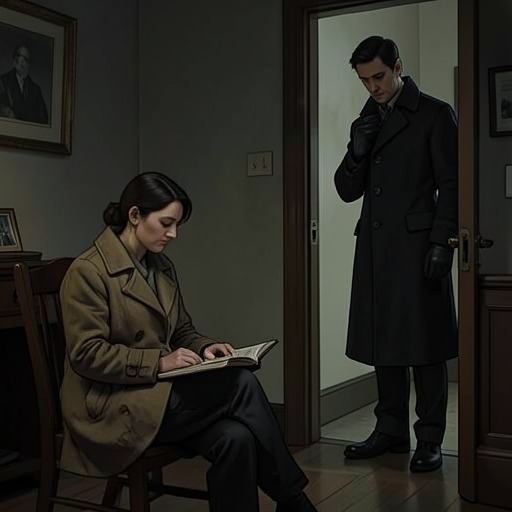
Barceló later brings Daniel a lead obtained through his own inquiries. He describes Manuel Gutierrez Fonseca, a city employee at the Barcelona municipal morgue since 1924, as a courteous man devoted to rules and established procedure. Barceló relates that Manuel once had to process the remains of his childhood best friend, an experience that did not stop him from following the rules. This account introduces the regulations governing identification and burial as more than administrative detail: in a city where bodies could arrive unidentified, procedure could be manipulated by those with power.
Manuel was on duty when the body identified as Julián Fortuny Carax reached the morgue in September 1936. Barceló has refreshed Manuel’s memory by checking the archives and making a hundred-peseta contribution to his retirement fund. The body had been brought in from an alley in the Raval, and its only accompanying items were a book and a passport identifying the dead man as Carax, born in Barcelona in 1900. Manuel remembered that the case did not follow the rules: the body had already been dead for at least a day, and the identification was asserted rather than established through ordinary procedure. A police officer overruled his objections, signed the form, and closed the case. Manuel later recognized that same signature on numerous death certificates for unidentified bodies arriving during the war and afterward. Barceló identifies the officer as Inspector Francisco Javier Fumero, giving Daniel a concrete reason to reconsider the official account of Carax’s death.
The revelation changes the investigation’s terms. What first looked like a trail of obscure books, evasive witnesses, and an unexplained murder now points toward a police officer who could impose identities on the dead and turn official records into instruments of concealment. Barceló does not solve the mystery alone, but his curiosity about books has matured into a capacity to gather testimony, test claims, and connect a forged or coerced identification to the broader pattern of wartime disappearances.
Barceló’s role is therefore both social and structural. He begins as an eccentric authority in Barcelona’s book culture, a man whose theatrical manner might invite dismissal, but repeatedly proves useful because he combines connoisseurship with practical judgment. His shop, wealth, home, and contacts give Daniel and Fermín places to turn when ordinary institutions are compromised. In a narrative where books preserve evidence that official records erase, Barceló is a reader who knows that the material history surrounding a volume—its printer’s notice, its custody, its survival, and the people who seek it—can lead beyond the page.