Isaac
The Shadow of the WindIsaac is the watchful keeper of the Cemetery of Forgotten Books, a hidden library whose preservation of books becomes essential to Daniel Sempere’s search for Julián Carax. He guards both the place and the histories attached to it; later, his relationship with Nuria Monfort makes him a link between the archive’s custodians and the people whose stories official records distort or erase.
Keeper of the Cemetery
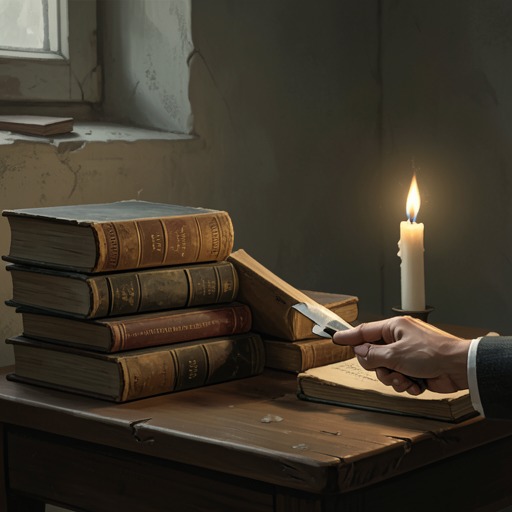
When Daniel first enters the Cemetery with his father, Isaac is the man who opens its door. His heavy grey hair and difficult-to-read gaze establish a guarded presence before he admits them. Inside, he guides them through the shadowed, labyrinthine library, where bookshelves, passageways, platforms, and bridges rise beneath a glass dome. Isaac’s role is not merely to show Daniel a remarkable place: he is its custodian, entrusted with keeping its books out of ordinary reach.
That responsibility appears again when Daniel brings a book to the Cemetery for safekeeping. Isaac checks the alley before letting him inside, then secures the entrance with a ring of keys and a complicated locking mechanism hidden beneath a glass case of relays and cogwheels. The elaborate device protects the door, but the scene also clarifies Isaac’s practical understanding of secrecy: a book that must not be found needs a place where it can be buried from discovery. His dry advice about locks reflects the same guarded, resourceful temperament.
Knowledge of Carax and Nuria
Isaac is a source of information in Daniel’s investigation into Carax’s books. He explains that nearly all the copies in a publisher’s warehouse were lost when the building burned, but that Nuria, the publisher’s secretary, had taken one copy of each Carax title beforehand. She had corresponded with Carax and was, in Isaac’s account, probably the only person in Barcelona who had read his novels. Isaac describes her as someone drawn to lost causes, first taking in stray animals and later devoting herself to unsuccessful writers.
Daniel recognizes that Isaac speaks of Nuria with unusual familiarity. Isaac then reveals why: she is his daughter, a fact he delivers with a knowing smile. The disclosure changes the weight of his account. His knowledge of Nuria’s loyalty to Carax’s work is not simply an archivist’s report; it comes from a father who knows her life and character, even if she may not realize how much he understands about her.
Records, Identity, and the Official Past
Isaac’s importance extends beyond the hidden library through the testimony he gives Daniel about the evidence surrounding Carax’s supposed death. Daniel examines an old envelope addressed to Carax, postmarked 18 October 1919, with a return address bearing Penelope Aldaya’s name and Barcelona address. The letter’s material traces preserve a connection that can be investigated, while the later account Isaac helps make intelligible rests on documents that claim to settle Carax’s identity.
A morgue account describes a body brought in during September 1936, identified by a passport as Julian Fortuny Carax, born in Barcelona in 1900. The passport indicated that he had crossed the border at La Junquera about a month earlier; the reported cause of death was a gunshot wound. Yet the official process is shown to be compromised. A third policeman orders the body’s removal to a common grave at Montjuic, signs the registration form despite objections that the identity and circumstances do not meet regulations, and later uses the same authority to assign identities to unidentified dead. Isaac’s account of this evidence makes the distinction between a document and the truth it claims to establish central to the mystery.
The later account of Miquel Moliner’s death exposes the consequence of that manipulation. After Miquel is killed, his body is left in the Raval and reaches the morgue under circumstances that prevent the death from being connected to the earlier killings. Because the employees find a damaged passport in Carax’s name and a copy of The Shadow of the Wind, the police identify the corpse as Carax. Francisco Javier Fumero recognizes Miquel but signs the report confirming the false identity and orders a common burial at Montjuic. Read beside the earlier morgue story, the false identification reveals how a record can conceal a person as effectively as the Cemetery’s secrecy protects a book.
A Father’s Inheritance
When Daniel comes to Isaac after Nuria’s death, Isaac accepts that Daniel is telling the truth and produces an envelope from his coat. He recalls that Nuria visited him on the afternoon before she died, as she had in earlier years. They used to eat together at a café on Calle Guardia, where he had taken her as a child, and their conversations often returned to old books. Nuria once told him she feared she had disappointed him; Isaac remembers that he had not considered whether he, too, had disappointed her. His recollection makes their distance personal rather than merely factual: a father and daughter could share an enduring subject and still misunderstand what each meant to the other.
Isaac’s place in the novel is therefore both custodial and familial. He protects books from disappearance, passes on the evidence that lets Daniel question official accounts, and remembers Nuria through ordinary details of their shared life. Across those roles, the archive and the family memory answer the same problem in different ways: what survives depends on someone choosing to keep it.