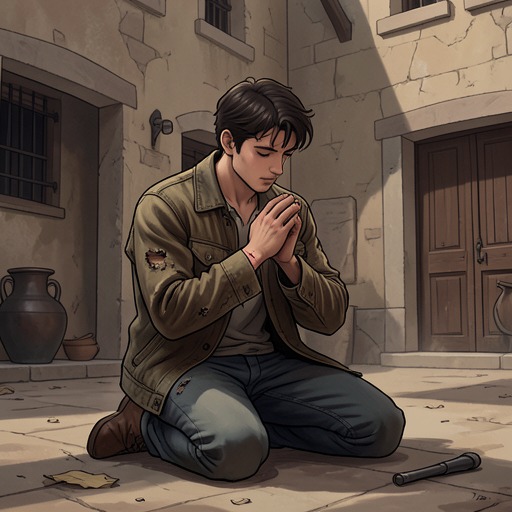
Julian Carax’s presumed death
The Shadow of the WindJulian Carax’s presumed death is the official story that the novelist returned to Barcelona in 1936 and was killed there, but the evidence behind that claim is unstable from the beginning. A body found with Carax’s passport and a copy of The Shadow of the Wind was identified, buried, and recorded under his name; later testimony reveals that the corpse was Miquel Moliner’s and that Inspector Francisco Javier Fumero knowingly endorsed the false identification. The episode makes a death certificate less a final answer than a document whose authority depends on who is allowed to name the dead.
The First Report
Nuria Monfort tells Daniel Sempere that, in the summer of 1936, an employee at the municipal morgue contacted the Cabestany publishing house about a body received three days earlier. The man, found in an alley in the Raval quarter, wore rags and carried a bullet wound. A copy of The Shadow of the Wind and a passport were found with him; the passport bore a French-border stamp from the month before. The police contacted Carax’s father, who denied having a son, and after two days without anyone claiming the corpse, it was buried in a common grave at Montjuic Cemetery. The morgue employee kept the book, and it was his call to the publisher that brought the news to Nuria.
The report offered Nuria no way to locate the grave or even to establish where Carax had been during the month since crossing the border. She believed that, if he had returned to Barcelona, he could have contacted her or the publisher; neither had heard from him. Her efforts to ask questions and lodge a complaint led nowhere. Instead, a young Inspector Fumero warned her against pursuing the matter and advised her to adopt a more positive attitude as the country was engaged in a crusade. His intervention connected the apparent death to an atmosphere in which inquiry itself could be treated as a danger.
Conflicting Records
Years later, Daniel reads an old envelope addressed to Carax. Its postmark is 18 October 1919, and its return address is Penelope Aldaya’s address on Avenida del Tibidabo. The letter prompts him to travel there, but the document’s significance extends beyond what it says: it is a surviving private record tied to Carax, in contrast with the official account that declares him dead. The story repeatedly makes documents carry competing claims about identity and history, and this letter sends Daniel toward evidence that the public record cannot supply.
Fermín Romero de Torres’s reconstruction complicates Nuria’s first account. He says Carax crossed the border and returned to Barcelona around the outbreak of the Spanish Civil War, remained for about a month without contacting his father or Nuria, and was then found dead. In that version, Carax’s apparent death is followed by the appearance of a faceless man who calls himself Laín Coubert, taking the name of a figure from Carax’s last novel and threatening to destroy the remaining books. Nuria thought the voice might belong to Jorge Aldaya, but Fermín cautions that she had lied to Daniel. His account makes the reported death part of a larger uncertainty: Carax’s whereabouts are obscure, witnesses are not fully reliable, and the name attached to the dead man becomes entangled with the novelist’s fiction.
The Morgue Account
A later inquiry into the morgue’s archives supplies details that appear, at first, to confirm the identification. Don Manuel remembers that the body arrived in September 1936 after police said it had been found in the Raval shortly before dawn. It carried only a book and a passport naming the man as Julian Fortuny Carax, born in Barcelona in 1900. The passport bore a stamp from the La Junquera border post, and the reported cause of death was a gunshot wound. Don Manuel believed the shot had been fired at close range. Using the passport, the authorities found Señor Fortuny, Carax’s father, who came that evening to identify the body.
But the record was altered through a decisive act of authority. Don Manuel recalls a third policeman entering the room while the other officers prepared Señor Fortuny. After the father left, this officer approached the body, spat on it, kept the passport, and ordered the corpse sent to Montjuic for burial in a common grave. Don Manuel objected that the rules did not permit burial before the person had been identified. The policeman threatened him, then declared that the dead man was whoever he said he was and signed the registration form. Don Manuel later encountered the same signature on numerous death certificates for unidentified bodies. In this account, the name Julian Carax was not securely established by the available evidence; it was imposed by a police officer who could turn an uncertain body into an official identity.
The Identity Reversal
The final account explains why the evidence had seemed to point so convincingly to Carax. Miquel Moliner was killed while helping his friend Julian escape, and the dead police officers’ bodies were removed while the bar’s manager was told to forget what had happened. Miquel’s body was left in a Raval alley so that his death would not be connected to the officers’ deaths. By the time it reached the morgue, his own papers were absent; the surviving identification came from a damaged passport in Carax’s name and a copy of The Shadow of the Wind. The police concluded that the dead man was Carax.
Fumero then went to the morgue and encountered Señor Fortuny, who had been summoned to identify the corpse. Fortuny had not seen Carax for two days and was distressed when he recognized the man as someone who had recently come to his door asking after Carax. The police took his reaction as confirmation. Fumero, who had not seen Carax for seventeen years, recognized Miquel but signed the forensic report identifying him as Julian Carax and ordered the immediate burial in a common grave at Montjuic. What Nuria had received as a report of Carax’s death was therefore a false identification sustained by a passport, a book, a misread response, and a deliberate signature.
Memory Against the Official Story
The revelation gives the records different and unequal kinds of authority. The passport and book seem to identify the corpse, but both can be separated from the person who carried them; the morgue form makes the misidentification durable, while Don Manuel’s recollection and the later reconstruction expose how it was produced. Nuria’s account, too, preserves crucial information but remains incomplete, as Fermín’s warning about her lies reminds Daniel. No single witness or document can settle the story on its own.
The reported death also reveals the reach of wartime violence beyond the moment of killing. Miquel’s death is hidden, Carax is made to occupy his place, and the common grave removes the possibility of ordinary public recognition. Don Manuel’s memory of repeated certificates for unidentified bodies widens the case beyond one mistaken identity: official records can erase as well as preserve, especially when police power controls the naming and disposal of the dead. The eventual correction does not restore a clean history; it shows how private testimony and preserved traces must work against an official version designed to close the matter.