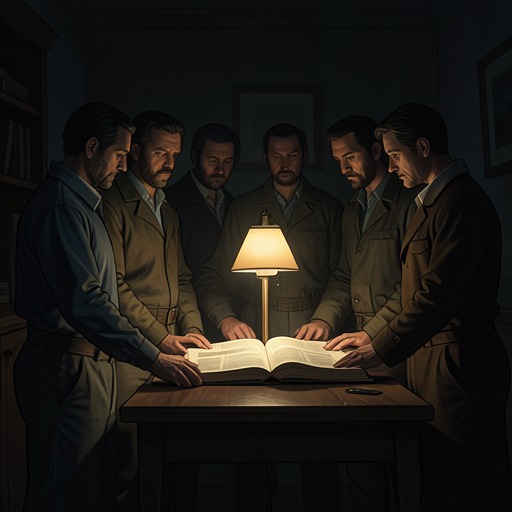
Postwar Barcelona under Francoist repression
The Shadow of the WindPostwar Barcelona under Francoist repression is not a clean break from wartime violence but its continuation in altered forms: police authority, enforced silence, political fear, and a public life built around what cannot safely be said. The city’s quiet and ordinary routines conceal disappearances and unresolved crimes, while family stories and written testimony preserve fragments that official memory has erased.
A City Shaped by Fear and Absence
The city Daniel Sempere grows up in is marked by poverty, resentment, and a sadness he initially accepts as simply the way the world is. Only after hearing Clara Barceló recount her father’s disappearance does he begin to understand that violence can have a human face and operate within ordinary life. Someone who appears in public as a uniformed official can also make people disappear into Montjuïc Castle or an unmarked grave. This realization unsettles the apparently familiar city: what Daniel had taken for reality may instead be a stage set hiding its history.
The book repeatedly sets Barcelona’s beauty against its political wounds. At dawn, Daniel and his father pass from the Ramblas through Calle Arco del Teatro into the Raval, where the old buildings and fading light make the city feel like a place of echoes. Elsewhere, streets, trams, traffic, and shop windows register the rhythms of everyday life, but their normality does not resolve the violence underneath. During a storm and blackout, the darkened streets become an image of a city whose past is difficult to see clearly, while a later, record-breaking snowfall transforms familiar routes and landmarks without making them safe or reassuring.
Political Violence and Its Continuity
Clara’s account gives the city’s repression a specific history. Her father, a lawyer connected to the Catalan president’s cabinet, sent his wife and daughter away when the Civil War began. He wrote to them weekly, first from his office on Calle Diputación and later without a return address. Eventually, he wrote secretly from a cell in Montjuïc Castle, where he was killed. His wife and daughter received his letters, but the correspondence could not protect him or restore him to them.
After returning to Barcelona, Clara’s mother tried to establish what had happened. An investigator recovered a broken wristwatch and identified Javier Fumero as the man who had killed Clara’s father in the castle’s moat. Clara describes Fumero as a man who shifted among political factions and then joined the police after Barcelona fell. The account links wartime opportunism to postwar authority: the man associated with a political murder becomes a decorated inspector, while his victim is forgotten. Clara’s mother dies not long after the investigation, and Clara is left with her uncle Gustavo Barceló as her only family in Barcelona.
The same continuity appears in Fumero’s treatment of people after the war. He comes to the Sempere bookshop displaying his police identification and invokes his office to threaten Daniel and his father over supposedly subversive books. He also pursues Fermín Romero de Torres, who describes him as an enemy and a continuing danger. Fermín’s account reaches back to the final phase of the war: after Barcelona fell, he was arrested at the port while trying to help his superiors escape to France, taken to Montjuïc, and interrogated about their whereabouts. The consequences endure into the postwar period, when he lives on the streets and avoids the security services. The state’s power is present not only in prisons but in the threat of renewed arrest and violence.
Families, Silence, and Inherited Memory
Silence is itself part of the postwar order. Daniel’s father rarely speaks about the past, and Daniel grows up without knowing why. When he asks about the war, his father explains that Daniel’s mother had made him promise not to tell their son about it or let him remember what happened. He is unsure whether he was right to keep that promise, but insists that war changes everything and acknowledges that many people entered the castle and never came out. The conversation makes a private family rule part of a wider pattern: the attempt to protect a child also leaves him unprepared to recognize the history that surrounds him.
The novel contrasts this inherited silence with the uneven survival of testimony. Clara’s father’s letters reach his family, but her mother must read them aloud, and Clara later rereads them with help because she is blind. When the letters stop, the family has no confirmation of his fate until an investigator uncovers limited evidence. In another generation, stories and documents transmit knowledge that official accounts leave out. The past reaches Daniel through other people’s memories, through books, and through records that survive by chance rather than through any public process of acknowledgment.
Forgetting as a Political Aftermath
The war’s end does not restore a shared account of what happened. In the retrospective testimony associated with Nuria Monfort, silence is described as something that allows people to be told that what they saw and did was an illusion or a nightmare. The warning that wars have no memory is not a claim that events leave no trace; the novel’s families and damaged lives prove the opposite. It describes a social condition in which witnesses fall silent, the dead lose their voices, and the knowledge needed to recognize recurring violence becomes harder to recover.
The account of the aftermath emphasizes that the period after the weapons fall silent brings further killings and fear. Fumero is said to have turned against former allies and to be serving those who prevailed. Those who survive withdraw into secrecy, while the peace that follows is associated with prisons, cemeteries, shame, and concealed responsibility. This is not presented as a settled or complete record of every event: some knowledge remains in rumor, personal recollection, and the guarded accounts of people who fear what disclosure may bring. That uncertainty is part of the city’s condition, not a reason to treat its violence as resolved.
The City as a Carrier of Memory
Barcelona’s built environment gives memory a material route through the novel. Streets and transport connect Daniel’s daily life with places implicated in the past: the route to Clara’s story, the journey toward the hillside mansions, and the views of the abandoned Aldaya mansion recur as he follows clues. The city changes with weather and light, but its geography preserves points of contact between private loss and public history. A familiar street may be crossed on an ordinary errand, while a castle, port, or old house recalls an event that has never been openly settled.
The postwar city is therefore more than a backdrop for Daniel’s investigation. Its gaps—in family knowledge, official recognition, and the fates of the disappeared—create the conditions that make searching necessary. Clara’s father is forgotten by the public, Fermín’s past is carried in the effects of his persecution, and Daniel’s father keeps to a promise that withholds the war from his son. Against those forms of erasure, the novel sets the fragile work of remembering: letters reread, a witness’s story entrusted to another person, and a younger generation learning to see that the city’s apparent quiet contains an unfinished history.