Sempere and Son
The Shadow of the WindSempere and Son is the bookshop of Daniel Sempere and his father, a family business whose everyday work becomes entangled with the political pressure surrounding the people it serves and the threatened circulation of Julian Carax’s novels. It is at once a place of labor and refuge: Fermin works among its shelves, Daniel returns to it after his meetings, and the sign outside gives a visiting police official a pretext to address the two men together. The bookshop eventually closes, but its history does not end with the shopfront; Daniel’s father and Fermin continue their partnership in a new family bookshop.
Identity and Daily Work
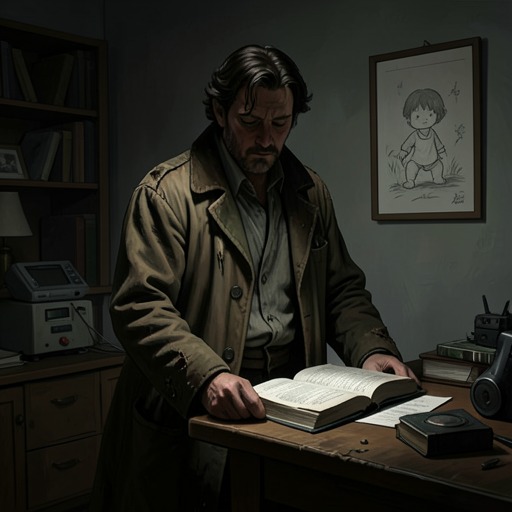
The name Sempere and Son presents the business as a shared undertaking between Daniel and his father. A visiting official makes that implication explicit by asking whether the sign applies to both of them. In daily practice, however, the shop also depends on Fermin, who is shown working there alongside the family. When Daniel returns after two-thirty, Fermin is on a ladder polishing a collection of the Episodios Nacionales by Don Benito. On another late evening, Daniel sees him through the window, arranging books in a pile, absorbed in his work. These glimpses establish a working interior defined by upkeep, stock, and the repeated handling of books rather than by any grand public display.
Daniel’s place in the shop is rendered through routine. After coming home, he finds that either Fermin or his father has already opened the business. He eats the toast and jam and drinks the strong coffee his father left upstairs, then returns through the back-room door and puts on his blue apron to protect his clothes from dust. The arrangement connects the family apartment directly to the shop floor: domestic care helps make the day’s work possible, and a cupboard in the shop gives Daniel a place to keep personal odds and ends. The bookshop is not merely his workplace; it is woven into the household and his own habits.
A Shop Under Scrutiny
The sign also makes the business’s family identity visible to an official visitor. He tells Daniel and his father that he has come on a courtesy call to warn them about doing business with people he characterizes as undesirable, including criminals and homosexuals. The warning places the bookshop under pressure because of the company it keeps, while offering no evidence that the family accepts the official’s terms or changes its conduct. Its significance lies in the intrusion: a commercial sign becomes an opening through which state authority attempts to regulate the shop’s relationships.
That moment resonates with an earlier remark about a cut on Daniel’s face. Someone comments that the injury looks serious and asks whether Daniel has been badly beaten. The exchange establishes that Daniel arrives at the shop visibly affected by violence, but the available evidence does not identify the person responsible or explain the circumstances. It nonetheless places the bookshop in a world where danger can follow its people into ordinary conversation and work.
The Carax Books and Their Perilous Circulation
The shop’s life belongs to a larger struggle over the survival and circulation of Carax’s novels. Cabestany published eight of them between 1928 and 1936, although a bookseller remarks that Cabestany was not especially romantic and suggests that his interest may have been personal or contrary. The same account distinguishes those books from the publications that brought Cabestany money: catechisms and inexpensive sentimental novels about the provincial heroine Violeta LaFleur, which sold extremely well. Carax’s novels thus occupied a precarious place in a commercial catalogue dominated by more reliable sellers.
After Cabestany took over the firm, a stranger offered three times the market value for the entire remaining stock of Carax’s novels. Cabestany sought more than the proposed price, and the buyer withdrew the offer. A few days later, shortly after midnight, Cabestany’s warehouse in Pueblo Nuevo burned to its foundations. The sequence links an attempted purchase of the books to their subsequent destruction, though the evidence does not establish who caused the fire. It shows the vulnerability of the novels not only as literary works but as physical stock held in a warehouse: a collection that might have been bought in a single transaction instead became exposed to a catastrophic loss.
Closure and Continuity
Sempere and Son itself eventually closes. Gustavo Barceló sells Daniel and his father his stock, explaining that he is tired of the bookselling trade and wants to take on new challenges. His first and last such project is a publishing company dedicated to reissuing Carax’s works. The transition sets the family bookshop’s ending beside a new effort to return the novels to circulation, shifting the work from retail bookselling to publishing.
The first volume of Barceló’s edition contains three novels recovered from a set of proofs that had ended up in a furniture warehouse belonging to the Cabestany family. It sells 342 copies, far fewer than the year’s bestseller, an illustrated life of the bullfighter El Cordobes. That modest figure gives the reissue a concrete measure of its limited market beside mass popularity. Barceló subsequently devotes his time to traveling around Europe with distinguished ladies and sending postcards of cathedrals, while Daniel’s father and Fermin continue together in a new family bookshop. The business therefore has two endings: the close of Sempere and Son as a particular shop, and the continuation of its working partnership in another form. Alongside the recovered proofs, that continuity keeps the book trade—and the fragile survival of Carax’s writing—open beyond the original storefront.