Spanish postwar period
The Shadow of the WindThe Spanish postwar period is not merely a historical backdrop but a condition of daily life in which poverty, loss, and unspoken violence shape both Barcelona and the people who inhabit it. Daniel Sempere initially accepts the city’s sadness as ordinary; only gradually does he recognize that the apparent stillness around him conceals a history of persecution and death.
A Childhood Shaped by Silence
Daniel grows up amid what he understands as a natural procession of postwar years: stillness, poverty, and resentment hidden from view. His father is a private man who lives with the past but seldom speaks of it. Daniel’s mother had asked him not to tell their son about the war or let him remember what had happened. When his father finally discloses that promise, he is uncertain whether keeping it was right. The silence is therefore both an act of protection and a barrier that leaves Daniel to sense the damage before he can understand its source.
The city’s violence becomes more legible to Daniel through stories of disappearance. After hearing about Clara Barceló’s father, he struggles to reconcile death as an impersonal misfortune with the possibility that it can have a human face: someone who moves through ordinary public life and then makes another person disappear. He imagines that the familiar world may be only a stage set. Childhood ends not with a single clear revelation, but with the dawning awareness that the city’s ordinary surfaces conceal grave, deliberate harm.
The City as a Postwar Landscape
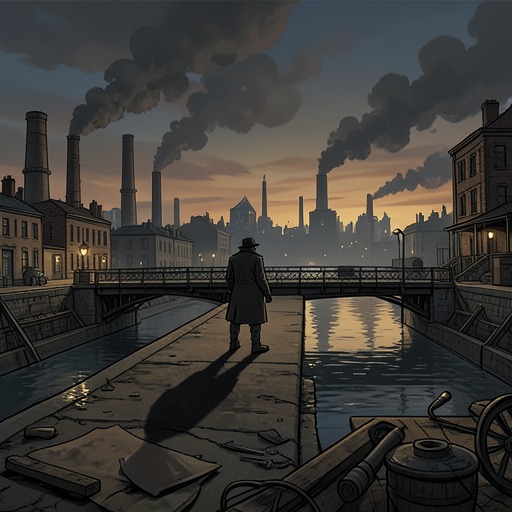
Barcelona’s streets give this historical condition a physical form. Daniel’s first early-morning journey with his father leads through Calle Arco del Teatro and into the Raval, where the light fades beneath balconies and the old carved door of a shadowed building appears almost like the entrance to another world. Later, during a storm, a blackout leaves the streets empty and dark. These scenes do not explain the political past directly; they make the city’s obscurity part of Daniel’s experience of it.
The postwar city also contains signs of change and routine. On an October morning, Daniel passes street sweepers, traffic, a blood-red Studebaker, and a poster announcing television as a new technology. The scene contrasts a modernizing public world with the persistence of deprivation and unease. Elsewhere, a third-class train and a blue tram carry him toward the mansions of Avenida del Tibidabo, where dawn reveals a more affluent Barcelona. Such differences in streets, transport, and housing make the city feel divided, even as the narrative keeps its wounds close beneath everyday movement.
Work, Friendship, and the Passing of Childhood
The postwar years also take shape through family work and changing relationships. Daniel helps his father in the bookshop by sorting the storeroom, delivering orders, running errands, and serving regular customers. His father believes he gives too little of himself to the work, while Daniel feels that he already spends his life there. In sleepless moments, he remembers the intimate world he and his father shared after his mother’s death, marked by Victor Hugo’s pen and tin trains. He sees that period as peaceful but sad, and recognizes it as a world already vanishing.
As the bookshop becomes busier, Daniel spends less time brooding over Clara Barceló and the mystery of Julián Carax. The change is practical as well as emotional: work occupies him, and his father considers hiring help. With more time freed by Fermín Romero de Torres’s arrival, Daniel turns toward the Carax mystery and toward his old friendship with Tomás Aguilar. Their friendship began in a schoolyard fight that cost Daniel a tooth and taught him a sharper sense of his own limits. In this way, growing up proceeds through ordinary work and personal attachments even as the larger history remains unresolved.
War, Testimony, and the Burden of Memory
The narrative’s account of the postwar period ultimately widens into a judgment on war and collective forgetting. The war’s aftermath is described as a silence in which people are urged to treat what they witnessed and learned as an illusion. After Barcelona falls, violence continues in secret, and the peace that follows is associated with prisons, cemeteries, shame, and secrets carried to the grave. The account insists that silence does not erase the past; it leaves survivors without a public language for what happened and risks allowing the violence to return under another name.
Nuria Monfort’s memoir gives that silence a personal countervoice. In her message to Daniel, she entrusts her story to him and asks him to remember her, connecting remembrance with continued existence. The request gives Daniel’s pursuit of the past an ethical dimension: he is not only uncovering events but receiving testimony from people whose voices might otherwise disappear. The postwar period thus links private grief, family secrecy, and public amnesia, while the act of telling becomes a way to resist the erasure that war leaves behind.