The Angel of Mist
The Shadow of the WindThe Angel of Mist is the mansion at Avenida del Tibidabo where private family history, Barcelona’s dark rumors, and the central tragedy of Julian Carax and Penelope converge. Known to few by its true name, the house outlasts its owners and its neglect: it preserves the Aldaya family’s secret in a crypt, draws Daniel and Bea into the story they have been piecing together, and finally lends its name to a novel that signals Julian’s return to writing.
Identity and Origins
The mansion was built in 1899 by the architectural partnership Nauli, Martorell i Bergada, for Salvador Jausa, a wealthy and extravagant Catalan financier. An orphan from humble origins, Jausa had made much of his fortune in Cuba and Puerto Rico. He returned with an American wife from Philadelphia, a maid named Marisela who had been in his service since his early years in Cuba, a caged macaque dressed as a harlequin, and seven trunks of luggage. The household first stayed in rooms at the Hotel Colon while Jausa sought a residence suited to his tastes.
The house’s later reputation was already attached to it when Don Ricardo Aldaya bought it at the turn of the century for a derisory price. The Aldayas’ principal mansion stood elsewhere, at the crossing of Calle Bruch and Calle Mallorca. Commissioned in 1896 by Simon Aldaya and designed by Puig i Cadafalch, that family residence was demolished in 1925 and replaced by an apartment block. The Tibidabo house, by contrast, had been Jausa’s summer home—and was known as The Angel of Mist, though the name was nearly forgotten outside the history of the property.
Jausa, Marisela, and the House’s Reputation
Jausa’s brief occupation became the beginning of the house’s lurid public legend. Barcelona society treated Marisela as both his lover and a sorceress, and rumors about her circulated at gatherings of well-born women. The gossip gave the house a reputation its later owners could not simply erase. After Jausa vanished during a storm one November night, Don Ricardo asked the photographer Gelabert to recover the film Jausa had reportedly been developing. Aldaya viewed the roll privately, burned it, and paid Gelabert to forget the incident. By then Aldaya already owned most of Jausa’s properties.
Stories about Jausa’s fate multiplied rather than resolved the mystery. Some said the dead Marisela had come back to take him to hell; others claimed a beggar resembling the missing millionaire had been seen in Ciudadela Park, before a curtained black carriage ran him down and did not stop. The house’s legend spread through the city, attaching the mansion to a past that remained both sensational and incomplete.
Villa Penelope and the Haunted Domestic Interior
A few months after Jausa’s disappearance, Don Ricardo moved his family into the mansion. Penelope, the couple’s youngest child, was born two weeks later, and Aldaya renamed the property Villa Penelope to mark the occasion. The imposed name did not take hold: the house retained its own character, seemingly beyond the influence of its new owners. The family complained of nighttime banging, foul smells, and cold draughts moving through the rooms. A double basement contained an unused crypt; upstairs, a chapel held a polychrome crucifix whose figure the servants thought resembled Rasputin.
The unease was embedded in ordinary household space. Books in the library were rearranged or turned backwards. A third-floor bedroom was left unused because damp stains on its walls seemed to form blurred faces; flowers wilted there within minutes, while flies could be heard but never seen. The cooks reported sugar disappearing from the pantry, milk turning red at each new moon, and dead birds or small rodents appearing at certain doors. Jewels and clothing buttons also went missing, sometimes reappearing months later in remote corners or buried in the garden, and often never returning at all.
Don Ricardo dismissed most of these incidents as pranks and nonsense, proposing a week of fasting to quiet his family’s fears. He reacted differently when his wife’s jewelry disappeared: more than five maids were dismissed over the losses, despite their distress. The contrast makes the house’s mysteries inseparable from the household’s power relations. Fear could be dismissed as superstition, but missing property brought punishment to the servants who lived under suspicion.
Abandonment, Daniel, and the Crypt
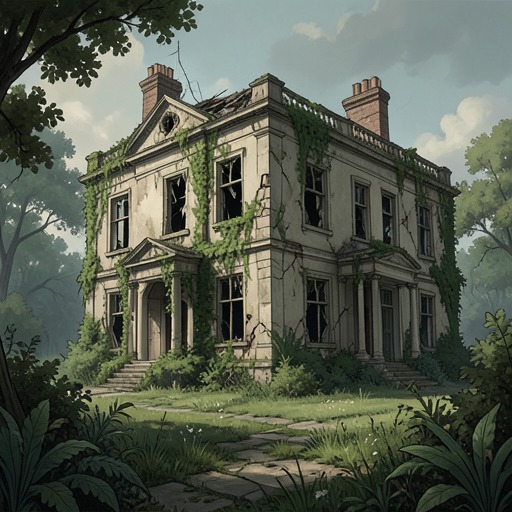
The mansion was put up for sale in 1922 at a very low price. Its notoriety initially attracted interest, but prospective buyers withdrew after visiting. It closed in 1923, and its deed passed to a real-estate company among Aldaya’s creditors. The property remained unsold for years; after the company’s collapse and its partners’ deaths in prison, a financial group took it over. Señor Aguilar, the father of Bea and Tomás, became its executive director, but his salesmen could not place the house, even at a price far below its already low asking price. Nobody had returned to the property for more than ten years.
Bea breaks that long absence by borrowing the key from her father’s office and bringing Daniel to the house. She explains that it belongs to the story of Carax and Penelope and that she wants to share it with him. For her, their meeting there is part of a secret plan, akin to Daniel’s having found a Julian Carax novel in the Cemetery of Forgotten Books. The mansion is not merely a setting for the past: it is the place where the story’s scattered clues can become physical and immediate.
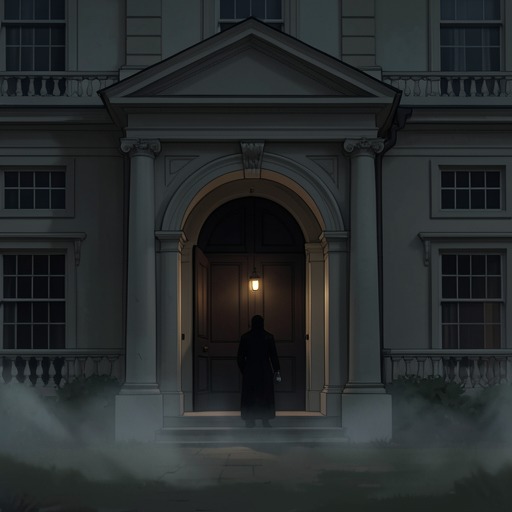
On a later visit, Daniel arrives before Bea, enters with the key she gave him, and explores alone. At the gate he sees the angel fountain’s hand rising from scarlet-tinted water; inside, candlelight reveals damp walls, fallen ceilings, and ruined doors. He descends the marble steps into the crypt, a bare stone chamber lined with crucifixes. Two white lacquered coffins rest on a marble slab, one scarcely two feet long. Dust obscures their inscriptions until Daniel brushes the lid of the larger coffin and reads Penelope Aldaya’s name and the dates 1902–1919. The discovery turns the house’s atmosphere of haunting into material evidence of Penelope’s death and burial, and connects its hidden lower level to the central human cost of the Aldaya history.
Later Life and Literary Return
The Angel of Mist survives against expectation. Señor Aguilar’s agency eventually sells it, and the mansion is completely restored. The angels’ statues are ground into gravel for a car park laid over what had been the Aldaya garden. The house becomes an advertising agency, promoting products as ordinary as cotton socks and skimmed milk and as aspirational as sports cars for jet-setting businessmen. Its old library, where Daniel nearly lost his life, is now a boardroom decorated with posters for deodorants and detergents; the room where Bea and Daniel conceived Julian has become the chief executive’s bathroom. The transformation does not erase the past so much as overlay it with commercial uses that make the former house difficult to recognize.
The name returns in a different form when a parcel postmarked Paris reaches the bookshop. Inside is a novel called The Angel of Mist by Boris Laurent. Daniel recognizes its opening sentence as soon as he reads it and finds a dedication in the familiar blue strokes of the pen he had admired as a child. The book is dedicated to Daniel for giving its author back his voice and pen, and to Beatriz for giving them both back their lives. The mansion’s name has passed from a haunted residence to a work of fiction: after holding a buried family history and serving as the site of its discovery, it becomes the title under which Julian’s renewed authorship reaches Daniel and Bea.