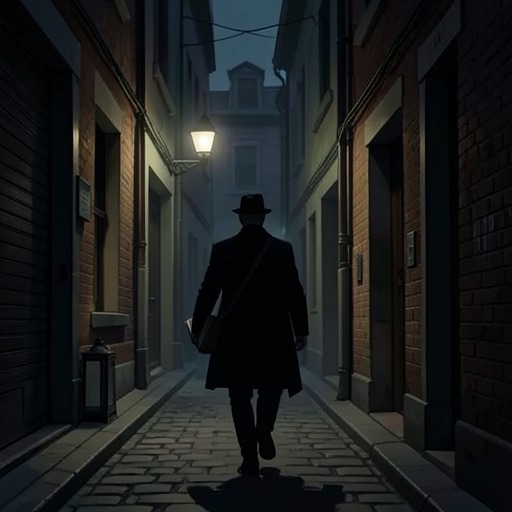
The near-destruction of Julian Carax's novels
The Shadow of the WindThe near-destruction of Julian Carax's novels was not a single fire but a sustained effort to erase a writer’s already scarce books from circulation. Poor sales, pulped returns, a secretive buyer’s offer for the remaining stock, and the burning of Cabestany’s warehouse brought Carax’s published work close to disappearance. Nuria’s decision to save one copy of every title, and her concealment of them in the Cemetery of Forgotten Books, preserved a path by which the novels could eventually return to readers.
Fragile Beginnings
Carax’s books entered the world with little commercial protection. The Red House sold only seventy-seven copies according to the Paris publisher’s office; most were said to have gone to young women of easy virtue and other patrons of the club where Carax played nocturnes and polonaises for a few coins. The copies returned to the publisher were pulped for the production of missals, fines, and lottery tickets. The book’s disappearance thus began through ordinary trade decisions: a low-selling title could be converted back into raw material, its literary survival made contingent on somebody choosing to keep it.
A later estimate put The Red House’s sales at about ninety copies, a discrepancy that underscores how uncertain the record of Carax’s publication history had become. Between 1928 and 1936, Cabestany published eight of his novels despite losing money on them. The publisher earned more reliably from catechisms and a series of inexpensive sentimental novels about the provincial heroine Violeta LaFleur. His continued investment in Carax remained unexplained to Isaac, who could only speculate that Cabestany had been indulging a private fancy or resisting the logic of commercial selection. Whatever the reason, the books’ existence depended on a publisher whose other business was more profitable.
From Disposal to Deliberate Erasure
That dependence became acute when Cabestany fell ill and financial difficulties followed. His eldest son took over the firm in 1936, and the business collapsed in less than a year. The son considered selling the company’s backlist for pulp, encouraged by a friend who believed that photo romances and Mein Kampf would create a large demand for cellulose. In this plan, Carax’s novels were not merely unwanted literature: they formed part of a stock to be destroyed for its material value.
Before that proposed liquidation, a stranger arrived at the son’s office and offered three times the market value for the entire remaining stock of Carax novels. The offer made the threatened books’ disappearance look intentional rather than incidental. Daniel recognized that the buyer wanted the books in order to burn them, and Isaac confirmed that the offer had indeed been made for that purpose. The buyer’s identity was not securely known to Isaac’s informant, but the proposed purchase connected the threat to the larger mystery of the man seeking out Carax’s work.
The negotiation failed because Cabestany’s son demanded more money than the buyer had offered. The buyer withdrew; shortly after midnight a few days later, Cabestany’s warehouse in Pueblo Nuevo burned to its foundations. The fire destroyed nearly all the Carax books held there. Its sequence—an extravagant offer, a rejected bargain, then a warehouse reduced to ashes—turns the fire into the decisive escalation of the effort to remove the novels from circulation. The son’s attempted profit-seeking had not saved the stock; it had left the books exposed to the catastrophe that followed.
Nuria’s Rescue and the Hidden Copies
The warehouse did not contain every surviving copy. When Cabestany’s secretary, Nuria, heard of the offer, she had a premonition and went to the warehouse on her own initiative. She removed one copy of each Carax title. She had corresponded with Carax and formed a friendship of sorts with him; Isaac described her as someone drawn to lost causes, a disposition that had led her, as a child, to take in stray animals and later to protect failed authors. The rescued set was therefore not an accidental remainder but the result of a personal act of preservation.
Some days after the fire, Nuria came to Isaac at the Cemetery of Forgotten Books, nervous because she believed someone was following her and feared it was the man called Coubert, who wanted the books destroyed. She hid the Carax volumes in the great hall’s maze of bookshelves, like buried treasure. Isaac did not ask where she placed them, and she did not tell him. Before leaving, she said that she would return for the books once she had found Carax. She had not heard from him for months, practically since he had sent her the final corrections for his last book; Isaac could not tell whether she was truthful about what she knew. After that visit, she did not hear from Carax again, and the books remained among the library’s shelves, gathering dust.
The concealment saved the novels from the immediate danger, but it did not restore them to ordinary circulation. The surviving copies were hidden, their location known only in part even to Isaac, and Nuria’s promised return never brought them back into the world. Daniel’s own copy came from the books Nuria had placed in the Cemetery of Forgotten Books, joining his personal discovery to her earlier rescue. The archive’s secrecy and the books’ physical survival thus became inseparable: concealment protected what public circulation had failed to protect.
Survival and Return to Print
The novels’ survival remained incomplete and vulnerable for years. By the time Daniel learned the story, nearly all the warehouse stock had been destroyed, while Nuria’s set had been left in hiding. Later, material associated with the Cabestany family re-entered circulation: proofs had ended up in a furniture warehouse, and these allowed Gustavo Barcelo to publish a new edition of Carax’s works. The first volume contained three novels and sold 342 copies, still many tens of thousands behind that year’s bestseller, an illustrated life of the bullfighter El Cordobes.
That later edition reverses the warehouse’s logic without undoing its losses. Carax’s books return as books rather than pulp, but their modest sales recall how little commercial force had protected them in the first place. The contrast between the early copies destroyed or hidden, the single rescued set, and a reissue that sells only 342 copies makes preservation a matter of custodianship rather than market success. Carax’s novels endure because individuals—including Nuria, Isaac, and eventually Barcelo—keep them from disappearing, even when the machinery of publishing treats them as disposable.