son of sin
The Shadow of the Wind“Son of sin” is Antoni Fortuny’s condemning name for Julian Carax, born to Sophie Carax by another man. More than an accusation about Julian’s parentage, the phrase makes a child bear the shame Antoni assigns to his mother and becomes part of the emotional inheritance that shapes Julian’s view of the man who raised him.
Origin and Meaning
After Sophie told Antoni that she was pregnant by another man, she refused to identify the father. Antoni concluded that the child must be the devil’s, reasoning that sin had only one father: the Evil One. He treated that belief as an explanation for the pregnancy and as a verdict on the child, calling Julian the “child of sin.”
The phrase recasts an adult betrayal and Antoni’s inability to accept Sophie’s account as a fault belonging to the unborn child. Its religious language gives his rejection the force of a moral sentence: Julian is not merely a son whose biological father is unknown, but a child whom Antoni declares to embody sin.
How the Phrase Enters Julian’s Life
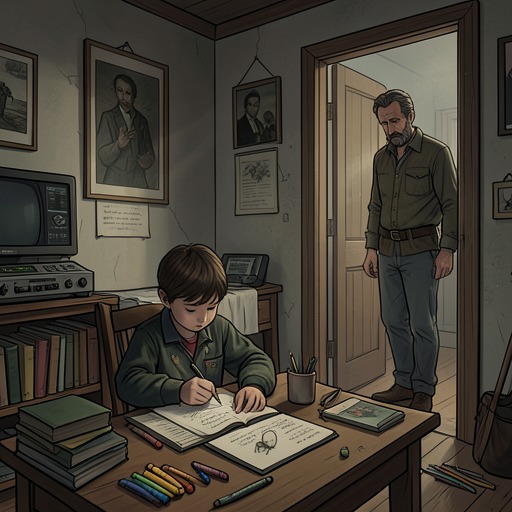
Nuria Monfort later recalled that Julian grew up watching Antoni insult and beat Sophie. Antoni also went into Julian’s room to tell him that he was the son of sin, that he had inherited his mother’s weak and despicable character, and that he would be miserable and fail at whatever he attempted. The phrase thus belonged to a repeated pattern of condemnation, not to a single outburst.
This declaration links Julian’s supposed origins to predictions about his character and future. Antoni presents suffering and failure as already determined by Julian’s birth. In the family history Nuria recounts, the name becomes one of the means by which Sophie’s punishment is extended to her son.
Julian’s Response and the Phrase’s Afterlife
Julian told Nuria that the hatter was not his real father: Sophie had had an affair with a stranger before marrying Antoni, and that man was Julian’s biological father. The evidence does not identify the stranger. Julian’s knowledge of his parentage therefore contrasts with Antoni’s insistence on assigning him a sinful identity, an identity grounded in condemnation rather than a known paternal history.
Nuria believed Julian had lost respect for Antoni because of what he had witnessed and endured, although she did not think he hated him. Julian spoke of those experiences as if they no longer mattered, as if they belonged to a past he had left behind. Nuria’s reflection challenges that appearance: words that poison a child’s heart, whether spoken with malice or ignorance, remain branded in memory and may later burn the soul.
Narrative Significance
The phrase condenses a larger family conflict into a name imposed on a child. Antoni interprets Sophie’s pregnancy through religious blame, then transfers that blame to Julian; Nuria’s account reveals the personal cost of that transfer in Julian’s childhood and his later response to Antoni. The contrast between Julian’s apparent detachment and Nuria’s insistence that such words are not forgotten makes “son of sin” a sign of how familial violence can persist in memory even when its recipient seems to have moved on.