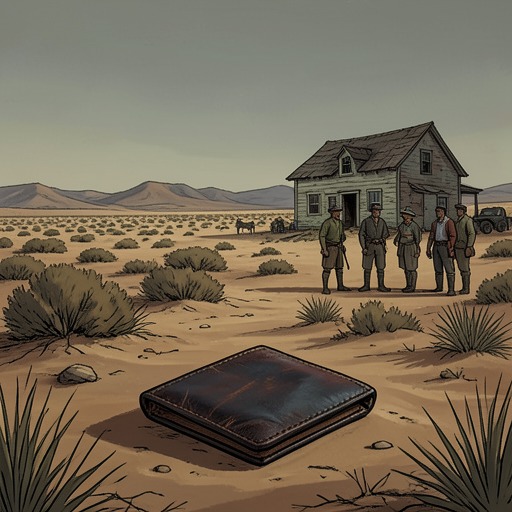
Abandoned chemical factory
The Shape of WaterThe Abandoned chemical factory, the ruined Sicilchim complex beyond the Pasture outside Vigàta, is at once a relic of failed development, a boundary imposed on the town’s marginal spaces, and a place where Salvo Montalbano finds evidence prepared to mislead him. Its rusted machinery and broken floors preserve the physical remains of an industrial promise whose collapse left unemployment and compensation claims behind; its enclosing walls, meanwhile, make the ruin part of the changing uses and controls of the surrounding landscape.
Setting and industrial history
The factory occupies the ground behind the Pasture, a broad tract of Mediterranean scrub on the outskirts of Vigàta extending almost to the shore. It is described as a large chemical works, built in a period when Deputy Cusumano inaugurated it amid expectations of progress. The promise proved brief: what had seemed a strong wind of development dwindled to almost nothing, while the industrial venture left a disorderly legacy of compensation benefits and unemployment. The account connects the derelict building to political decisions and economic consequences without specifying what chemical processes took place there or asserting that the site is contaminated.
That history gives the factory’s emptiness an economic dimension. The complex is not merely an abandoned backdrop: it is the remaining structure of a development project whose benefits did not endure, while the costs are visible in the surrounding town’s lack of employment. The novel’s contrast is sharp. The building was once presented as a sign of progress; now its disused structures stand behind scrubland where young surveyors, unable to find work in their profession, earn temporary wages collecting rubbish for Splendour.
Walls and the changing landscape
A high wall was erected around the factory to prevent migrants from taking shelter in the abandoned complex. Above it, the old buildings still rise, corroded by weather, neglect, and sea salt. The perimeter therefore does more than mark industrial property: it turns the ruin into a space that is both unused and actively kept inaccessible to people seeking shelter. The text presents that boundary alongside the wider geography of the Pasture, where labour, state control, and informal commerce meet at the town’s edge.
The factory’s exterior also shapes the first impression of the site. Its decaying forms are likened to architecture by Gaudi under the influence of hallucinogens: a vivid comparison that makes the industrial remains seem distorted rather than simply old. Inside, the disorder is concrete. Montalbano sees a second, crumbling enclosure wall within the protective perimeter, remnants of the factory’s operating days. Beyond it stand rusted machines, large pipes, enormous alembics, perforated iron scaffolds, precariously hanging trestles, and steel turrets at illogical angles. Broken trusses leave great openings in the floors, below which lie dilapidated concrete and grass growing through the cracks.
The Pasture and the factory’s surroundings
The factory’s proximity to the Pasture matters because the two spaces have acquired different uses after the collapse of industrial activity. The Pasture is assigned to the town’s rubbish collectors as a cleaning sector. Its rubbish includes paper, plastic bags, beer and Coca-Cola containers, and discarded condoms. Over roughly a year, the condoms become an abundant feature of the landscape, reflecting a change in the area’s nighttime use after soldiers are sent to Sicily to support territorial control.
Gegè Gullotta responds to the soldiers’ arrival by arranging permissions through the people who actually control the area, rather than through formally authorized officials. He establishes a market in sex and light drugs in the Pasture; business serves the soldiers, Gegè, and those taking a share of the proceeds. The account places this activity among the Pasture’s bushes and along its sandy shore, not inside the factory. The factory nevertheless forms part of the same marginal terrain: a monumental industrial failure stands next to a scrubland whose uses are now shaped by cleaning work, military deployment, and a profitable informal economy.
Montalbano enters the ruins
Access to the complex is difficult even for an inspector investigating it. Fazio complains that nobody can identify who owns Sicilchim or who serves as its official custodian, and compares obtaining the keys to a nearly impossible task. When Montalbano reaches the Pasture at about two o’clock, the small iron gate is locked, its lock crusted with rust and salt. He has brought oil spray used for firearms and waits for it to work before trying the key. The entrance is obstructed by plaster fragments, metal scraps, and sand, suggesting that the custodian has not visited for years.
Inside, the ruin first arrests Montalbano with its appearance. He is spellbound by the view through the breaches in the inner wall and regrets not having brought a camera. A low, continuous vibration then draws his attention: he wonders what machinery could still be running in the abandoned place. After shots, an echo, and breaking glass have masked the sound, it returns in varied tones. Montalbano recognizes it as wind passing through broken cables and perforated smokestacks. The factory, though lifeless as a workplace, is not silent; its damaged structures turn the wind into a plaintive melody. The scene gives the ruin a presence beyond its function as a clue-site, while keeping that presence grounded in its physical construction and coastal exposure.
A setting for planted evidence
The factory’s role in the investigation becomes concrete when Montalbano searches the area parallel to the spot where Saro Montaperto found a necklace on the other side of the wall. After climbing over debris for almost half an hour, he searches among sun-yellowed magazines and paper, weeds, bottles, a bottomless wheelbarrow, tyres, scrap iron, and a rotten beam. Beside the beam lies a stylish, brand-new leather handbag, sharply out of place amid the refuse and ruin.
The handbag contains two large stones, apparently put inside to give it enough weight to travel over the high wall. Its metal initials have been torn away, but their impressions remain in the leather: I and S, identifying Ingrid Sjostrom. Montalbano recognizes the implication of the discovery: the conspicuous object has been placed so that it will point toward her. The factory’s wall, which once served to keep people out, now figures in a calculated attempt to send incriminating evidence across a boundary. In this way the site’s physical arrangement becomes part of the deception, and the abandoned industrial landscape links the novel’s account of failed development to the manufacture of a false lead.