Canneto riverbed
The Shape of WaterThe Canneto riverbed is both a difficult physical route and a crucial piece of geography in Salvo Montalbano’s investigation: although considered impassable, its dry bed offers a possible way for a car to reach the Pasture scrubland without being seen. The riverbed’s steep, stony descent makes that possibility more than a matter of drawing a line on a map. Montalbano has to test it on the ground, and Ingrid Sjostrom’s drive turns the landscape into a demonstration of what a determined driver can manage.
Setting and Physical Character
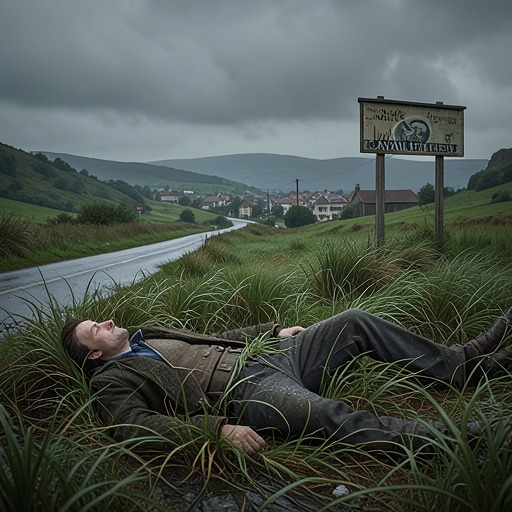
The riverbed is completely dry in the relevant scenes. From the bridge spanning it, Montalbano and Ingrid can see the channel by moonlight. It runs directly toward the beach, but the route is steep and strewn with large rocks and stones. The bridge provides a vantage point from which its direction is clear; it does not make the descent look easy. The riverbed is at once a visible connection between inland road and coast and a rough obstacle between them.
The route has a reputation for being impassable, a judgment Montalbano challenges through experience. He has crossed the dry bed himself, establishing that passage is physically possible, but the attempt has a cost: his car’s suspension is ruined. The route is therefore neither an impossible barrier nor a convenient shortcut. A vehicle can make it through, but the jolting terrain can leave tangible damage behind.
A Possible Route to the Pasture
The riverbed matters to the investigation because it complicates the search for an unseen approach to the Pasture scrubland. Montalbano reasons that, despite the many roads and byways between Montelusa and Vigàta, a car taking a route intended to avoid observation would, at a certain point, have had to cross the Canneto riverbed to reach the Pasture. This makes the channel a specific link in a possible journey, rather than simply one difficult feature among many in the surrounding terrain.
The claim meets immediate resistance: the riverbed is regarded as impassable. Montalbano answers not with a map or an abstract estimate, but with the fact that he has driven across it. His damaged suspension gives his rebuttal weight while also exposing the weakness in treating the route as an ordinary road. The crossing is possible, but it demands a vehicle and driver capable of enduring a punishing passage. The evidence establishes a potential route, not by itself proof that a particular car used it.
The Bridge and Ingrid’s Test
Later, after fifteen minutes of silence in the car, Montalbano resumes his investigative role and stops at the bridge. He gets out and asks Ingrid to join him, then points out the riverbed in the moonlight and traces its descent toward the beach. His question is practical: could a car be driven down such a steep incline over the rocks? Ingrid cannot be sure in the dark, especially since she says it would be different in daylight, but agrees to try.
With her ankle sore and one foot not working properly, Ingrid wraps it tightly and gets behind the wheel. She first drives in reverse to a dirt road running from the provincial road to the area beneath the bridge. From there she sets off down the riverbed. The crossing takes ten minutes of continuous, ferocious jolts. Montalbano is shaken so violently that he feels his head might separate from his body, while Ingrid remains calm and determined, concentrating on the drive with her tongue protruding between her lips.
They reach the beach. Ingrid’s question afterward—whether she has passed the test—makes the descent an explicit trial of driving ability, not merely a conversation about terrain. Her excitement and pleasure at reaching the bottom contrast with Montalbano’s bruising experience of the journey. The successful run confirms that a car can negotiate the route under these circumstances, even though it does not settle who previously made the crossing or what vehicle was used.
Investigative Significance
The Canneto riverbed gives Montalbano a way to test a route that conventional assumptions would dismiss. Its dry channel, bridge, steep slope, rocks, and connection to the beach turn topography into evidence: the question is not simply whether a road exists, but whether a driver could descend it and emerge at the coast. The damaged suspension and Ingrid’s ten-minute ordeal keep that possibility grounded in physical cost.
The location also shapes the investigation as an experiment. Montalbano first relies on his own crossing to dispute the claim of impossibility, then shows Ingrid the descent and lets her attempt it. What had been a hidden route on a hypothetical journey becomes a passage they have traversed together. The riverbed’s importance lies in this distinction: it makes an unseen approach plausible, while leaving the actual journey to the Pasture scrubland unproven by the test alone.