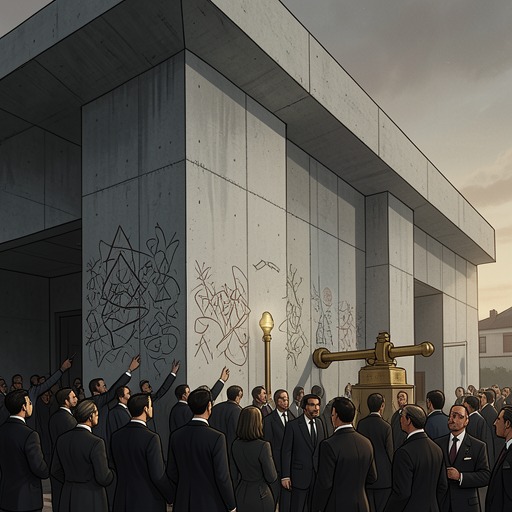
Corruption and Mafia infiltration of the Sicilian political system
The Shape of WaterCorruption and Mafia infiltration of the Sicilian political system appears not as a single conspiracy but as a web of public offices, private favors, party succession, and criminal coercion. Its reach is visible in ordinary employment as well as high politics: political influence secures jobs, contracts accumulate in the hands of a few, and violence shadows the struggle over power. Silvio Luparello’s career and death reveal the system’s most polished face; Pietro Rizzo’s response to that death exposes its capacity to turn private catastrophe into political leverage.
Patronage in Daily Life
The network reaches down to temporary work. Pino Catalane and Saro Montaperto, trained as land surveyors but employed as ecological agents by Splendour, owe their positions to the electoral influence of Chamber Deputy Cusumano. The two had worked hard for his campaign, and that service was repaid with employment rather than professional surveying work. Their assignment to the Pasture scrubland comes when two other workers are absent after attempting an armed supermarket robbery. Political favor and criminality thus occupy the same practical landscape: a government-contracted cleaning company offers jobs through a deputy’s connections, while the work itself takes place at the margins of town, near an abandoned industrial ruin.
The scale of the patronage becomes clearer in Luparello’s rise. An engineer and heir to a Montelusa building dynasty, he returned after graduating with highest honours from Milan Polytechnic and entered politics through Catholic networks formed at the national organization of Catholic university students. Publicly, he cultivated an image of modesty and service, appearing beside party leaders without seeking the foreground and repeatedly withdrawing from elections for ostensibly self-effacing reasons. Privately, those years in the background allowed him to build influence. Over nearly two decades he gathered political dependants, beginning with Cusumano and extending to Senator Portolano and Chamber Deputy Tricomi; the newspapers described them as devoted friends, while Montalbano’s account presents them as men in Luparello’s service.
Luparello’s Political Power and Succession
By the time of his death, Luparello effectively controlled the party in Montelusa and its province and had come to dominate roughly 80 percent of public and private contracts. The proportion makes the political structure tangible: influence was not confined to speeches or party offices but extended into the allocation of work and resources. His position also survived the upheaval caused by Milanese judges who displaced a political class that had governed for fifty years. Because Luparello had remained in the shadows, he could emerge as a critic of his own party’s corruption and present himself as a standard-bearer for renewal. He became provincial secretary only three days before he died.
His successor’s election shows how quickly the formal structure could adjust to a death. The party convened unusually soon, rather than observing the customary interval of mourning, and unanimously elected Dr Angelo Cardamone, Luparello’s longtime opponent within the party. Their differences concerned the governing coalition and whether to open a cautious dialogue with the left. Cardamone publicly promised not to betray his predecessor’s memory, but the transition also marked a contest over who would inherit Luparello’s political authority. His widow later questioned whether Luparello, after patiently manoeuvring for years to reach the political foreground, would really have risked recognition and blackmail by going to a notorious sexual meeting place. Her doubt calls attention to the gap between the public story surrounding his death and the careful political life he had constructed.
Scandal as Political Leverage
Rizzo’s conduct after Luparello’s death demonstrates how the network could turn information into power. The two street cleaners who discovered the body first informed Rizzo, whom they regarded as Luparello’s alter ego. According to Montalbano, Rizzo showed no surprise or alarm and told them to report the discovery. One of the workers had transcribed the exchange. That record gives the investigation a concrete trace of Rizzo’s response, though it does not by itself establish what he knew or intended.
Montalbano reconstructs a larger scheme from the circumstances. He believes that a woman present when Luparello died called Rizzo for help; Rizzo then arranged to remove and dress the body, and the woman left. At the house he found her necklace and clothing, recognized an opportunity, and identified her as Ingrid Sjostrom, the Swedish daughter-in-law of Angelo Cardamone. In Montalbano’s interpretation, Rizzo could use the implied affair to compromise Cardamone, Luparello’s successor, while disgracing the dead engineer and weakening the political figures who might claim his inheritance. He allegedly arranged for the body to be found at the Pasture and used Ingrid’s bag and necklace to make her appear to have accompanied Luparello there. The account describes political influence operating through fabricated scandal: private sexual conduct becomes a weapon against a rival’s family and a means of bargaining for power.
The gendered threat behind that fabrication is not merely invented. Ingrid tells Montalbano that, two years earlier, her father-in-law entered her room while her husband was away and threatened her; she says that he later continued kissing and touching her when opportunities arose. She had asked her husband to move out, but he refused, and she sought occasional use of Luparello’s house. Her account places the political household itself within a structure of unequal power, where a woman’s safety and reputation could be compromised by a powerful older man. Rizzo’s alleged framing would exploit that vulnerability and the assumptions attached to Ingrid’s foreignness and sexual reputation, even as the evidence against her was deliberately manufactured.
Criminal Violence and the Limits of Proof
The political story unfolds alongside visible criminal violence. A television report announces a shoot-out between petty Mafiosi outside Miletta on the same evening that it reports the party’s rapid election of Cardamone. Elsewhere, Rizzo’s alleged operatives include men Montalbano describes as underhanded butchers; one, Angelo Nicotra, is known among them as Marilyn. These details place political maneuvering in contact with criminal actors, but they do not establish that every intermediary or violent act belongs to a single Mafia chain of command. The narrative’s emphasis is on the porous boundary between respectable power and coercive networks, not on a fully documented organizational chart.
That distinction matters to the investigation’s outcome. The commissioner finds Montalbano’s reconstruction plausible for anyone who understood Rizzo’s character, but stresses that it has no proof capable of withstanding a lawyer’s scrutiny. Rizzo knew many people, respectable and otherwise, and Montalbano describes the resulting field of possible enemies as a jungle. The clues may make the political logic legible—Rizzo’s silence, the planted belongings, the timing of the succession—but deduction is not the same as evidence sufficient for prosecution.
Systemic Significance
The novel links corruption to the circulation of favors and control over resources, rather than treating it as an isolated exchange of money. Cusumano’s role in securing temporary jobs, Luparello’s command of party relationships and contracts, and the swift succession after his death show how official positions coexist with informal authority. Rizzo’s alleged use of a staged sexual scandal extends that same logic into the realm of reputation: political opponents can be constrained not only through offices and contracts but through the threat of exposure and disgrace.
Mafia presence and political corruption consequently remain intertwined but not interchangeable. The reported shoot-out establishes a setting in which organized criminal violence is part of public life; the investigation suggests that political operators can work through dangerous intermediaries; yet Montalbano’s account remains short of demonstrable proof. That unresolved distance between a persuasive explanation and a provable case is itself central to the portrait. The system can be recognized through its patterns of patronage, rapid adaptation, and concealed coercion, even when its individual transactions remain difficult to establish in court.