Dignity in death
The Shape of WaterDignity in death is tested through two sharply contrasting scenes: Silvio Luparello’s exposed body in a car and the carefully ordered home where the Continos lie dead. Montalbano has argued that no death is sacred, while Commissioner Burlando holds that every death, even the most abject, is. The investigation gives each position a concrete image, then unsettles the apparent opposition: a body can be stripped of its public composure, while a scene of self-inflicted and inflicted death can still command a solemn response.
The Dispute Over Sacredness
About ten days before seeing Luparello’s corpse, Montalbano and his friend Commissioner Burlando discussed Ariès’s Western Attitudes Toward Death, a book both had read. Burlando maintained that every death was sacred, however abject; Montalbano sincerely rejected the claim, saying he could see nothing sacred in any death, not even a pope’s. Their disagreement is therefore not an abstract exchange introduced after the fact. When Montalbano first looks at Luparello, the memory of that conversation immediately returns, and he wishes Burlando were beside him to see the body.
The wish gives the disagreement the shape of a test. Montalbano does not begin by invoking rank or seeking guidance from a superior; the commissioner comes to mind because the scene appears to demand an answer to their prior argument. What can the dead body mean when the signs of personal dignity have been so visibly undone? Later, in a different house and before two other bodies, Montalbano thinks of Burlando again, this time judging that the commissioner was right. The repeated recollection links the scenes without making them equivalent: it is the contrast between them that changes the force of the earlier dispute.
Luparello’s Body and Public Composure
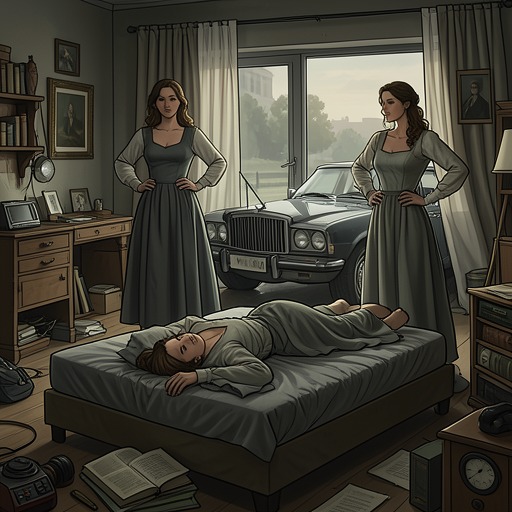
Montalbano leans into the car, which feels like an oven, and sees Luparello’s corpse. The man had been known as elegant and meticulously groomed, but the body before the inspector has lost every mark of that composed appearance. His tie is missing, his shirt rumpled, his glasses askew, and one side of his jacket collar turned up. His socks have sagged over his loafers. These details make the corpse’s disarray specific: the scene does not merely announce that death has occurred; it reverses the care associated with Luparello’s living presentation.
The most disturbing element is the exposure of Luparello’s body. His trousers are pulled down to his knees, his underwear shows, and his shirt and undershirt have ridden up his chest. The exposed sexual organ stands in stark contrast to the meticulous attention formerly given to the rest of his person. Montalbano’s attention to this contrast makes the indignity of the scene inseparable from its physical particulars. The corpse’s appearance does not prove that death itself lacks sacredness, but it makes the claim difficult to experience as consoling: what Montalbano sees is an intimate and carefully managed public image reduced to bodily exposure.
The Continos’ House
At the Continos’ apartment on Piazza Dante, the scene is different in nearly every visible respect. The rooms are sparkling clean and in perfect order. Master Contino lies in an armchair with a small bloodstain over his heart; an old five-shot Smith & Wesson lies on the floor beside him. His wife is on the bed, also with a bloodstain over her heart, her hands clasped around a rosary. Montalbano understands that she must have been praying before agreeing to let her husband kill her. The careful order of the rooms, the rosary, and the bodies’ positions give this scene a gravity absent from the disarray surrounding Luparello.
The dignity Montalbano recognizes here does not erase the violence: the deaths are a murder-suicide, and the revolver that caused them is an ancient weapon that still works. Nor does the scene offer a simple picture of peaceful death. Instead, dignity emerges in the inspector’s response to the particular circumstances before him. The rosary held in the wife’s hands and the stillness of the ordered rooms make the deaths legible to him as more than a shocking discovery. Where Luparello’s exposure had seemed to deny any sacred aspect, the Continos’ scene makes him recognize one, even though its order cannot undo what happened.
Recognition and Remorse
The commissioner’s argument returns in a changed form. At Luparello’s car, Montalbano wants Burlando to witness the degrading spectacle that had challenged his claim about death. At the Continos’ home, the inspector again thinks of his friend, but now concludes that he had been right: here, death had found its dignity. That reversal is grounded in the difference between the two scenes rather than in a stated change of doctrine. Montalbano does not withdraw his earlier rejection in a formal argument; the later encounter makes him acknowledge that dignity can be present where he had not expected to find it.
His response is also shadowed by remorse. After giving the sergeant instructions and leaving him to wait for the judge, Montalbano feels sudden melancholy and wonders whether he could have acted more wisely with the schoolmaster, or alerted Contino’s friends and doctor in time. The scene’s moral weight thus extends beyond the bodies and the question of sacredness. Dignity is not only something the living may perceive after death; the encounter also forces Montalbano to reckon with possible failures of intervention before it. The idea remains unresolved as a universal rule, but the two scenes turn it into a personal judgment: what the dead demand of the living may become clearest when the chance to help has passed.