Giorgio dies after driving off a cliff
The Shape of WaterGiorgio Zicari’s death is disclosed as a fatal road accident, but the explanation makes the crash more than a matter of a missed turn: it joins dangerous speed and heavy sedation to a grief that had left him almost constantly deranged after his father died. The delayed discovery, at the foot of the San Filippo bend, turns that private collapse into a recovered body and an account of how he lost control.
Absence and Discovery
Giorgio Zicari’s failure to return first becomes alarming through his absence. By the morning after the day Salvo Montalbano departed, he still had not come back. His relative says this prompted an appeal to the police and the Italian Carabinieri, whose searches are described as extremely superficial. The account ruefully connects their lack of success with their possible preoccupation with the investigation into Rizzo’s murder.
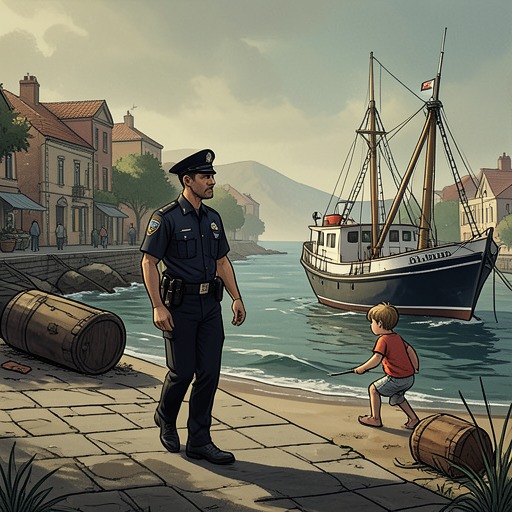
The body is found on Sunday afternoon by a fisherman at sea. From his boat, he sees a car that has fallen onto the rocks below the San Filippo bend, just before the Capo Massaria headland. He rows toward it, sees a body in the driver’s seat, and hurries away to report what he has found. The discovery establishes both the location of the wreck and the fact that Giorgio Zicari died at the wheel.
The Crash and Its Explanation
The reported cause is a missed curve at high speed. Rather than follow the bend, Giorgio Zicari continues straight, breaks through the small guard wall, and crashes onto the rocks. The account stresses that he was going very fast at that moment; the road’s curve and barrier mark the point at which speed becomes fatal.
His condition supplies the explanation offered for how he came to drive that way. Since his father’s death, Giorgio Zicari had lived in a state described as almost constant derangement and had taken too many tranquillizers and sedatives. The account does not separate grief from medication as competing explanations: it presents them together, alongside his speed, as the circumstances surrounding the crash. His relative insists that Giorgio Zicari had a real passion for his father and loved him, speaking of passion and love in a firm, precise tone that leaves little room for ambiguity about the depth of his attachment.
Aftermath and Significance
The report of the wreck is followed by Salvo Montalbano’s own silent response. At the airport, the announcement for the Milan flight sounds as he hears the news; after reaching his car, he drives hard and stops only after some sixty miles, beside an artificial lake. There he takes Giorgio’s neck brace from the trunk, throws it into the water, and waits for it to sink. The act gives the crash an immediate consequence beyond the recovery of the body: Montalbano disposes of an object tied to the case and recognizes that his inference had been right, even as he reflects that he had wanted to act like a god and had proved only a fourth-rate one.
The death is thus disclosed through a chain of absence, an imperfect search, and a fisherman’s discovery, before a relative supplies a cause rooted in speed, medication, and bereavement. The account’s emphatic naming of Giorgio Zicari’s love for his father places intimate grief beside the physical facts of the road: the curve he failed to take, the low wall he broke through, and the rocks where the car came to rest.