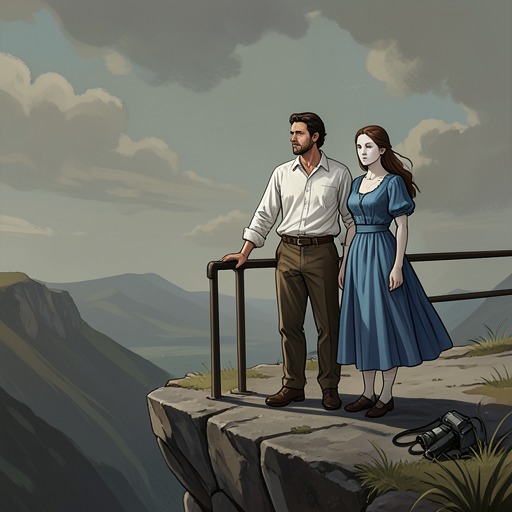
Giosuè Contino’s murder-suicide
The Shape of WaterGiosuè Contino’s murder-suicide is the devastating outcome of an earlier crisis that Salvo Montalbano had survived only by intervening in time. The deaths turn a private confession, first heard beneath a lighthouse, into a question Montalbano cannot set aside: whether his rescue of the old schoolteacher was enough, and whether he should have done more afterward.
The Earlier Attempt and Rescue
Six months before the deaths, Montalbano encountered Contino during one of his customary walks along Vigàta’s eastern jetty, a route he took two or three times a week toward the lighthouse. Before setting out, he had stopped at Anselmo Greco’s shabby shop, which stood in deliberate contrast to the clothing boutiques and mirrored cafés along the main street. Greco sold an assortment of old-fashioned goods as well as càlia e simenza, roasted chickpeas and salted pumpkin seeds; Montalbano bought a paper cone of the mixture and carried it with him on the walk.
Under the lighthouse, Montalbano saw an elderly man sitting motionless on the low concrete breakwater, his head bowed. At first he looked more closely to determine whether the man was fishing. Instead, Contino stood, made the sign of the cross, and balanced on his tiptoes. Montalbano shouted for him to stop, then reached him in a few bounds, seized him by the lapels, and carried him bodily to safety. The abrupt physical intervention precedes any understanding of what has brought Contino there: the inspector acts on the immediate danger before he knows its cause.
When asked whether he had meant to kill himself, Contino answered yes. He explained that his wife was cheating on him. Montalbano had expected many explanations, but not that one from a man who appeared to be over eighty. The age gap between the spouses made the disclosure startling to him, though the evidence gives no further account of their marriage or of the alleged infidelity. Contino’s brief explanation therefore supplies a motive for his despair without resolving the private history behind it.
The Bodies in the Apartment
The later scene is markedly different from the exposed edge of the breakwater. A municipal policeman keeps curious bystanders away from the front door on Piazza Dante, while Sergeant Fazio reports that it is all over. Inside, the rooms are in perfect order and sparkling clean. Contino lies in an armchair with a small bloodstain over his heart; beside him on the floor is an ancient Smith & Wesson five-shot revolver, old enough to seem like an artifact from Buffalo Bill’s time but still capable of firing.
Contino’s wife is on the bed, also with a bloodstain over her heart. Her hands are clasped around a rosary. The arrangement suggests that she had been praying before she agreed to let her husband kill her, an inference Montalbano draws from the scene rather than a fuller account of what passed between the couple. The tidy rooms, the two wounds in the same place, and the rosary held in the dead woman’s hands give the deaths a controlled, intimate appearance; none of those details lessens the violence or makes the wife’s consent independently known.
Montalbano recalls the commissioner’s earlier judgment and thinks that here death has found its dignity. The thought registers the difference between the scene before him and a disorderly killing, but it also sits uneasily beside what he knows: Contino had once stood at the point of taking his own life, and the intervention then had not prevented this ending. The murder-suicide is thus presented both as a terrible private decision and as the consequence of a crisis that had already briefly entered the inspector’s care.
Montalbano’s Remorse and the Wider Aftermath
Nervous and surly, Montalbano gives Fazio instructions and leaves him to wait for the judge. As he goes, melancholy is joined by a quieter remorse. He wonders whether he might have dealt more wisely with the schoolteacher, or alerted Contino’s friends and doctor in time. The narrative does not establish that any particular intervention would have changed the outcome; it shows instead how the earlier rescue becomes, after the deaths, a measure against which Montalbano judges his own response.
He takes a long walk along the wharf and the eastern jetty, returning to the landscape of the earlier encounter before going back to the office. His spirits revive slightly, but the respite is brief. Fazio is beside himself: while half the town had been watching Contino shoot his gun, intruders had emptied two apartments from top to bottom. Montalbano tells Fazio to join the officers already sent to investigate the burglaries and says he will remain at the office.
The thefts unfold alongside, not as an explanation for, the deaths. Their timing makes the town’s attention itself part of the aftermath: a public spectacle has drawn onlookers while another crime proceeds out of sight. Montalbano then decides to use the trap he has been planning and reaches for the phone. The story moves on to a new investigation, but Contino’s case leaves behind a personal remainder: the inspector’s knowledge that he once pulled the schoolteacher back from the edge, and his unresolved sense that rescue without timely support may not have been enough.