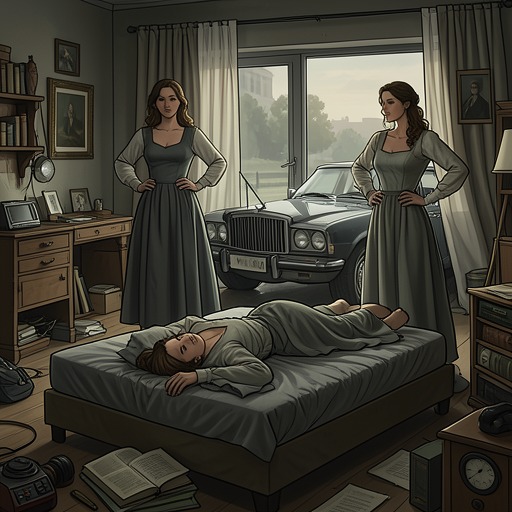
Luparello’s Capo Massaria cottage
The Shape of WaterLuparello’s Capo Massaria cottage is a secluded private retreat whose contents become evidence in the investigation of Silvio Luparello’s death and a resource in Pietro Rizzo’s political maneuvering. Ingrid Sjostrom had used the house to escape harassment by her father-in-law, Dr Cardamone; after Luparello died, her clothes and bag there exposed a connection that Rizzo could exploit. The cottage’s changing interior—first unexpectedly intact, later cleaned almost bare—records competing attempts to control what could be discovered about the death and Ingrid’s visits.
A Private Retreat and a Place of Refuge
The cottage is described as Luparello’s little house at Capo Massaria, also referred to as his pied-à-terre. Ingrid confirms that she had taken Dr Cardamone there. Her explanation makes the house’s private function more complicated than a hiding place for an affair: she says she began using it after Cardamone repeatedly entered her room and kissed and touched her, despite her fear and efforts to resist his advances. She and her husband, Giacomo, lived in the same palazzo as Cardamone, and Giacomo refused her requests to move away. The cottage therefore offered a space apart from the household in which the harassment occurred.
Ingrid did not tell Giacomo the full reason for her visits. She says she concealed Cardamone’s involvement and led her husband to believe that she went to the cottage with Luparello. That lie shaped what Giacomo understood about the house and its contents, while Ingrid’s own account leaves her unsure whether her husband suspected anything. The retreat held a secret, but not the one Giacomo was led to imagine.
Contents Ingrid Expected to Disappear
After Luparello’s death, Ingrid feared that police or his family would discover her clothes and bag at the cottage. She told Giacomo about the belongings, but not about Cardamone. Giacomo then assured her that a friend would take care of the problem and that anyone who entered would find only whitewashed walls. His account gave Ingrid reason to expect an emptied house.
When Salvo Montalbano later took Ingrid to Capo Massaria, she expected nothing to remain inside. Instead, she was surprised to find everything still there, just as it had been. The contrast matters: the cottage was not merely a remembered meeting place but a location whose material contents could contradict the assurances she had received. Ingrid’s reaction also reveals how much she had relied on Giacomo’s report that the belongings had been removed, without knowing who had supposedly arranged it or what had actually happened inside.
The Death and Pietro Rizzo’s Intervention
In Montalbano’s reconstruction, Luparello dies during or just after sex at the cottage. The woman with him panics, loses the necklace she is wearing without noticing, and calls Rizzo for help. Rizzo tells her to leave and says he will manage the aftermath, allowing her to withdraw from the scene. The lost necklace and the woman’s clothes in a wardrobe turn the private interior into a store of clues: when Rizzo arrives, they disclose an opportunity to use the circumstances of the death for political advantage.
Rizzo’s first stated plan is to dress Luparello’s body hurriedly and remove it to somewhere less compromising. But finding the necklace and the woman’s clothes changes the stakes. He recognizes that evidence connecting Luparello to Ingrid could give him leverage over political allies and opponents. The cottage thus supplies not only a place where the death occurred but also the objects through which Rizzo can turn a private encounter into a public scandal and a political weapon.
A Cleared Interior and the Evidence That Remains
Montalbano asks whether Rizzo went to the cottage. The answer is that he did, and that the house had been cleaned to perfection. By then, only a few of Luparello’s belongings remained. This later condition differs sharply from the intact interior Ingrid encountered: the rooms she had expected to be empty had still held their contents when she saw them, but the subsequent inspection found almost everything else removed.
That sequence makes the cottage’s changing state central to the reconstruction. Ingrid’s clothes and bag first represent the exposure she feared; the necklace and wardrobe contents, in Montalbano’s account, help explain how Rizzo discovered his chance to frame the political consequences. The later clearing of the house obscures those traces without undoing their significance to the inquiry. The cottage is therefore both a refuge shaped by Ingrid’s constrained circumstances and a contested scene whose belongings, removal, and absence reveal how people attempted to manage the truth.