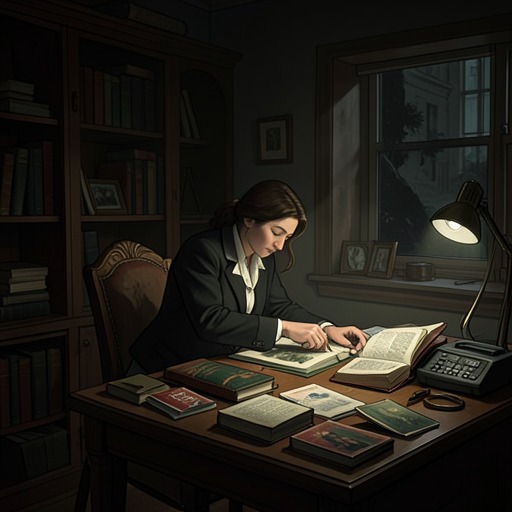
Montalbano destroys the false evidence against Ingrid
The Shape of WaterSalvo Montalbano destroys the false evidence against Ingrid Sjostrom by removing her belongings from the Capo Massaria house and hurling her bag into the sea. The decisive act is both physical and moral: he makes the bag difficult to recover, tells Ingrid that nothing remains with which to frame her, and accepts responsibility for intervening rather than leaving the evidence in place.
Discovery and entry
By the glare of the headlights, Montalbano notices that the entrance gate to the Capo Massaria house is open. He quickly turns off his own headlights, gets out, and asks Ingrid to wait in her car with the lights off. She cannot clearly remember whether they shut the gate when they left, though she thinks they did. The uncertainty makes an accidental explanation possible, but also leaves open the risk that someone else has entered the house.
Montalbano takes his bag and pistol from his car and approaches on foot, trying to move quietly. The front door opens without resistance or sound. Inside, reflections from the water give the large room a dim light; he checks the bathroom and then the other rooms, pistol in hand. His comparison of himself to a hero in an American television programme punctures the suspense with self-consciousness. The search finds no one and no sign that anyone else has been there. He concludes that he probably left the gate open himself, replacing the threat of an intruder with a more ordinary explanation without eliminating the need to finish what he came to do.
Disposal of the evidence
From the picture window, Montalbano looks down toward the sea, with the Capo Massaria headland projecting over the water like a ship’s prow. He judges that the water below must be quite deep. He then adds weight to Ingrid’s bag with silverware and a heavy crystal ashtray, swings it around his head, and throws it out to sea. The objects have a practical role: they ballast the bag, making it less likely to be found. His action is purposeful, not a hurried abandonment; he considers the depth and gives the bag extra weight before casting it away.
He also takes everything belonging to Ingrid from the bedroom wardrobe. With the bag gone and her clothes removed, he shuts the front door carefully and carries the clothes outside. The two acts are related but distinct: the bag is disposed of beyond easy recovery, while Ingrid’s other belongings are returned to her. In removing what can connect her to the house, Montalbano dismantles the material basis of the frame. The scene does not describe an official seizure or a public explanation; the evidence is eliminated privately, through a sequence of deliberate choices.
Ingrid’s return and departure
When Montalbano reaches the top of the stairs, Ingrid’s headlights illuminate him. He had told her to keep them off, and asks why she turned the car around. She explains that she did not want to leave him alone in case there was trouble. Her return contrasts with his attempt to manage the danger by keeping her at a distance: she has waited, then chosen to come back rather than leave him there by himself.
He gives her the clothes. Ingrid puts them on the passenger seat and asks where the bag is. Montalbano tells her that he threw it into the sea and that they have nothing left with which to frame her. The exchange states the consequence plainly: the missing bag is not an accident or a lost possession but the result of his intervention against the threatened accusation. Ingrid gets out, walks up to him, and embraces him, resting her head against his chest for a while. She then returns to her car and drives away without looking back at him. The embrace acknowledges what he has done without turning the moment into an explanation or a promise; her departure closes the scene on a quiet, consequential separation.
Significance of the action
The sequence makes protection depend on concealment. Montalbano does not expose the alleged frame by preserving its physical evidence; he destroys that evidence, taking the bag out of circulation and returning Ingrid’s clothes. His assurance that the means to frame her are gone gives the act its immediate purpose, while the careful search of the house and the weight added to the bag show how thoroughly he carries it out. The safety he offers is therefore inseparable from his decision to intervene in secret.
The scene’s suspense turns on ordinary objects and small movements: an open gate, a pistol carried through darkened rooms, a wardrobe emptied of Ingrid’s clothes, silverware and a crystal ashtray packed into a bag, headlights switched on at the wrong moment. Each detail advances the same practical task, but the final embrace changes its emotional register. Montalbano’s disposal of the bag prevents it from serving as evidence against Ingrid; her return to the car and departure leave that protection in place without resolving everything between them. The action ends not with a public vindication, but with the danger of being framed materially reduced and the two characters briefly joined in silence.