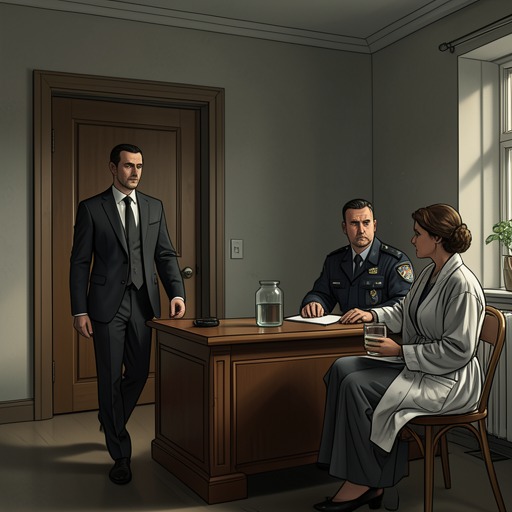
Montalbano discovers the neck brace clue
The Shape of WaterSalvo Montalbano discovers the neck brace clue by bringing together bodily pain, an overlooked object at The abandoned Sicilchim factory, and the details of Silvio Luparello’s fatal wound. The recognition helps expose how Giorgio Zicari tried to conceal the circumstances of his uncle’s death: the brace was not merely discarded medical equipment, but part of the staging of the corpse.
The bodily trigger
At four in the morning, Montalbano is awake with a persistent pain at the back of his head. It does not ease when he lies still, and its dull, unbroken quality makes it especially difficult to ignore. On his bedside table are the salve and gauze he had used on Ingrid Sjostrom. He rubs salve onto the nape of his neck and wraps it in gauze, but tightens the dressing enough to make turning his head difficult.
In the bathroom mirror, the light seems to set off a sudden flash of understanding. The moment is presented through bodily sensation before it becomes an articulated deduction: Montalbano feels as if he can see inside things. The memory of a grammar-school priest’s lesson that truth is light gives the flash a retrospective, almost emblematic shape. Yet the insight does not arrive as abstract reasoning alone. His own neck, newly constrained by the bandage, makes the physical evidence of the case newly legible.
Recognition at the factory
Montalbano later returns to The abandoned Sicilchim factory with its key, which he retrieves from a tin where he keeps assorted small possessions. There, on a rotten beam near the place where Ingrid Sjostrom’s bag had been found, he examines an object that had previously seemed like an unidentified pipe coupling sleeve. This time he recognizes it as a brand-new neck brace that has plainly been used.
The change is in the object’s meaning, not its location. It had been present among the factory evidence, but its appearance had not yet connected it to the crime. Now the brace’s function makes it consequential. Montalbano’s own neck begins to hurt as he picks it up, a physical echo that links the object to the pain and injury at the center of the case. He takes the brace back to headquarters rather than leaving it as an unexplained piece of debris.
The clue and the staged body
A later account of the killing sharpens the significance of the discovery. Montalbano hears that the killer first kicked Luparello in the groin, made him kneel, pressed a gun to the back of his neck, and fired. At the description of the shot, a pang passes through Montalbano’s neck. The bodily response does not itself establish what happened, but it reinforces the connection between the wound’s location and the brace he has recognized.
When Montalbano eventually recounts the case to Livia, he explains the brace’s role in Giorgio Zicari’s attempt to conceal the death. After Luparello died during a tryst at The Capo Massaria house, Giorgio dressed him as best he could and dragged him to a car, intending to leave the body somewhere else. Realizing that the plan would not disguise the fact that he was transporting a dead man, Giorgio put on the corpse the neck brace he had worn until that very day. He tried to obscure it with black cloth. The brace therefore connects the factory object to the movement and presentation of the body, and to Giorgio’s improvised effort to protect his uncle’s image and memory.
Consequences and significance
The discovery makes a previously unreadable object part of a causal reconstruction. The brace’s presence at the factory, near Ingrid Sjostrom’s bag, can be understood against Giorgio’s attempt to relocate Luparello’s body; its use on the corpse explains why it had been worn and why it was connected to the staged discovery. Montalbano’s recognition thus shifts the investigation from treating the object as miscellaneous industrial material to seeing it as evidence of a particular person’s actions.
The scene also gives the investigation a distinctly physical mode of knowing. Montalbano’s headache, the tight gauze around his nape, the sudden difficulty turning his head, and the pain that returns when he handles the brace all make his body an instrument of attention. The clue becomes intelligible through a conjunction of observation and sensation, then gains its full explanatory force when set beside the wound and Giorgio’s later-described staging. What had looked like discarded equipment becomes a trace of concealment—and a route toward the truth about how Luparello’s death was hidden.