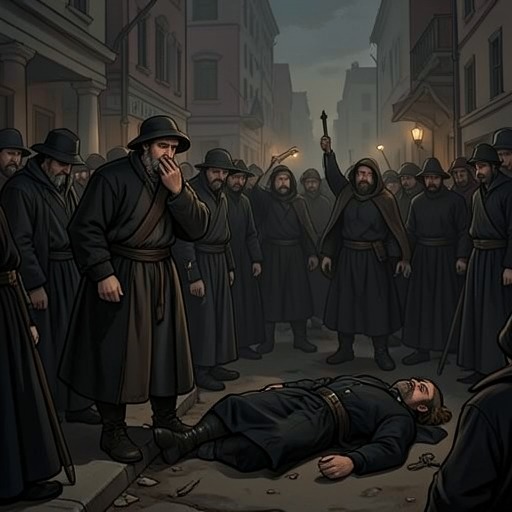
Montalbano sinks the neck brace in the lake
The Shape of WaterSalvo Montalbano’s decision to sink the neck brace in an artificial lake is a quiet act of concealment after he has concluded that his guess about the events surrounding him was right. Rather than resolve the matter openly, he removes the object from his car and watches it disappear beneath the water.
The account before the drive
At the airport, Montalbano hears that a cousin had been missing after his father’s death. The following morning, when the cousin still had not returned, the speaker alerted the police and the carabinieri; the searches were described as superficial. A fisherman later saw a car on the rocks below the San Filippo bend, rowed closer, found a body in the driver’s seat, and reported it.
The speaker attributes the crash to the cousin’s prolonged derangement after his father’s death, worsened by excessive tranquillizers and sedatives. Driving fast, he continued straight instead of taking the curve, broke through the low guard wall, and went over. The speaker insists that the cousin had loved his father, giving the account a personal grief that sits beside the factual description of the accident. The conversation places Montalbano’s subsequent action in the wake of another man’s death and a claim of enduring attachment.
The disposal
Once outside the airport car park, where his own car was waiting, Montalbano presses the accelerator down. He wants to avoid thinking and concentrate on driving. After roughly sixty miles, he stops beside an artificial lake, opens the trunk, takes out the neck brace, throws it into the water, and waits until it sinks. The sequence is deliberate: he carries the object to a remote stopping place and stays until it has vanished from sight.
The physical act is precise, but the account does not spell out the brace’s evidentiary role or the details of the inference Montalbano has made. It does establish that he treats its removal as consequential. Only after the brace has sunk does he smile, connecting the disposal to his sense that he has guessed correctly.
Meaning and consequence
Montalbano recognizes that he has wanted to act like a god, and accepts that Livia’s assessment of him was true. Yet he also judges himself a fourth-rate god, describing this as his first such experience and hoping it will be his last. The self-mocking comparison does not undo his choice: he has used his own judgment to decide what should disappear, then confirms that decision by waiting for the brace to sink.
The episode ends on certainty rather than public explanation. Montalbano’s smile signals that, in his view, the guess was right; the lake conceals the object on which he has acted. The quietness of the scene sharpens its moral tension: a deliberate intervention is carried out without witnesses, and the narrative leaves the reader with the distance between Montalbano’s confidence in his deduction and his unease at having assumed godlike authority.