Nenè’s unexplained illness
The Shape of WaterNenè’s unexplained illness is an ongoing crisis with no known cause, no effective local explanation, and no affordable route to specialist care. It is not merely background hardship: it governs the child’s days, weighs on his parents, and turns the discovery of a valuable lost necklace into a painfully consequential question about how far they can go to secure treatment. The narrative gives the illness no diagnosis or resolution; its force lies in the uncertainty surrounding Nenè and in the practical and moral pressures that uncertainty creates.
Symptoms and Daily Life
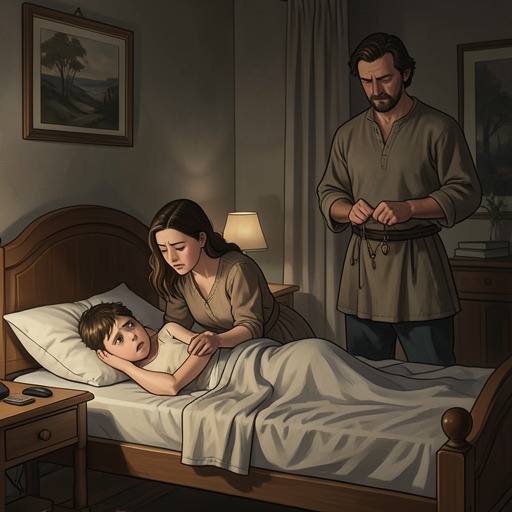
Nenè sleeps only intermittently, for about two hours a night, and spends the rest of the time awake without crying. The narrator presents this not as a reassuring sign but as an unsettling departure from what his father expects of a baby. His illness consumes him day after day, while its cause and cure remain unknown. The doctors in Vigàta cannot explain what is wrong, leaving the family without even the certainty that a name for the condition might bring.
The account makes Nenè’s vulnerability visible through particular details. When Montalbano sees him, the baby is described as sallow and hollow-cheeked, with large eyes that seem already grown-up and angry. Earlier, his brow wrinkles when he meets his father’s gaze. Nenè cannot speak, but the narration renders his expression as a silent reproach directed at the person who, in that moment, seems responsible for his plight. This is the story’s interpretation of his look, not a medical explanation: his illness remains opaque even as its emotional presence is made unmistakable.
The Family’s Search for Help
The uncertainty has immediate consequences for Nenè’s parents, Saro and Tana. Local doctors have not found an explanation, and the family would need to take him elsewhere to consult a specialist. They cannot afford to do so. The possibility of treatment in a larger medical centre is therefore not an abstract hope but a financial problem with no obvious solution. Tana tells Saro that the fever is going down and that Nenè is doing a little better, but the narration makes clear that she says this to reassure him; it does not establish that the illness has improved.
When Montalbano asks what the parents had intended to do with the money they hoped to obtain from the necklace, Tana says they wanted to take their son far away, to Rome, Milan, or wherever doctors might know what was wrong. Their answer clarifies the stakes behind Saro’s calculations. He estimates that the Heart-shaped diamond necklace might be worth twenty million lire and imagines that a finder’s share could bring them two million, then immediately measures that sum against the cost of Nenè’s treatments. The figure is not evidence that treatment would succeed or that the money would be enough; it records the parents trying to imagine a way to reach care they otherwise cannot afford.
The Necklace and a Moment of Hope
The necklace places the family’s honesty in direct tension with their need. Tana objects to selling something that does not belong to them. Saro counters that handing it to the factory foreman could mean losing control of its return to its owner, and he considers the finder’s share as a possible means of paying for treatment. After talking through the night, the couple settle on a temporary compromise: they will keep the necklace secret for a week and pawn it only if nobody comes forward to claim it. The decision is provisional, and the text presents it as an attempt to preserve their sense of honesty while still confronting the cost of their son’s care.
At dawn, after Saro has decided on this possible course, he goes to kiss Nenè and finds him sleeping deeply and peacefully. The narration links the moment to the father’s hope, saying that Nenè seemed somehow to know Saro had found a way to make him well. That phrasing gives the scene an emotional lift, but it does not report a recovery: the family has found a possible source of money, not a cure, and the illness remains unexplained. Nenè’s peaceful sleep is a brief change in the scene, not proof that his condition has changed.
Narrative Significance
Nenè’s illness gives the necklace’s monetary value an intimate measure. For Saro and Tana, it is not simply a fortune or a temptation; it might be the means to take their child beyond the limits of local medical knowledge and their own poverty. That hope does not erase the ethical difficulty of keeping and pawning another person’s property. Instead, the illness makes the parents’ choice legible as a conflict between honesty and urgent care, without making either the moral question or the medical outcome easy.
The illness is also represented through a contrast between the absence of explanation and the intensity of observation. No doctor can say what is wrong, and no cure is offered, yet the narrative closely records Nenè’s short sleep, unbroken wakefulness, fever, face, and gaze. His inability to speak does not make him a neutral plot device: the account gives his silent expression emotional weight, while remaining clear that the adults cannot interpret or remedy the condition itself. Montalbano’s distress at seeing the sick child confirms the scene’s human stakes; he says that he cannot bear to see children suffer. The story leaves those stakes open. Nenè’s treatment remains a hope, and the last reported change is only the peaceful sleep that his father encounters at the end of a night spent searching for a way forward.