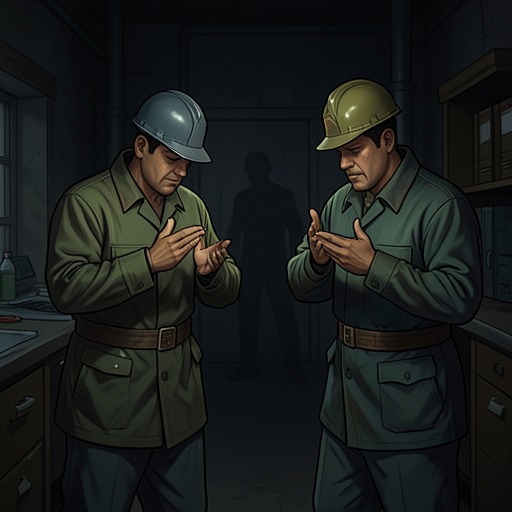
Silvio Luparello and Rizzo
The Shape of WaterSilvio Luparello and Rizzo are portrayed as political partners joined by an asymmetry of visibility: Luparello cultivated influence from the shadows, while Rizzo acted as the trusted intermediary who could respond in his name. Their bond becomes most consequential after Luparello’s death, when Rizzo’s access to information and ability to move people and objects turn private loyalty into a means of controlling the public story.
A partnership built in the shadows
Luparello’s power grew through patient political manoeuvring. An heir to a Montelusa building dynasty, he entered politics through Catholic networks and spent years appearing beside party leaders without taking the front position. His repeated public withdrawals from elections were presented as acts of humility and service, but the account of his career shows how he used his time out of the limelight to gather influence. Deputy Cusumano was among the political figures who became his dependants; in time, Luparello controlled the party in Montelusa and its province, as well as a vast share of public and private contracts.
Rizzo belonged to the inner circle that made this informal authority legible and usable. The two street cleaners who discovered Luparello’s body went to Rizzo before contacting the police because they knew him as Luparello’s alter ego. Rizzo’s position is therefore more than that of a colleague who happens to receive news: other people treat him as the person to approach when Luparello is involved. His authority rests on proximity to Luparello, not on any public office identified in this account.
The death and Rizzo’s intervention
Montalbano reconstructs the events of the Sunday night as a hypothesis rather than a fully confirmed account. He proposes that Luparello told his wife he would be late because of a political meeting, but went instead to his small house on Capo Massaria for a lovers’ tryst. Luparello died during or just after sex. According to the reconstruction, the woman with him panicked, lost her necklace, and eventually called Rizzo, whom she understood to be the person able to help.
In Montalbano’s account, Rizzo told the woman to leave the house and leave the key where he could find it, promising to take care of the situation. He then went to the house, where he found the necklace and the woman’s clothes, and hurriedly dressed the corpse so it could be removed from a compromising setting. The account presents Rizzo as both the recipient of the woman’s appeal and the person who takes charge of managing the consequences of Luparello’s death. The woman’s identity and the precise circumstances remain part of Montalbano’s reconstruction, not an independently established description of the relationship.
Rizzo’s handling of the body also exposes the partnership’s practical infrastructure. While two men left with the corpse, Rizzo took Luparello’s keys and returned to Montelusa, where he could obtain documents belonging to the dead engineer. The keys and papers gave him access to the material traces of Luparello’s life, while his control of the response at Capo Massaria gave him a chance to shape what others would discover.
From trusted intermediary to political operator
The discovery scene makes Rizzo’s standing visible through the cleaners’ conduct. Before calling the police, they informed him; when Montalbano later recounts the exchange, he says a cleaner had transcribed it. Rizzo showed no surprise or alarm, but told them to report the discovery at once. That response can be read as composure consistent with his closeness to Luparello, though it does not by itself establish what Rizzo knew before he was contacted.
The subsequent reconstruction gives that composure a darker context. Rizzo’s actions do not stop at arranging the corpse’s removal or retrieving documents. Finding the woman’s belongings gives him material he can use to redirect suspicion: he takes a handbag he finds at the house and orders it thrown over the wall of an abandoned factory, while the necklace is hidden behind a bush. The bag belongs to Ingrid Sjostrom and bears her initials. In the account Montalbano presents, Rizzo turns a private death and the traces of an unknown lover’s presence into instruments for a separate political manoeuvre.
What the relationship reveals
The partnership is defined less through scenes of personal intimacy than through delegated access and reliance. Luparello’s authority accumulates through concealed networks; Rizzo is the figure others approach when that authority must be acted upon. After Luparello dies, Rizzo’s apparent ability to enter the dead man’s house, take his keys, and retrieve his documents shows how political influence can survive its central figure, at least temporarily, through the people who know how to exercise it.
That continuity is also unstable. Rizzo’s intervention may initially appear to protect Luparello’s reputation by moving his body away from the compromising scene, but the same intervention enables him to exploit the circumstances and plant evidence against someone else. The relationship therefore joins loyalty and opportunism without making them identical: Rizzo acts as Luparello’s shadow man, yet the crisis created by Luparello’s death becomes an opening for Rizzo’s own manoeuvres. Their political bond is revealed most clearly at the moment it can no longer serve Luparello himself.