Silvio Luparello’s death and discovery
The Shape of WaterSilvio Luparello’s death and discovery begin with an apparently abandoned car at the Pasture, but the body inside soon unsettles the public image of a powerful political figure and opens a question the circumstances cannot readily answer: whether his death was a natural consequence of heart disease or the outcome of political coercion. The discovery is made by two precariously employed cleanup workers, in a landscape shaped by political patronage, unemployment, and the informal businesses that have grown at the edge of town.
Setting and background
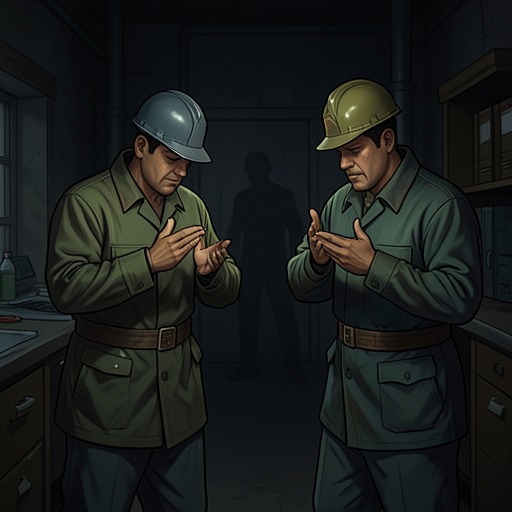
Before daybreak, the foreman at Splendour, the government-contracted refuse company in Vigàta, tells the workers that Peppe Schèmmari and Caluzzo Brucculeri will be absent: they have been arrested after attempting to rob a supermarket at gunpoint. Their vacant assignments go to Pino Catalane and Saro Montaperto, young land surveyors working as temporary ecological agents. They owe their employment to the intervention of Deputy Cusumano, for whose election campaign they had worked. The change of assignment puts them in the Pasture, a broad stretch of Mediterranean scrub running almost to the shore.
The setting carries the residue of earlier promises of development. Behind the scrub stand the ruins of a large chemical works, inaugurated by Deputy Cusumano during a brief period of supposed progress. The factory’s collapse left unemployment and compensation claims in its wake; a high wall later enclosed the structures, which weather and sea salt continued to corrode. The workers’ daily task is to clear rubbish from this marginal landscape, where ordinary refuse includes cans, plastic, paper, and discarded condoms.
For about a year, the condoms have accumulated in great numbers. The change follows the arrival of military detachments sent to Sicily to help control the territory, a decision presented as a response to law-and-order concerns. Their presence has also created a market at the Pasture: Gegè Gullotta, previously dealing in light drugs, secured unofficial permission from those who controlled the area and established a business supplying sex and drugs to the soldiers. The scrub is therefore not an empty backdrop. It is a space used and governed through overlapping official deployments and informal arrangements, and it is within that activity that Luparello’s carefully maintained public standing will collide with the circumstances of his death.
Discovery at the Pasture
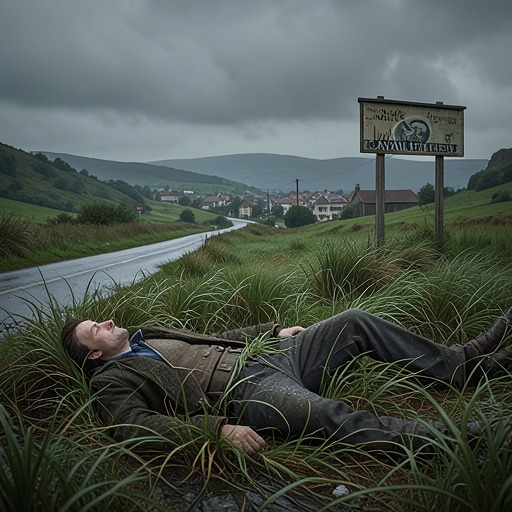
At about seven in the morning, Pino, working nearest the beach, spots the nose of a car protruding from unusually dense bushes roughly twenty yards away. He approaches cautiously, expecting that someone might still be inside after a night at the Pasture. At the rear of the car he sees a motionless man in the passenger seat, his head thrown back. At first the figure might appear asleep, but Pino’s impression changes as he notices the look and smell of the scene. He calls Saro over.
The driver’s door is locked. The men cannot reach the other side because the car is pressed close to the shrubbery, so they lean in despite the brambles scratching them. The man’s eyes are open and still. Recognition, rather than the sight of death itself, freezes them: the dead man is Silvio Luparello. The car is a large green BMW, tucked out of ordinary view among the brush. The concealed position and locked doors make the discovery feel less like a public accident than a scene whose circumstances demand explanation, though the two workers have no answer to offer.
Medical uncertainty and public image
When Inspector Montalbano later examines the corpse, the heat inside the car is oppressive. He asks the doctor how Luparello died. The doctor, Pasquano, points to the apparent explanation: Luparello had undergone a double bypass in London, performed by a famous surgeon, and the operation had reportedly been difficult. Montalbano had recently seen Luparello on television and thought he looked healthy. The contrast between that appearance and the concealed seriousness of his condition makes a natural death plausible without settling the matter.
The scene also carries a stark bodily incongruity. Luparello’s sex organ is exposed, unlike the meticulous care evident in the rest of his appearance. The detail clashes with the composed image of the engineer and public figure, and with the setting in which he has been found. It directs attention toward a sexual encounter, but by itself it does not establish who accompanied him, why he was there, or whether the circumstances were voluntary.
That uncertainty is sharpened by the gap between Luparello’s public reputation and his private life. A practising Catholic and heir to a dynasty of Montelusa builders, he had cultivated political connections over many years while remaining just behind the party’s leading figures. He repeatedly withdrew from elections for publicly stated reasons of humility, yet eventually gathered influential followers and came to dominate party affairs and a large share of public and private contracts in the province. Only three days before his death, he became provincial secretary, acclaimed as a figure of renewal during a period of political upheaval. His death therefore arrives at the precise moment when a long, largely shadowed career has entered the open.
Political interpretation and aftermath
Luparello’s widow offers Montalbano a reading that neither equates his death with murder nor accepts the circumstances as ordinary. She doubts that a man who had spent years manoeuvring patiently toward political prominence would willingly go with a woman of ill repute to a place where he could be recognized and blackmailed. She also clarifies that she does not mean a prostitute: after their marriage, Luparello had told her he had never been with one. Her uncertainty about the identity of the person who drew him to the Pasture becomes more pointed when she explains that, for decades, she had observed his affairs without specifying the sex of his partners.
The widow believes that Luparello was forced, through a threat of violence or blackmail, to go to the place where his body was found. In her account, a plan was made but not completed: the stress, or fear, may have overwhelmed a man already seriously ill. She calls this a political crime, not a homicide or physical elimination, and insists that an act of extreme violence led to his death. This is her interpretation, not a proven account of what happened. Its force lies in the way it joins Luparello’s heart condition to the political value of his new position and to the compromising setting of the discovery.
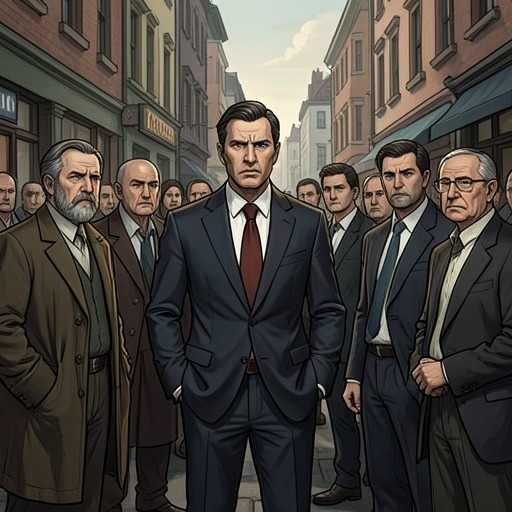
The political succession makes that value immediate. While the funeral draws a crowd of at least two thousand and the widow faints during its emotional proceedings, the party convenes unusually quickly to elect a replacement. Angelo Cardamone, Luparello’s longtime internal rival, is chosen unanimously. The public language of mourning and renewal thus proceeds alongside a rapid transfer of authority. The death is consequential not only because a prominent man has been found dead, but because the timing exposes how swiftly personal loss can become a contest over political power. The car among the scrub offers no definitive explanation; instead, the discovery binds bodily vulnerability, private secrecy, and public succession into a single unresolved event.