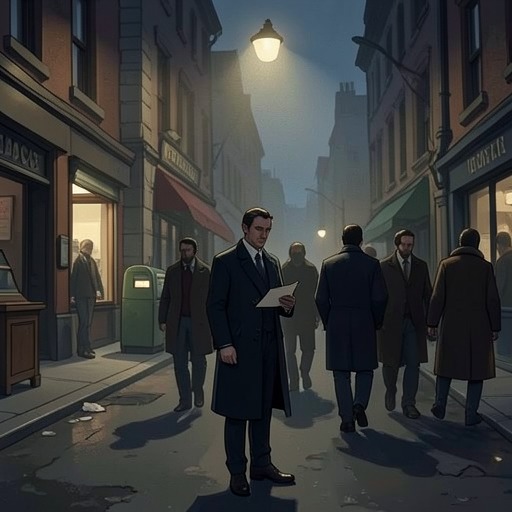
Audrey Barbour’s body is discovered in Benedict Canyon
The ShardsAudrey Barbour’s body is discovered in a soundproofed room in an abandoned house in Benedict Canyon, making her the Trawler’s fourth known victim and turning a place Bret had already entered into the setting of a confirmed murder scene. The discovery appears to reinforce his suspicions about Robert Mallory, who had been associated with the house, but it does not establish Robert as the killer; the account preserves that uncertainty even as later revelations expose the Trawler’s use of animal remains in a staged construction.
Discovery at the Benedict Canyon House
On Monday morning, November 9, Bret watches local news coverage from the Wrights’ home while recovering from the recent violence and taking Vicodin. The report says that a dozen police cars had arrived at the abandoned Benedict Canyon house late the previous night. Officers found Audrey in a soundproofed room in the makeshift basement, a space Bret had previously tried but failed to enter. The report transforms his memory of the house: it is no longer merely a place connected with Robert and with Matt Kellner’s disappearance, but a site where Audrey had been held and killed.
The television footage shows a body bag being carried out through a door Bret recognizes from his own entry into the house. Laurie Wright cries as the scene unfolds. Bret connects the location to his belief that Robert had held Matt there and made plans in the house, but these are his understanding of the place, not a conclusion established by the discovery itself. The revelation makes the house a junction between Bret’s private suspicions and the public investigation.
The Trawler’s Pattern and Its Delayed Explanation
The discovery confirms Audrey as the fourth known victim of the Trawler, whose earlier pattern had included the disappearance of pets around intended victims. That animal clue had been visible before the killings were fully understood, but its purpose remained unknown. Bret and the others had not yet learned what the Trawler did with the animals or why they disappeared.
The explanation arrives months after Audrey’s body is found. Her remains had been assembled with limbs from missing animals, a carefully sewn construction that the Trawler and his associates called a project. The book identifies this as an elaborate variation on what had been done to the other three girls, some of whom may also have spent time in the house. Thus the apparent animal disappearances acquire a more disturbing significance in retrospect: they were not incidental losses but part of the Trawler’s larger pattern of preparation and staging.
What the Later Disclosures Reveal
The account of Audrey’s presentation is withheld at first and disclosed only in fragments over time; the full extent of the Trawler’s work takes a year to emerge. The room’s soundproofing, the concealment of the body, and the use of animal remains establish that the murder scene was deliberately prepared, rather than simply a place where the body happened to be found. The staged construction also connects the individual crime to the recurring pattern that had preceded it.
The delayed disclosure changes the meaning of the initial news report without resolving every question. The Trawler’s involvement is confirmed, but Robert does not become the principal suspect in the days after the discovery. Bret later learns that investigators considered the theory tempting, while concluding that certain elements did not fit. The event therefore strengthens the connection between Robert, the house, and the wider sequence of crimes, while leaving the crucial distinction between association and proof intact.