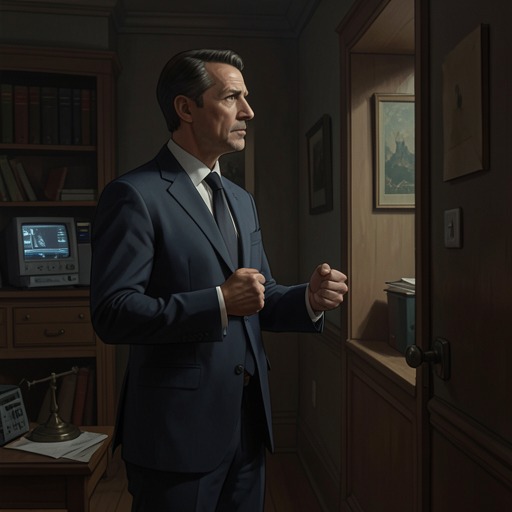
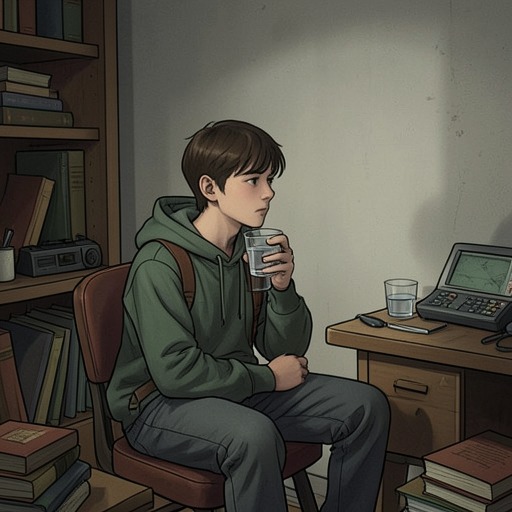
Bret’s false account of the Century Towers fight
The ShardsBret’s false account of the Century Towers fight is the story he gives police and repeats to people around him after Robert Mallory falls to his death. It recasts their encounter as an attempted rescue that became self-defense, assigning Robert the role of unstable attacker and Bret the role of frightened friend. The account becomes a powerful explanation in the immediate aftermath, but its authority is undermined by the novel’s later disclosure that Bret’s version helped make a disputed narrative seem like the truth.
Background and the Search for an Explanation
The account follows Bret’s visit to Robert at Century Towers and the ensuing fight. Before the confrontation, Bret had already been trying to understand other unresolved events. At Matt Kellner’s home, Matt’s father Ronald showed him crime-scene photographs and said the family did not know what had really happened. Bret later told Dr. Croft that he had also seen Matt’s autopsy report and photographs of Matt, and that the evidence did not look accidental. These earlier encounters establish Bret as someone gathering fragments and trying to connect them, but they do not independently establish his later accusations against Robert.
Bret’s account draws on several different kinds of material: his claimed experience of the confrontation, information he says he knew about Robert’s past, and conclusions he had formed about the Trawler crimes. After Robert’s death, those elements are delivered together as a single, forceful explanation. The resulting narrative is not simply a description of the fight; it makes Bret’s interpretation of a much wider series of events part of his justification for what happened at Century Towers.
The Story Bret Tells
Bret says Robert contacted him after leaving the hospital and sounded extremely upset. According to Bret, he went to Century City because he feared that Robert, who had attempted suicide before, might kill himself. He portrays himself as panicked but motivated by concern for a friend, arriving at the apartment intending to prevent another suicide attempt.
Bret says that he could not find Robert at first and was searching the master bedroom when he heard a noise. He then claims to have discovered that Robert had secured the front door in a way that prevented Bret from leaving, trapping him inside. In Bret’s version, he called for help, could not get anyone to respond, and defended himself with a knife he found in the kitchen. He says the fight continued across the balconies on the twenty-eighth and twenty-seventh floors, where he tried to pull Robert away from the railings while protecting himself. His telling ends with Robert jumping.
The account frames the encounter as a rescue reversed into a struggle: Bret says he went to help, but Robert made him a prisoner and forced him to defend himself. Bret emphasizes Robert’s previous suicide attempt and mental instability, and connects him to the disappearance of Katherine Latchford, the Trawler crimes, Debbie Schaffer’s disappearance, the attack on Susan Reynolds and Thom Wright, and Matt’s death. These are Bret’s claims to the police, not facts established by the account itself. Their accumulation gives his explanation a broad apparent coherence while making it difficult to separate firsthand observation from inference.
Repetition, Evidence, and Credibility
Bret repeats his story to the police, the Reynolds family, Laurie Wright, and the doctors treating him. He says that he went to help a distressed friend, that Robert had trapped him, and that he fought back. He also tells listeners that Robert had been institutionalized, had attempted suicide, and had harmed his stepsister. The repeated version holds to the same central sequence and presents Robert’s history as context for the encounter.
The scene also distinguishes between what Bret claims and what others have verified. Bret sustains injuries and receives 115 stitches, but the account says physicians found no serious or lethal injury. His injuries support the fact that a confrontation occurred; they do not, by themselves, establish the details or the direction of responsibility in his narrative. The police ask few questions, and Bret signs statements while bandaged. He becomes tearful during questioning, but the story offers no independent confirmation of the claims that Robert called him, intended to kill himself, or deliberately trapped him.
That gap between physical aftermath and narrated explanation is central to the event. Bret’s statement supplies the sequence that available questioning does not test in depth. His distress and injuries make the story immediately persuasive, while the allegations about Robert make Bret’s actions appear defensive and necessary. The account thus functions both as testimony and as self-exoneration: it gives a legible cause to the fight, but it cannot resolve what actually happened between the two men.
Consequences and Narrative Significance
Bret’s version becomes the core account of the November 7 encounter, even as Robert’s aunt Abigail publicly disputes what she believes happened between Robert and Bret. Abigail was not present, and the force of Bret’s dramatic description helps it prevail as the narrative carried forward. The novel does not present that public acceptance as proof that Bret’s version is true; instead, it shows how an account can acquire authority through its vividness and through the absence of a witness able to refute it.
That authority does not last. After the Trawler abducts Leslie Slavin and takes credit for Audrey Barbour’s death, it becomes clear that Robert did not commit the murders Bret had attributed to him. The revised understanding casts Robert as a victim of the Trawler’s long-running manipulation and obsession, rather than the perpetrator Bret had described. Bret’s explanation of the Century Towers fight remains forceful enough to shape the immediate story, but its broader accusations collapse, and Bret becomes increasingly isolated at school.
The event therefore makes narration itself consequential. Bret’s story protects him in the immediate aftermath and organizes a confusing chain of violence into a comprehensible account, yet its unverified details and disproved accusations leave the reader alert to the difference between what he says, what the evidence shows, and what other characters come to believe. The fight’s significance lies not only in Robert’s death, but in the story Bret constructs around it—and in the social consequences that follow when that story is accepted and then questioned.