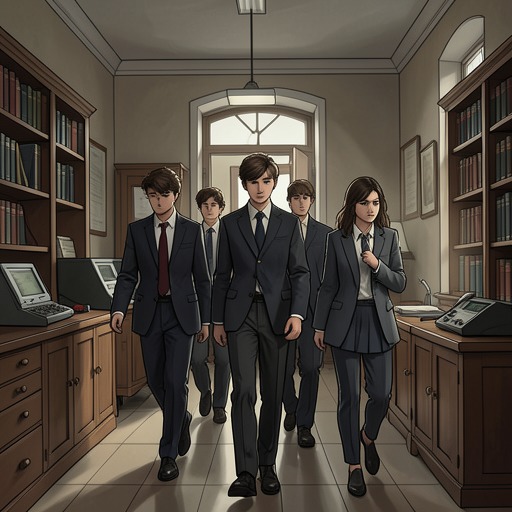
Desecration of the Buckley Griffin
The ShardsThe desecration of the Buckley Griffin was a violent act of vandalism at Buckley that greeted students before the school year began. Its aftermath—blood and mutilated koi around the statue—made the campus’s polished routines feel suddenly unsafe, while the lack of proof left Bret Ellis caught between suspicion and self-protective explanations.
Discovery and Immediate Context
When Bret first encountered the aftermath, a police car was parked behind the library, and blood and mutilated koi lay scattered around the Griffin in the courtyard. The scene coincided with Robert Mallory’s arrival as a new student. Robert gave a composed account of family loss and relocation, but Bret found his emotionless manner unsettling; that impression, he acknowledged, was only a feeling, not evidence that Robert had harmed the statue.
The vandalism occurred on the night before school began. Bret later believed that a figure he had seen with a flashlight in the library courtyard had desecrated the statue, but the account provides no confirmed identification of the perpetrator. The event’s unanswered circumstances became part of a larger atmosphere of unease at Buckley.
Bret’s Explanations and Suspicions
During the following September week, Bret tried to recast the vandalism as a harmless prank that had taken a ghoulish turn unintentionally. He also imagined that whoever had been in the courtyard realized the act had gone too far and regretted it. These explanations belonged to a larger effort to believe that Robert was sane, that Buckley’s students remained innocent and safe, and that privilege and status could protect them.
That reassuring account did not hold. Bret felt increasingly disconnected from school and the outside world, describing himself as no longer a tangible participant in either. His numbness and his need to construct a comforting narrative show how the vandalism persisted beyond the physical scene: it had disrupted his confidence in the order around him, even as he tried to make it seem containable.
A Pattern Without a Name
The statue’s desecration also became entangled in Bret’s growing suspicion of Robert. After Robert pursued Bret’s car on Ventura Boulevard, and amid Robert’s connections to Matt Kellner and Susan Reynolds, Bret concluded that Robert was probably the figure in the courtyard. Bret expressed certainty in that suspicion despite admitting that he had no proof. The narrative thus distinguishes his conviction from an established fact.
Reports of home invasions supplied a wider but still incomplete context. One newspaper account described a Woodland Hills attack preceded by phone calls, rearranged furniture, and a missing neighborhood dog; the victim was assaulted by a masked intruder and left unaware that the incident fit a pattern. Bret briefly wondered whether the Riders of the Afterlife, a cult he had just read about, might be behind both the invasions and disappearances. Neither that speculation nor his suspicion about the statue established who had committed the vandalism.
Meaning and Aftermath
In retrospect, the statue’s desecration sits alongside clues that would later be associated with the Trawler, including the recurring disappearance of household and neighborhood pets before attacks. At the time, however, the connections had not been made, and the Trawler had not yet been named. The Griffin incident therefore carries the tension of an early warning whose meaning remains unavailable to the people living through it.
Bret’s response gives the event its lasting narrative force. He alternately minimized the vandalism as a prank and treated it as evidence implicating Robert, while the available account confirms neither a harmless explanation nor Robert’s guilt. The bloodied statue marks the beginning of a widening breach between Buckley’s appearance of safety and Bret’s experience of fear, uncertainty, and emotional detachment.