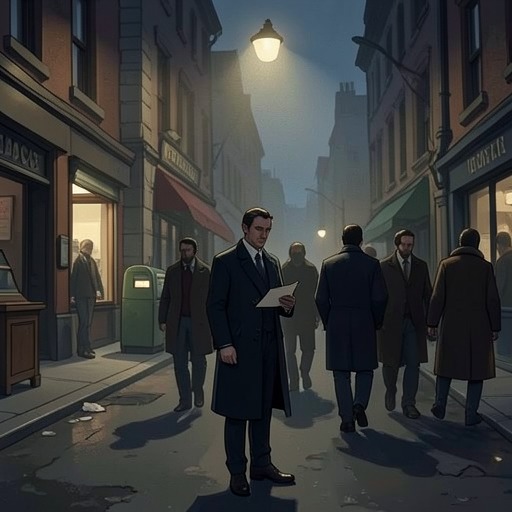
Leslie Slavin is abducted by the Trawler
The ShardsLeslie Slavin’s abduction is the event that ruptures Bret Ellis’s account of Robert Mallory as the Trawler. On a crowded Saturday night in Westwood, the seventeen-year-old disappears after leaving friends at Yesterdays and walking to her car in a Glendon Avenue garage. The Trawler’s subsequent letter to the Los Angeles Times claims the crimes for himself and his associates, identifies Audrey Barbour as a sacrifice, and clears Robert of responsibility. Leslie’s disappearance therefore does more than extend the campaign: it exposes the false certainty at the center of Bret’s story.
Background: A Story Bret Believes He Has Solved
By the time Leslie disappears, Bret has told his classmates that Robert was the Trawler and that Robert died after trying to kill him. The tale has brought Bret attention and sympathy; students regard him as the survivor who exposed the killer. But the story’s confidence exceeds what Bret knows. The evidence eventually shows that the Trawler and his followers had been fixated on Robert and had also targeted people in his circle, a pattern Bret had mistaken for proof that Robert himself was responsible.
The abduction also follows a renewed wave of home invasions. Earlier attacks had involved warning signs such as silent calls, rearranged household objects, and missing neighborhood pets; the Trawler’s methods had included preparing for attacks in advance and remaining difficult to identify. The account of Leslie’s disappearance places her within that continuing threat, rather than presenting it as an isolated crime.
The Abduction and the Trawler’s Claim
Leslie vanishes on November 21 after leaving her group of friends at Yesterdays and heading alone toward the car parked in a garage on Glendon Avenue. The evidence establishes the circumstances and location of her disappearance, but does not describe the abduction itself or establish Leslie’s ultimate fate.
Afterward, a letter sent by the Trawler to the Los Angeles Times and verified by the Los Angeles Police Department changes the meaning of the crimes. The writer acknowledges a renewed series of home invasions, while denying responsibility for the attack on the Reynolds residence on North Canon Drive. He identifies Robert indirectly as “the God,” describes Audrey Barbour as a sacrifice, and says the sacrifice was intended for the deceased boy he calls by that name. The letter thus claims the killings for the Trawler while rejecting the accusation that Robert was the killer.
The letter further states that the Trawler and his associates had soundproofed the basement of the abandoned Benedict Canyon house that Robert sometimes visited. Audrey had been held there for days before she was killed and discovered. Bret realizes that her body may have been in the house when he himself wandered through it. The disclosure joins a physical location Bret had encountered to the campaign he had misread, without resolving every detail of what happened there.
Consequences: Bret’s Account Collapses
The letter also describes the Trawler and his friends as having become intimate with people associated with Robert, and mentions gifts left for Robert’s classmates, including mementos, photographs, and posters. These disclosures recast the campaign as a sustained fixation on Robert and his social world. They also explain why proximity to Robert had seemed to connect so many people to the crimes, while not proving that Robert had committed them.
Leslie’s abduction and the Trawler’s claim have a direct social consequence for Bret. Once it becomes apparent that Robert did not kill anyone and had instead been the target of the Trawler’s mind games and obsession, Bret’s insistence that Robert was the killer can no longer hold. Bret becomes a pariah at Buckley: classmates and teachers avoid him, he is left alone at school, and former friends occupy the place in the courtyard and at lunch that he once shared with them. His dramatic story had made him appear heroic; the new evidence makes that performance untenable.
Narrative Significance
The event is presented retrospectively by Bret, whose earlier version of Robert’s death has shaped both his classmates’ understanding and the narrative he tells about himself. Leslie’s disappearance interrupts that version, while the verified letter supplies information that Bret had not known and forces him to confront the gap between a compelling story and an accurate one.
The abduction itself remains only partly narrated: the text gives Leslie’s age, the Saturday-night setting, the route from Yesterdays to the Glendon Avenue garage, and the fact that she vanished, but not the mechanics of the crime or a confirmed outcome for her. That restraint keeps the focus on what the event reveals about the larger plot. The Trawler remains active, Robert is recast as a target rather than the murderer Bret alleged, and Bret’s public certainty gives way to isolation and doubt.