Matt Kellner’s autopsy report
The ShardsMatt Kellner’s autopsy report is the documentary basis for the official account of Matt’s death—and, because that account clashes with the evidence Bret encounters, a source of unresolved doubt rather than a definitive explanation. Read aloud and examined alongside crime-scene photographs, the report attributes Matt’s death to a drug-related psychotic episode and drowning. Its claims about drugs and the aquarium’s contents, set against signs of violence and the absence of a clear account of Matt’s final days, leave the circumstances contested.
Discovery and context
Matt’s disappearance was first recognized when his parents could no longer account for his routine. He normally lived in the pool house on the Kellner property, went to Buckley, and left a note when he went away for a weekend. After his family realized the aquarium was drained and the pool house had been dark and quiet, they found that Matt’s red Datsun was missing. His father, Ronald, had last seen him the previous Thursday; school and household observations placed Matt at school and then back at home on Friday, but did not establish where he went afterward. By Wednesday, with no note and no reliable information about his whereabouts, the Kellners cooperated with the Los Angeles Police Department and Matt was officially missing.
The uncertainty extended to the car and the location of Matt’s final days. Ronald told Bret that nobody had driven the Datsun to Crystal Cove, and the car’s whereabouts could not be reconciled with a confident account of what Matt had done. When Bret later asked Ronald whether Matt’s death had been an accident in the pool, Ronald rejected the assumption that the family knew what had happened. He brought out papers and photographs, inviting Bret to help make sense of them rather than presenting a settled explanation.
Findings and official reconstruction
The report, as Ronald described it, recorded 6,000 milligrams of methaqualone in Matt’s system. Ronald identified the drug as Quaaludes. The official explanation, pieced together from the autopsy and items found in Matt’s backpack, proposed that Matt had taken a massive amount of LSD, suffered a psychotic break, taken Quaaludes, and fallen into the pool, where he drowned. Authorities also inferred marijuana use, although Ronald said the autopsy could not establish marijuana levels in Matt’s system.
The report further stated that the mostly undigested contents of Matt’s aquarium were found in his stomach. In the official reconstruction, Matt had apparently ingested them during the supposed psychotic episode. This finding was difficult for Bret to square with his own knowledge: the aquarium had been empty for weeks, and Matt had not known what had happened to its fish. The report thus does more than describe a death; it turns the disappearance of the aquarium’s contents into part of an explanation that Bret finds implausible, while the stamped medical-examiner document gives that explanation the authority of an official record.
Photographs and contradictions
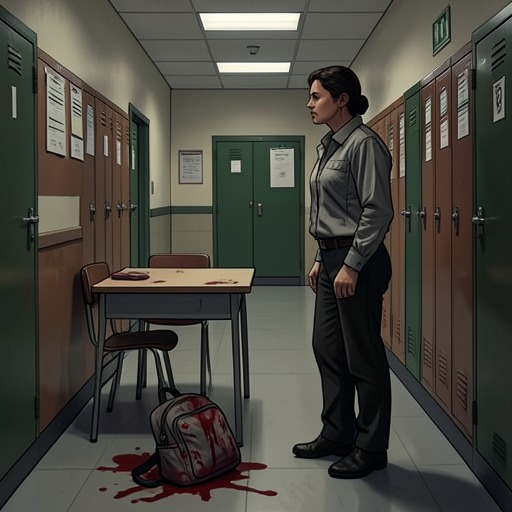
The autopsy report was accompanied by crime-scene photographs Ronald had arranged to have taken. They showed bruising across Matt’s body, a deep wound on his left arm, and a serious injury to his forehead. Ronald asked whether the head injury could have resulted from Matt striking his head when he fell into the pool, but the photographs did not persuade Bret that the death looked accidental. Later, Bret told Dr. Croft that he had seen the report and the photographs and that Matt’s injuries did not look accidental; Dr. Croft had not seen the report himself.
Other photographs documented the killing of Alex, Matt’s cat. The images showed the animal’s body and head displayed separately at the pool house. Their deliberate arrangement, together with the injuries documented in the photographs of Matt, deepened the conflict between the scene Bret saw and the official account of a drug episode followed by a fall. The report and photographs therefore have distinct evidentiary roles: the report presents a medical and official reconstruction, while the images make visible details that leave Bret questioning it.
Evidentiary limits and significance
Ronald showed Bret the materials because he was still trying to piece together where his son had been and what had happened. Bret’s response was not to solve the case but to recognize the disparity between the typed account and what the photographs appeared to show. He knew Matt as someone who could be too stoned to get up and change the television channel; the quantity of Quaaludes described in the report seemed to Bret incompatible with the actions the official account attributed to him. That is Bret’s inference, not an independent medical conclusion, and the report does not establish who caused Matt’s injuries or how the animal display was made.
The report’s authority and its gaps remain intertwined. It offers measurable findings and a coherent official sequence, yet the unexplained missing days, aquarium contents, visible injuries, and photographs prevent that sequence from settling the matter for Bret. Later, when Bret tells Dr. Croft that no one seems willing to acknowledge that Matt was attacked, the report remains part of what he has seen but not a resolution he can accept. As an object in the narrative, it converts private suspicion into a dispute over evidence: an official document records one explanation, while the surrounding material keeps the death unresolved.