Matt Kellner’s disappearance and death
The ShardsMatt Kellner’s disappearance and death turn a missing classmate’s absence into one of the novel’s central unresolved mysteries. First explained at Buckley as an accidental drowning, Matt’s death is surrounded by signs of a possible staged scene and by a trail of details that connect, in Bret Ellis’s mind, to the Trawler’s pattern. The evidence undermines the school’s clean account, but the story withholds a conclusive explanation of who caused Matt’s death or exactly what happened to him.
Disappearance and Initial Alarm
Matt’s absence becomes official when Susan Reynolds tells their lunch group that he is missing. She has just emerged from a meeting with Dr. Croft and Headmaster Walters, and her announcement confirms Bret’s growing unease: Matt has not appeared at Buckley for two days, and his red Datsun is no longer in its usual senior-parking-lot space. The school plans to announce the disappearance at an assembly the following morning. Bret is so alarmed that he drops his sandwich and struggles to keep his body from revealing his fear, while the other students look to Susan for information.
The circumstances at Matt’s home make the absence harder to date precisely. Ron and Sheila Kellner describe a familiar routine: Matt generally swam before school, drove his Datsun to Buckley, and returned to his pool house by late afternoon. On weekends he sometimes went to the beach alone, but he ordinarily left a note saying where he had gone and when he would return. This time there is no note. Sheila notices that the pool house has remained dark, without the aquarium’s usual glow or the candles Matt sometimes lit beside the pool; the pool and Jacuzzi also appear unused. The Kellners begin cooperating with the Los Angeles Police Department after realizing that several days have passed without anyone seeing him.
The last confirmed sightings do not establish where Matt went. Ron last saw him the previous Thursday, when he asked about the Datsun’s faulty headlight. Ron took the car to a Nissan dealership in Encino, had it serviced and the headlight replaced, then returned it to the pool-house garage. Matt was confirmed at Buckley the following Friday: the head of security remembered him leaving alone at about 3:15 p.m., and the housekeeper saw him return to Haskell Avenue. His absence over the weekend initially seems compatible with his occasional solitary beach trips, but the missing note, unused pool, and unaccounted-for car eventually make that explanation less reassuring.
Signs of a Possible Pattern
Bret connects Matt’s disappearance to the Trawler’s known crimes before he has proof. Earlier home invasions had appeared random, with victims of different ages and genders, but one recurring warning sign involved animals: pets belonging to a targeted household or other animals in the neighborhood would disappear before an assault. In some areas, three animals were sacrificed. The connection between that pattern and the use of the animals’ remains would only become clear later, but the repeated disappearances had already become significant to Bret.
Matt’s circumstances seem to Bret to echo some of those signs. Before he vanished, there had been anonymous silent phone calls, furniture rearranged inside the residence, aquarium fish missing, and Matt’s cat Alex gone. Bret recognizes the possibility that the pattern may be closing around Matt, but also tries to discount it: Matt is male, and the Trawler’s pattern is not a dependable rule. The earlier invasions had affected men as well as women, leaving Bret uncertain whether gender excludes Matt from danger or whether the apparent pattern is incomplete. His suspicion grows out of particular clues, but he repeatedly acknowledges that he has no proof and may be reading events through fear.
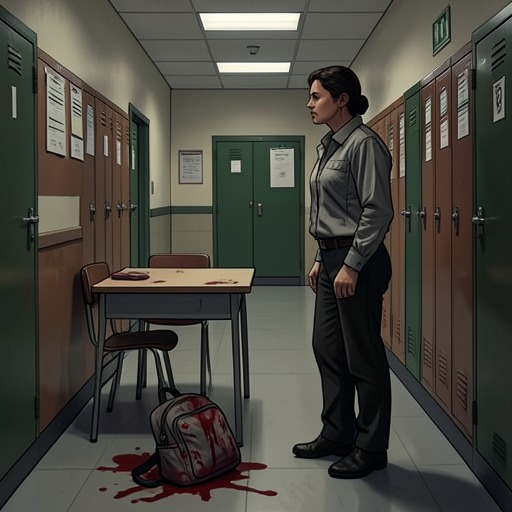
The first major physical clue appears when a ranger finds Matt’s backpack in a parking lot at Crystal Cove State Park, above a bluff overlooking the ocean. An identification tag links it to Matt, and blood on the bag brings it to the attention of Orange County authorities, who connect it to the missing-person report filed by the Kellners with the Los Angeles Police Department. Dr. Croft considers the information too upsetting to share with younger students, so Susan tells the student body only that Matt is still missing and asks anyone with information to contact the administration confidentially.
For Bret, the backpack intensifies the possibility that Matt is dead, but the group’s response is muted. His classmates ask questions about the blood and the backpack’s location, yet nobody has answers, and the discussion quickly ebbs. Bret notices that neither Robert Mallory nor Ryan Vaughn asks about Matt. Classes continue, students go to physical education, and Bret tries to maintain the appearance of an ordinary school day. The contrast between the ominous evidence and the routine response becomes part of the event: the missing student is briefly a subject of attention, then school life resumes without an equivalent public reckoning.
Discovery at Haskell Avenue
A week after Matt probably disappeared, a gardener arrives at the Kellner property unaware of the missing-person case. While working in the backyard near the pool house, he encounters evidence of deliberate animal mutilation and then finds Matt’s body in the pool. Matt’s red Datsun is parked in the pool-house garage; the gardener would not have seen the blood on its passenger seat and dashboard. The garden and pool-house setting, previously associated with Matt’s private routines, has become a crime scene.
Matt is found naked and motionless in the water. The gardener recognizes him from his build, hair, and height. Alex’s separated head has been placed at the edge of the pool, while the cat’s body is secured to a pool-house column. The arrangement recalls the earlier animal-related warning signs and makes the death difficult to reconcile with an uncomplicated accident. The gardener runs to the main house, and the discovery changes the case from a disappearance with a bloodstained backpack into a death accompanied by evidence of staging or ritualized cruelty.
At Monday’s mid-morning assembly, Dr. Croft tells the Buckley student body that Matt has died over the weekend. The school presents the death as an accident: Matt supposedly returned home after leaving the area, slipped into the pool, hit his head, and drowned, with drugs suggested as a possible factor. The announcement does not remind students that Matt had been missing for a week or that his bloodstained backpack had been found far from Los Angeles. This simplified account arrives as a surprise, even to Susan, and its suddenness helps it pass initially without challenge.
Bret feels relief at first because the announcement appears to disconnect Matt’s death from the Trawler. That relief does not last as certainty. Once the shock begins to recede, Bret senses that something in the explanation is wrong. He skips physical education and returns to his house on Mulholland, numb and unwilling to be near Robert, whom he regards as the person closest to Matt in the days before his death. The initial announcement closes the immediate suspense for the school, but for Bret it begins a different phase of doubt.
Official Account and Conflicting Evidence
In the days following the announcement, rumors shift from accidental drowning to suicide. Bret rejects both versions. He believes Matt may have fled because he feared the unexplained phone calls, rearranged furniture, and missing cat. In this reconstruction, Matt leaves Encino without telling anyone so that he cannot be tracked, drives down the coast, pays cash, and sleeps in his car. Bret regards this as plausible given Matt’s habits and his growing paranoia, but it remains an inference rather than a confirmed account. The bloodstained backpack and the question of how Matt could have returned home remain unexplained.
Later, Ron Kellner shares crime-scene photographs and information from the autopsy report with Bret. The photographs show bruising on Matt’s body and a substantial wound to his arm, as well as an injury to his forehead. Ron questions whether the head injury could have been caused by a fall into the pool. He also states that blood covered the front seat and dashboard of the Datsun, apparently where Matt was said to have cut himself. These photographs and observations complicate the idea of a simple fall, but they do not by themselves establish who inflicted the injuries or when.
The Datsun’s mileage provides a separate challenge to the story that Matt drove to Crystal Cove. Ron had noted the mileage when he took the car for service on the Thursday before Matt disappeared, then checked it again when the car was back in the garage a week later. On that basis, he insists that it had not been driven the roughly 140 miles to Crystal Cove. He allows that it may have been driven a short distance, but says it did not make the journey to the state park. The backpack’s discovery location and the car’s mileage therefore point in different directions from the suggestion that Matt simply drove away and later returned.
Ron also recounts the authorities’ drug-related explanation. They theorized that Matt had taken a large quantity of drugs, experienced a psychotic episode, injured himself, and fallen into the pool. The autopsy report, however, did not establish marijuana levels, and the explanation relied on the drug paraphernalia found in the backpack. Ron further tells Bret that the report lists mostly undigested contents from Matt’s aquarium in his stomach. Bret knows the aquarium had been empty for weeks and that Matt did not know what had happened to its fish. The report records an official conclusion, but its details leave Bret unable to reconcile that conclusion with what he knew of Matt’s circumstances.
The photographs of Alex’s remains compound the contradiction. Ron shows Bret images of the cat’s body secured to the column and of its head at the pool’s edge. The killing and arrangement of the animal match the evidence discovered by the gardener, but sit uneasily beside the suggestion that Matt, incapacitated by drugs and then accidentally drowned, performed the elaborate acts himself. Bret doubts that account on the basis of his experience of Matt and the drug quantities Ron describes. That doubt supports suspicion, not a final identification of the person responsible.
Aftermath and Continuing Uncertainty
The official explanation and the public response keep Matt’s death small. It receives a brief newspaper item identifying him as a 17-year-old from Encino who drowned in a pool, and a short obituary with his junior-yearbook photograph. There is no funeral or memorial service. At Buckley, where a student death should have been a significant occasion, Matt’s death does not become one. Bret observes that Matt had become socially invisible, and that the school’s limited response makes it easier for the story to settle into the unremarkable form of an accident.
That public forgetting contrasts with the evidence Bret continues to assemble. At a later school assembly, he sees Robert sitting calmly while Susan speaks and notices that Matt’s name is no longer being mentioned. Bret’s suspicion that Robert killed Matt persists, but he recognizes that he cannot substantiate it: Robert was said to have been in Palm Springs during the disappearance, and Bret had also seen him at school that week. A phone number marked with the initials RM, found in Matt’s pool-house desk, becomes another unresolved clue. Bret compares it with the number listed for Robert’s Century City address and finds that they do not match. He keeps calling the number, but nobody answers and there is no answering machine.
Ron’s account of the Datsun mileage later intensifies Bret’s suspicion of a house where he believes the number may be located. He imagines that Matt may have been taken there and kept there, but the scene presents this as a fearful conclusion Bret reaches from a combination of clues, not a verified discovery. His own repeated reminder that he may be hearing things that are not there does not dispel the dread; instead, the evidence seems to revive it. The narrative thus distinguishes between concrete contradictions—the mileage, the blood, the autopsy details—and Bret’s unconfirmed reconstruction of what they mean.
Matt’s death remains consequential beyond the school’s initial account. Bret refers to it again in a conversation with Terry Schaffer, describing himself as having thought about Matt and finding the loss difficult. When asked how Matt died, Bret can offer no settled answer: he says the school’s view was accidental drowning, while admitting that an overdose might also have been involved and that nobody knows. The uncertainty is not resolved by the additional evidence; it is made more exact. Matt’s disappearance, the discovery at Haskell Avenue, and the official account form a case in which each explanation leaves material facts unanswered, while Bret’s grief and suspicion persist without becoming proof.