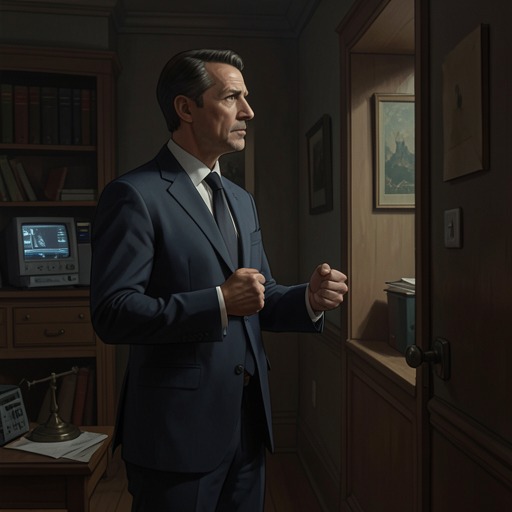
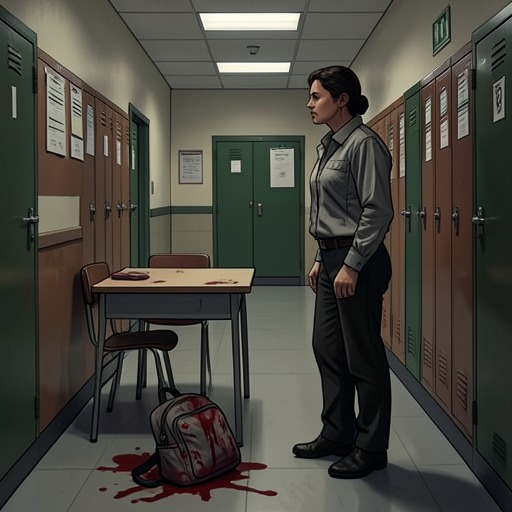
Maxell cassette recording of Matt Kellner
The ShardsThe Maxell cassette recording of Matt Kellner turns an unmarked tape into evidence of a violent final encounter: its recorded voices and background sounds connect Matt’s aquarium fish, the injuries later documented by his family, and the night he died. Bret concludes that Robert Mallory was the voice tormenting Matt, but he does not take the tape to the police or give it to the Kellners. Its importance lies as much in what it records as in Bret’s decision to keep it concealed.
Discovery and Identification
The cassette appears in the open mailbox at the empty house on Mulholland early on a Sunday morning. Bret first assumes Debbie Schaffer has left him a mixtape, but the cassette has no case or song list, and his name is misspelled with two t’s in handwriting he does not recognize. He hesitates before playing it, briefly entertaining the possibility that it came from Ryan Vaughn, then returns to the bedroom and puts it in his stereo. The sequence makes the tape’s arrival an act of uncertain communication before its contents become evidence.
At first, the recording seems to contain only silence and environmental sound. Bret hears wind, distant waves, and a fire; using his Walkman and headphones, he can make out the audio more clearly. A voice repeatedly orders someone to eat, while another voice, crying and frightened, resists. The first voice sounds deliberately disguised, and Bret initially struggles to understand what the recording represents. His uncertainty gives way as the exchange continues and the recording becomes harder to dismiss as performance.
What the Recording Reveals
Bret recognizes the distressed voice as Matt’s. The tape’s dialogue and sounds indicate that Matt is being made to eat the fish from his aquarium while the disguised speaker continues to taunt and pressure him. Matt asks for the mask to be removed, says he is afraid and cold, and pleads while the other voice repeats its commands. The recording thus supplies a direct, if incomplete, account of coercion that the official explanation of Matt’s death does not provide.
The recording also links Matt’s final night to details Ronald Kellner later describes from the autopsy and crime-scene photographs. Ronald says blood was found across the front seat and dashboard of Matt’s Datsun, and relays the official theory that Matt injured himself during a psychotic episode before taking drugs and drowning in the pool. He also reports that the aquarium’s contents were found in Matt’s stomach. Bret knows the aquarium had been empty for weeks; the tape gives him a possible explanation for that otherwise baffling finding. The audio does not establish every circumstance of Matt’s death, but it undermines the idea that the fish were simply swallowed during an isolated episode of psychosis.
Near the end, the recording includes Al Stewart’s “Year of the Cat,” along with questions and insults directed at Matt and sounds of someone striking him. Bret connects those sounds with the bruises shown in Ronald’s photographs. The recording ends abruptly. In the surrounding narrative, it is identified as a record of the last night of Matt’s life, making the cut-off ending both a limit on what the tape can prove and the close of its most disturbing evidence.
Bret’s Interpretation and Concealment
Bret becomes convinced that Robert made the recording and was the disguised speaker. He understands the encounter as a game that escalated while Robert was unstable and Matt was intoxicated, ending in Matt’s death. That interpretation is reinforced later, when Bret sits across from Robert at Hamburger Hamlet: Bret knows the voice on the tape came from the boy in front of him, yet does not disclose that he has heard it. Robert, in turn, does not explain why he was placed in a facility outside Jacksonville. The tape therefore shapes a confrontation that remains outwardly controlled but is sustained by information withheld on both sides.
Bret initially considers burning the cassette. He also drives to Haskell Avenue intending to leave it in Ronald and Sheila Kellner’s mailbox, wiping his fingerprints from it, but changes his mind before doing so. He cannot explain his reluctance to bring it to the police or the family, describing the evidence to himself as tainted. Instead, he keeps the tape in his possession and tries not to hear it again while also refusing to let it out of his sight. His handling of it prevents the recording from becoming an official account or a shared source of knowledge.
Material Object and Narrative Significance
The cassette’s physical form matters to the way the story releases information. It arrives anonymously, carries no track list, and must be played and replayed before its sounds become intelligible to Bret. Unlike a report or a photograph, it preserves voices, pauses, and the surrounding soundscape; those features make the encounter seem present while leaving its circumstances partly uncertain. Bret’s effort to distinguish wind and waves from the recorded sounds becomes part of the work of interpreting evidence.
The tape also unsettles the boundary between public explanation and private knowledge. The autopsy report and Ronald’s account supply an official theory, while the recording offers sounds that point toward another account but is hidden from the authorities and Matt’s parents. Bret’s certainty about Robert’s role is strong, but the evidence remains in his hands, outside any shared investigation. The cassette consequently functions both as a record of Matt’s final night and as a measure of Bret’s increasing secrecy: the crucial evidence has been found, yet its discovery does not produce disclosure or resolution.