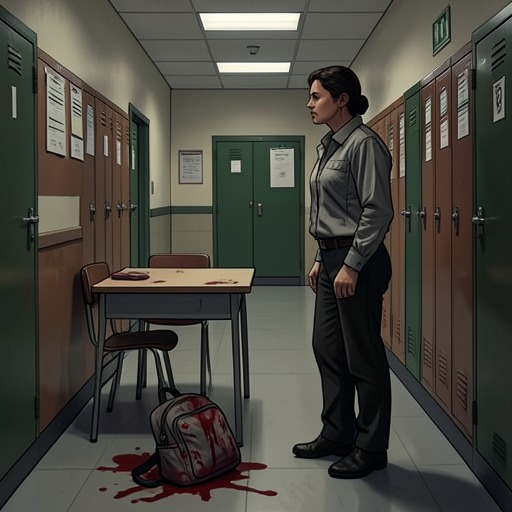
Sheila Kellner
The ShardsSheila Kellner, the mother of Matt Kellner, appears in the account of Matt’s disappearance and death as a quiet presence at the family home. Her observations help establish how his absence disrupted familiar household routines; later, her questions and descriptions of his injuries expose the uncertainty that the official explanation does not resolve.
Family Life and Matt’s Routine
Sheila and Ron Kellner had grown used to Matt’s regular schedule after he moved into the pool house in tenth grade. He would swim before school, sometimes with reggae audible from the guesthouse, and drive his red Datsun to Buckley. He usually stopped at McDonald’s in Sherman Oaks rather than coming to the main residence for breakfast. On weekends, he might drive alone toward Newport and beyond, but he ordinarily left a note saying where he had gone and when he expected to return.
From the windows of the main house, Sheila could sometimes see the pool-house aquarium glowing at night or candles Matt had placed along the pool. She rarely saw Matt himself, as though he kept out of his parents’ sight. During the weekend when he disappeared, the usual signs were absent: there was no aquarium light, no candlelight, no sound from the pool, and no indication that the Jacuzzi had been used. The missing lights and sounds became significant precisely because they departed from a routine Sheila had learned to recognize.
Matt’s Disappearance and Sheila’s Observations
By Wednesday, after several days without anyone seeing Matt, the Kellners began cooperating with the Los Angeles Police Department and he was officially considered missing. Ron’s last encounter with his son had been the previous Thursday, when he went to the pool house about the Datsun’s broken headlight. Matt said he rarely drove at night and could replace it the following week; Ron took the car to a Nissan dealership in Encino and had the work done himself. Matt was later confirmed to have left Buckley alone at about 3:15 on Friday, and the housekeeper saw him return to Haskell Avenue that afternoon.
The absence was initially easy to explain away: Matt sometimes spent weekends alone, and one missed school day did not immediately seem extraordinary. But the family had not checked his separate garage. On Wednesday morning, a call from Dr. Croft’s secretary asking when he would return to school prompted Ron to notice the Datsun was gone; Sheila, in turn, realized she had seen no lights in the guesthouse all weekend. Unlike his usual trips, Matt had left no note or message. Her recollection of these small departures from habit helped define the point at which an ordinary absence became alarming.
Meeting Bret at the House
When Bret visited the pool house, he had never been introduced to Sheila or Ron despite having known Matt and visited Haskell Avenue for about a year. Leaving the guesthouse, Bret saw Sheila sitting alone in the gazebo beside the lawn. She wore a tennis skirt with a flower-patterned blouse and smoked; Bret initially approached because he felt he should explain who he was. He understood her stillness as the effect of sedation and saw that she appeared stunned.
In their conversation, Sheila returned to the question of what had happened to her son. She said the family did not know, then specified that Matt had been very bruised, including on the side of his face. When Bret tentatively suggested that the injuries might have resulted from a fall into the pool, she rejected that explanation and clarified that bruising was also present on his chest, back, and legs. Her restrained account does not establish who caused the injuries, but it makes clear that the family’s questions extend beyond the bare fact of Matt’s drowning.
The Official Account and Unresolved Questions
Ron showed Bret photographs taken by a crime-scene photographer. They documented Matt’s body and visible bruising, as well as a wound to his arm and an injury to his forehead. The images made the discrepancies between an accidental fall and the reported injuries concrete, while Sheila’s earlier observations had already challenged Bret’s tentative attempt to explain them as the result of falling into the pool.
Ron also described the authorities’ account: they believed Matt had taken drugs, experienced a psychotic episode, injured himself, taken Quaaludes, and drowned after falling into the pool. The proposed drug sequence included LSD, although the autopsy reportedly did not find marijuana levels. Ron added that the contents of Matt’s aquarium were found largely undigested in his stomach. For Bret, that detail conflicted with what he knew: the aquarium had been empty for weeks, and Matt had not known what had happened to the fish. The official story was documented in the autopsy report, but the evidence and the family’s experience did not settle how Matt died.
Sheila’s narrative role is defined by the contrast between observable domestic habit and unknowable cause. She can identify the missing lights and the silence at the pool, and she can describe the bruising, but she cannot account for what happened to Matt. Her repeated question keeps the uncertainty present even as the family confronts an official explanation. The evidence does not provide a later resolution for Sheila herself.