The Trawler’s letter to the Los Angeles Times
The ShardsThe Trawler’s letter to the Los Angeles Times is a criminal communication that changes how the murders and related intrusions are understood. Verified by the Los Angeles Police Department and published in late 1981, it presents the killer’s actions as a repeating, deliberate narrative: surveillance and selection precede abduction and murder, while home invasions and animal thefts belong to the wider pattern. The letter also takes credit for the crimes and attempts to absolve Robert Mallory, making it at once a source of information, a claim to authorship, and a calculated intervention in public suspicion.
Publication and Naming
The letter appeared after the killer had already been active in Los Angeles County for more than a year. By the time the public learned the name “The Trawler,” investigators had begun connecting disappearances, assaults, and home invasions. The nickname itself had originated as a private joke among two Hollywood-division investigators, then entered news coverage through a leaked police memo. In the summer of 1981, the crimes had not yet cohered publicly into a named serial case; articles connecting them appeared later that September.
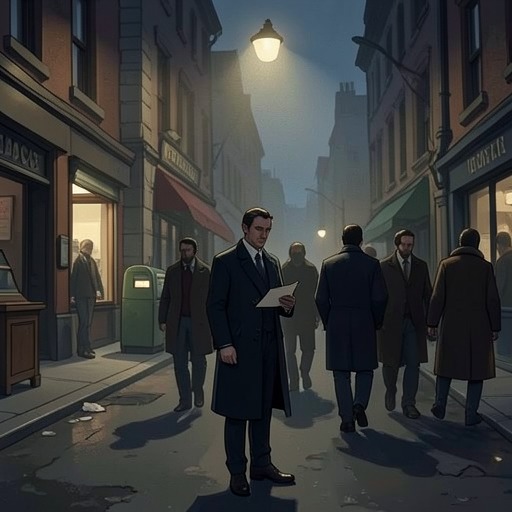
The letter’s publication gave the emerging case a voice as well as a label. On the front page of the Los Angeles Times, photographs of Katherine Latchford, Sarah Johnson, Julie Selwyn, and Audrey Barbour accompanied an article about the killer. The report continued across the Metro section, where it printed excerpts from the letter, some typed and redacted and others handwritten in different-colored pens. The narrator reads it at Buckley and experiences the article as an account with the force of an interview, although its source is the killer’s own written self-presentation.
The Pattern the Letter Describes
The Trawler depicts himself and his associates moving through Los Angeles at night, staying in motels and looking for people and houses that might suit their purpose. He describes watching young women with binoculars, following possible targets through public places, and assessing whether a person could be selected for what he calls a sacrifice. The account links this stalking to the selection of a neighborhood, a residence, and a victim, turning the separate acts into a procedure rather than a series of unrelated crimes.
The letter also places the home invasions within that procedure. In periods between murders, the Trawler says, his group returned to what he calls rearrangements or tests, using intrusions to assess whether a target was suitable. He distinguishes these attacks from the later killings, claiming he had never sacrificed someone he had physically attacked in an invasion. That distinction matters: it presents the break-ins not as an incidental sideline but as part of the same process of watching, choosing, and rehearsing.
The killer describes the murders as acts of alteration and remaking, and frames the victims as objects in a project addressed to a figure he calls “the God.” He says that his pattern had begun before he came to Los Angeles and that the city represented another stage in a continuing course of activity. The article does not fully disclose what the alterations involved or list the materials used. Its selective excerpts instead leave gaps around the killer’s most disturbing claims, making omission part of the reader’s encounter with the letter.
Secrecy, Publicity, and Evidence
The newspaper’s account reveals the limits of what the public is told. Details of the victims’ injuries had not been fully released, and the article avoids clarifying the Trawler’s euphemisms or specifying all the materials he mentions. The resulting distance between what the letter asserts and what the paper confirms preserves uncertainty even as it expands the known pattern. Readers receive an outline of the crimes, but not a complete or independently verified account of every detail.
The letter’s disclosures arrive in a pre-digital information environment, where reports, leaked documents, and private knowledge circulate unevenly. The narrator emphasizes that the details of the murders remained concealed for months and that only rumors and leaks filled the gap before later confirmation. Against that background, the printed excerpts become more than a confession: they are a rare, mediated channel into the killer’s claimed methods, shaped by the newspaper’s redactions and by the killer’s own choice of what to tell.
Robert Mallory and the Letter’s Intervention
In a later letter reported by the Los Angeles Times, the Trawler refers to Robert Mallory only as “the God.” He claims that another victim, Audrey Barbour, was left as a sacrifice for this figure at an abandoned house in Benedict Canyon that Robert sometimes visited. The letter says that the Trawler and his associates had soundproofed the basement and that the victim had been held there for days before she was killed and discovered. The narrator recognizes, while reading the report, that Audrey’s body may have been in the house during his own earlier visit.
The Trawler’s stated purpose is not simply to recount the crimes: he objects to the possibility that Robert might be suspected and claims the murders for himself. He denies that Robert had committed wrongdoing, while insisting that the victims and the project were his own. This does not make the letter a neutral account. Its claims both redirect suspicion and assert the killer’s authority over the story of the crimes; the narrator’s response registers the terrible consequence of that redirection without treating the letter as a complete resolution of every question.
Narrative Significance
The letter helps transform scattered warnings and incidents into an intelligible pattern, but its coherence is also a performance. It gives the Trawler a role in the city’s unfolding account of violence, supplying a sequence, a vocabulary, and a claimed purpose. The article’s publication makes that self-authored narrative public, while redaction, delayed confirmation, and the narrator’s own prior suspicions keep the truth partial and unstable.
That tension gives the letter its double force. It is evidence that connects the home invasions with the murders and clarifies how the killer describes his routines; it is also a piece of self-mythologizing that attempts to control attribution and public fear. Its revelations revise the narrator’s understanding of Robert and the Benedict Canyon house, yet leave readers confronting the difference between a killer’s account, what the newspaper verifies, and what remains unknown.