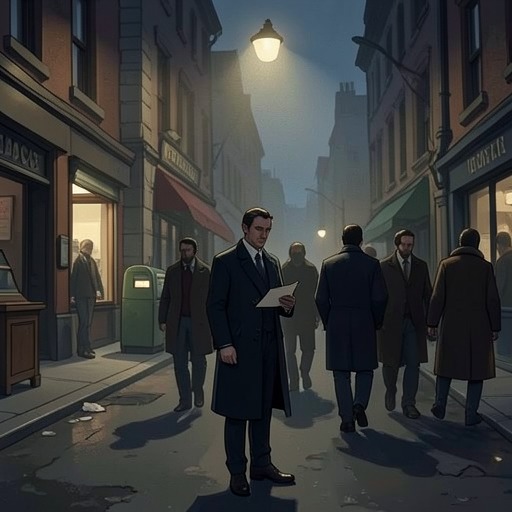
Tower Records on Ventura Boulevard
The ShardsTower Records on Ventura Boulevard is the destination Sarah Johnson never reached after leaving a party in Tarzana in early January 1981. Her disappearance ties the familiar commercial landmark to the Trawler’s developing pattern of surveillance, intrusion, and murder, while the account’s delayed disclosures turn an ordinary trip to buy a cassette into a crucial point in the case.
Setting and Narrative Role
Situated on Ventura Boulevard in Sherman Oaks, Tower Records appears as a routine stop on Sarah’s drive home to her parents’ house in Studio City. She had left a party in Tarzana and was on her way to pick up a cassette, but she never made it inside. The store therefore marks the last intended destination in a route that abruptly breaks off, rather than a place where the narrative shows the abduction taking place.
That gap matters: the book does not present a witnessed attack at the store. Instead, the location anchors the disappearance to a specific, everyday journey through the San Fernando Valley, leaving the reader with a clear destination but no immediate account of what happened between the drive and Sarah’s eventual discovery.
Sarah Johnson’s Disappearance
Sarah’s cat had gone missing, she had noticed that furniture in her bedroom had been rearranged, and she had complained to her mother about unsettling calls in which someone breathed into the phone. These warning signs later fit a broader pattern associated with the Trawler, but Sarah was not assaulted in a home invasion. She disappeared while en route to Tower Records, making her case distinct from the attacks that had already made the intruder’s methods recognizable.
Her body was found about eight weeks later, in the first week of March, in a drainpipe at an abandoned construction site on the outskirts of Simi Valley. The account connects her killing to Julie Selwyn’s later murder through similarities in the condition of their remains, while emphasizing that the significance of those injuries was not fully disclosed until a Los Angeles Times article near the end of the year. The long delay between Sarah’s disappearance and the discovery of her body extends the uncertainty that began with the unfinished trip to the store.
The Trawler’s Pattern and the Store’s Significance
Sarah’s route to Tower Records sits within a wider sequence of advance preparations attributed to the Trawler: missing pets, unnerving calls, and signs that someone had entered a victim’s home beforehand. In Sarah’s case, those clues did not lead to a reported assault at home; her disappearance occurred during an ordinary errand. The store thus belongs to the geography of the case as a named destination, not as a confirmed crime scene.
The narrative also makes the episode a study in how a pattern becomes legible only after the fact. Sarah’s mother heard about the calls, and Sarah had noticed the altered furniture, but neither clue at the time explained why she would vanish on the way to buy a cassette. Read alongside the other disappearances and intrusions, the abandoned errand becomes one part of a deliberate sequence; considered on its own, Tower Records remains simply the place she was trying to reach.