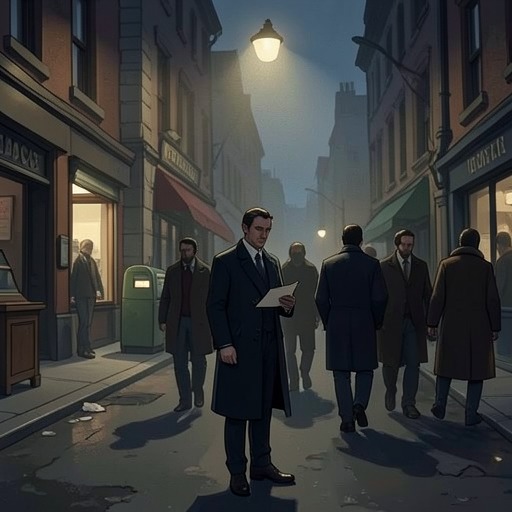
Trawler murders
The ShardsThe Trawler murders are the killings of Katherine Latchford, Sarah Johnson, and Julie Selwyn, crimes that became intelligible to Bret only as scattered clues began to form a pattern. Their bodies were found in different places and their deaths were separated from their abductions by weeks; meanwhile, missing pets, silent calls, rearranged rooms, and ominous posters linked the killings to a broader campaign of home invasions. The case reveals both the Trawler’s effort to compose a public story through crime and the limits of the people around Bret in recognizing its significance.
Background and Emerging Pattern
The home invasions began in May 1980 in the hills above the San Fernando Valley. At first, they seemed indiscriminate: the targets included couples, people living alone, and families with children, and both boys and girls were attacked. The intruder’s descriptions were inconsistent, partly because witnesses had seen a figure in a black ski mask and dark clothing. The crimes seemed to offer no reliable way to identify who might be targeted next.
One recurring clue involved animals. Pets belonging to a victim or to neighbors disappeared before an invasion or assault; the animals could be dogs, cats, birds, snakes, mice, rabbits, or guinea pigs. In some neighborhoods, three animals were ultimately sacrificed before an attack. The connection was visible before its purpose was understood: the narrator recalls that the significance of the animals’ remains did not become clear until late 1981.
The early reports also moved through a shifting geography. During the summer of 1980, twenty break-ins were attributed to the intruder in neighborhoods below Mulholland, from Studio City through Sherman Oaks and Encino, with brief extensions into Bel Air and Benedict Canyon. Reports later appeared farther afield, including Pasadena, Glendale, and Hollywood, before the series abruptly stopped. In retrospect, this dispersal and interruption make the crimes look less like isolated incidents than fragments of a pattern whose connections had not yet been made.
The Three Victims and Their Bodies
Katherine Latchford was found in a month-old dumpster behind a gas station near Redlands. Sarah Johnson’s body was concealed in a drainpipe at an abandoned construction site outside Simi Valley. Julie Selwyn’s remains were discovered in a more public setting: two boys from Taft found her on a tennis court at Shadow Ranch Park in Woodland Hills while arriving to play tennis early one morning. Her body had been positioned against the net and partly covered with newspapers. The unusual presentation suggested to the narrator that the killer had grown more confident in the story he was making and might have wanted a more immediate public effect.
The newspapers concealed what the narrator calls the Trawler’s alterations and remakings. Those changes were not fully described in the first reporting; later Los Angeles Times articles supplied some answers but withheld detail because the material was considered too disturbing for a family newspaper. A separate, unverified report claimed that fish missing from Katherine’s aquarium had been used in the assault on her body. The narrator emphasizes that this claim was not confirmed at the time, making it part of the case’s rumor and uncertainty rather than an established public fact.
The public account left fundamental questions open. The three bodies had been found weeks after the victims disappeared, and the press asked where they had been kept, how they had been preserved, when the women had been killed, and what had caused their deaths. Reporting also connected the murders to the home-invasion series: before disappearing, all three victims had experienced silent phone calls, rearranged bedroom furniture, and unexplained gifts. Sarah had received a poster for Public Image Ltd’s Second Edition; Julie had received a promotional poster for the Cure’s Three Imaginary Boys. Missing pets in the surrounding neighborhoods were another shared warning sign. Yet the victims had not previously been attacked by the person responsible for the invasions, a distinction that complicated any simple account of how the pattern worked.
Naming the Trawler and Building a Case
The week Julie Selwyn’s body was found, the Los Angeles Police Department confirmed that the suspected killer, or killers, had made two calls. Newspaper accounts later described a disguised voice that claimed responsibility for crimes and threatened further ones. The nickname Trawler appeared twice as a joke in a redacted Hollywood-division police file before it became prominent in the press. A letter reproduced in the Los Angeles Times, written in childlike handwriting, claimed that the writer and friends had abducted Julie while she walked to her car after a party on a hillside street in Encino. The letter’s unreleased details about damage to her body were known only to the perpetrator, providing confirmation of his guilt that the public account did not otherwise contain.
For Bret, the disclosures turned the murders into an unfolding narrative. He became frightened by the confirmation that the Trawler was real, but also found himself drawn into the crimes’ heightened atmosphere, imagining that he was being watched at his empty house on Mulholland. That sense of danger did not last as a sustained drama: fear returned when he went to bed, and he tried to blunt it by using drugs to sleep. The case thus entered his private life not simply as news, but as a source of fear that he repeatedly tried to narrate and contain.
The Trawler’s crime story also arrived through fragments of media: police-file references, newspaper reports, photographs, and claims that remained unverified. Bret’s later suspicions about the deaths were shaped by this uneven flow of information. Evidence, rumor, and interpretation did not arrive together, and the account never made every question answerable merely by naming the killer.
Matt Kellner and the Expanding Pattern
When Matt Kellner disappeared, Bret immediately connected his absence to the three murders. Matt’s parents had assumed his routine remained unchanged: he lived in a pool house, drove a red Datsun to Buckley, and sometimes left a note when he went to the beach. By Wednesday, his father, Ronald, had not seen him since the previous Thursday; the school confirmed that Matt had left alone at about 3:15 p.m. on Friday. His parents had not checked the separate garage until they learned that he had missed school for three days, and his absence from the pool house was initially difficult to distinguish from his established habit of keeping apart from the family.
For Bret, the missing car, unlit pool house, silent aquarium, and missing cat echoed the Trawler’s earlier signs: silent calls, rearranged furniture, vanished fish, and the cat’s disappearance. He also recognized the problem with his own inference. Matt was male, while the three confirmed murder victims were young women; earlier invasions, however, had targeted both sexes. Bret wondered whether he was seeing a real pattern or forcing disparate events into one, and whether there might be male victims who had not yet been identified.
Ronald’s account of the car later challenged the idea that Matt had simply driven away. He had recorded the Datsun’s mileage when a Nissan dealership in Encino replaced its headlight and serviced it the Thursday before Matt disappeared. A week later, the mileage showed that it had not made the long journey to Crystal Cove that the official account implied. Ronald also showed Bret crime-scene photographs of Matt’s body, including visible bruising and a serious wound to the arm. He said that blood had been found on the Datsun’s front seat and dashboard, and described the authorities’ theory: a drug-induced psychotic episode, a self-inflicted wound, and drowning in the pool. The autopsy report, as Ronald relayed it, also recorded the largely undigested contents of Matt’s aquarium in his stomach. Bret knew the aquarium had been empty for weeks, leaving the official explanation in conflict with what he understood of Matt’s circumstances.
A Maxell cassette later added another piece to the disturbing record. Bret found it marked with his name misspelled and played it, first hearing recorded wind, distant waves, and a fire before making out voices. One voice repeatedly instructed another to eat, while the other resisted and wept. The recording’s sounds linked the case’s clues to Matt’s final night without resolving every question about how or by whom the recording had been made. Across the photographs, mileage, autopsy account, and tape, the investigation accumulates evidence but does not become a clean, closed chain of proof.
Public Indifference and Narrative Significance
Bret was disturbed that Julie’s discovery and its connection to the other two killings attracted little attention at Buckley. When he raised the case, Susan Reynolds and Debbie Schaffer knew Julie had been found but did not engage with the broader connection; their attention returned to schoolwork, music, and plans for a party. Bret felt isolated in his concern. He also understood the indifference in the context of a decade in which serial killers had moved across California and committed large numbers of murders, before modern surveillance and forensic methods. Against that grim backdrop, three confirmed victims could fail to command sustained attention, while the students’ sense of youth and invulnerability further dulled the warnings.
The contrast between the case’s scattered signs and the community’s limited attention is central to its significance. Missing animals, unexplained gifts, telephone calls, and disturbed rooms were signs of a campaign, but they did not announce their connection to everyone at once. The murders made that pattern more visible without making it complete: the reports still left gaps, the victims had not been attacked in advance, and some claims remained unverified. For Bret, the case became both a criminal investigation and a story he was trying to assemble from incomplete evidence, a process that sharpened his fear even as it exposed the danger of treating a compelling narrative as proof.